Opening the book…
Model of an atom and the related terminologies
Subatomic particles
An atom is the smallest particle of an element that represents its properties. It comprises subatomic particles called electrons, protons, and neutrons. Electrons (e-) carry a negative charge equal to the unit elementary charge (\(e\)), i.e., -1 \(e\), and have a mass equal to 9.11×10⁻³¹ kg. Protons (p+) carry a positive charge equal to -1\(e\) and a mass of 1.6726×10⁻²⁷ kg. Neutrons (no) are neutral particles having a mass equal to 1.6749×10⁻²⁷ kg. Electrons do not have substructures, but protons and neutrons are composed of elementary particles called quarks. However, the basic knowledge of subatomic particles, electrons, protons, and neutrons is sufficient for the purpose of this book.
Depicting an atom
According to the modern view of an atom, protons and neutrons are in the center of the atom in a region called the nucleus, and the electron cloud is around the nucleus. Figure 1.2.1 illustrates a helium atom. The diameter of a nucleus varies in the range of about 2 femtometers (fm) to 10 fm (1 fm = 10-15 m). The diameter of an atom varies in the range of about 5 angstroms (Å) to 15 Å (1Å = 10-10 m). It means the nucleus is about one thousandth the size of an atom; i.e., electrons occupy more than 99.999% of the atom's volume, and more than 99.999% of the atom's mass is in the nucleus.

Atomic number
The number of protons in an atom is called its atomic number (\(Z\)). Atomic number defines the element, e.g., an atom with one proton is \(\ce{H}\), with six protons is \(\ce{C}\), with eight protons is \(\ce{O}\), and so on. In other words, the atomic number is implicit in the element's symbol or name.
Mass number
The number of protons and neutrons is called the mass number (\(A\)). Atomic number is also shown as a subscript and mass number as a superscript to the left of the symbol of an element, as \(\ce{\overset{A}{_{Z}}{X}}\), where \(\ce{X}\) is the symbol of an element. For example, \(\ce{\overset{12}{_6}{C}}\) represents a carbon atom having 6 protons and 6 neutrons, i.e., atomic number 6 and mass number 12.
Atomic mass and relative atomic mass
Atomic mass (\(m_a\)) is the sum of the masses of protons, neutrons, and electrons in an atom. Atomic mass is slightly less than the sum of the masses of the atom's isolated protons, neutrons, and electrons. This difference, called the mass defect, arises because energy is released equal to the binding energy when protons and neutrons are bonded together in the nucleus. The binding energy is proportional to the loss of mass given by the formula \(E = mc^2\) where \(E\) is the energy, \(m\) is the mass, and \(c\) is the speed of light. Consequently, the nuclear forces, stronger than the electrostatic repulsion between positively charged protons, bind neutrons and protons. Energy equal to the binding energy is needed to break a proton or a neutron from the nucleus. Nuclear forces operate at short distances, comparable to the sizes of the nuclei. Electrons in an atom are at distances larger than the range of nuclear Forces. Therefore, electrostatic attractive forces between electrons and oppositely charged protons in the nucleus hold electrons in an atom.
Atomic mass is usually measured in unified atomic mass unit \(u\), which is exactly equal to \(\frac{1}{12}{th}\) the mass of \(\ce{\overset{12}{_6}{C}}\) atom in its neutral state. Biologists usually use dalton (\(Da\)) in the place of \(u\) (\(Da = u = 1.99264688270(62)\times10^{-26}\) kg).
Relative atomic mass is the same as atomic mass but without any unit, i.e., a dimensionless unit. The unit is lost because it is a ratio of atomic mass to \(\frac{1}{12}{th}\) the mass of \(\ce{\overset{12}{_6}{C}}\), i.e., the mass units in the numerator and denominator of the ratio cancel each other.
Isotopes
Isotopes are atoms of the same element having a different number of neutrons. For example, protium \(\ce{\overset{1}{_1}{H}}\), deuterium \(\ce{\overset{2}{_1}{H}}\), and tritium \(\ce{\overset{2}{_1}{H}}\), are isotopes of hydrogen having zero, one, and two neutrons, respectively. Similarly, \(\ce{\overset{12}{_6}{C}}\), \(\ce{\overset{13}{_6}{C}}\), and \(\ce{\overset{14}{_6}{C}}\) are isotopes of carbon having six, seven, and eight neutrons, respectively.
Atomic weight
Atomic weight or standard atomic weight (\(A_{r}^{o}(E)\) for element E) is the weighted average of relative atomic masses of all isotopes of that element in a natural sample. The following formula calculates the atomic weight:
\[A_{r}^{o}(E)=\sum(\text { relative atomic mass of isotope }) \times(\text { fractional abundance of the isotope })\nonumber\]
, where \(\sum\) means summation over all isotopes of the element, the fractional abundance of the isotope is the % abundance divided by 100. For example, copper (\(\ce{Cu}\)) has two isotopes in natural samples: \(\ce{\overset{63}{_29}{Cu}}\) having relative atomic mass 62.929 is 69% (fractional abundance \(= \frac{69}{100} = 0.69\)) and \(\ce{\overset{65}{_29}{Cu}}\) having relative atomic mass 64.927 is 31% (fractional abundance \(= \frac{31}{100} = 0.31\)). Standard atomic weight of copper (\(A_{r}^{o}(_{29}\ce{Cu}\)) is calculated as shown below.
\[A_{r}^{o}(_{29}\ce{Cu})=62.929\times0.69 + 64.927\times0.31 = 63.55\]
Note that atomic weight is a dimensionless quantity because it is calculated from relative atomic masses, which are dimensionless.
Ions: cations and anions
The number of electrons in a neutral atom equals the number of protons in it. However, an atom may lose or gain one or more electrons and become an ion, a charged particle. The charge is shown as a superscript to the right of the element's symbol: a number followed by a sign (+/-). Loss of one or more electrons forms a particle with a positive charge, i.e., a cation. For example, \(\ce{\overset{23}{_11}{Na}^{+}}\) is a cation of sodium that has 11 protons but one less, i.e., 10 electrons resulting in 1+ charge on it and \(\ce{\overset{24}{_12}{Mg}^{2+}}\) is a cation of magnesium having 12 protons but two less, i.e., 10 electrons resulting in 2+ charge on it. Similarly, \(\ce{\overset{19}{_9}{F}^{-}}\) is an anion of fluorine having 9 protons but one more, i.e., 10 electrons resulting in 1- charge on it and \(\ce{\overset{16}{_8}{O}^{2-}}\) is an anion of oxygen having 8 protons but two more, i.e., 10 electrons resulting in 2- charge on it. Note that a one charge is represented by a +/- sign without a number, but a charge of more than one is represented by a number followed by a sign.
Electron configuration of an atom
Electron configuration is the arrangement of electrons around the nucleus, as illustrated in Figure 1.2.1 for a helium atom. To understand it, first recall the dual nature of radiation and matter. Electromagnetic radiation is a wave, but can also be treated as particles, i.e., packets of energy called photons. The energy \(E\) of a photon is related to the frequency \(\nu\) and mass \(m\) by the following equations. \[E = h\nu = mc^2\nonumber\], where \(h\) is Plank's constant and \(c\) is the speed of light. De Broglie derived the following equation relating the wavelength \(\lambda \) of a wave associated with a matter particle to the mass \(m\) and speed \(v\) of a matter particle. \[\lambda = \frac{h}{mv}\nonumber\] Matter particles that we see around have large masses that are associated with wavelengths too small to be characterized. Still, the wavelength of particles with a mass as small as an electron is comparable to that of electromagnetic radiation. It has been experimentally characterized, e.g., by electron diffraction, which is similar to X-ray diffraction.
The Schrödinger equation is a mathematical equation that can predict the behaviour of an electron in an atom or a molecule, treating it as a wave. Solution of the Schrödinger equation yields a wavefunction, called psi \(\psi\), that represents the probability amplitude of finding an electron at a given point in space around the nucleus. Recall that waves have amplitudes that vary along the wave and have phases: positive on the crest side and negative on the trough. The square of the wavefunction \(\psi^2\) has physical meaning, i.e., the probability of finding an electron at the given point.
Electron quantum numbers in an atom
The analogy of the electron waves in an atom is that of the standing waves. Recall that standing waves are established only when the length is equal to \(\frac{1}{2}\lambda\) or a multiple of it. Similarly, the electron wavefunction \(\psi\) takes three quantum numbers: principle \(n\), angular momentum \(l\), and magnetic \(l_m\) quantum number.
- The \(n\) has integer values, i.e., 1, 2, 3, 4, etc., and it defines the shell associated with energy and the average distance from the nucleus- the higher the \(n\), the higher the energy and the longer the average distance.
- The \(l\) has integer values from 0 to \(l-1\) and defines the shape of the regions around the nucleus where the electron is found, called a subshell within the shell. \(l\) = 0 is designated as \(s\) subshell, \(l\) = 1 is \(p\), \(l\) = 2 is \(d\), \(l\) = 3 is \(f\) and so on. The \(l\) also contributes to the energy along with \(n\), i.e., the higher the \(n+l \), the higher the energy of the orbital. When \(n + l\) values are equal, the \(n\) breaks the tie, i.e., the higher the \(n\), the higher the energy.
- The \(m_l\) has integer values from \(-l\) to 0 to \(+l\). It defines the number and orientation of a unique region around the nucleus where an electron may be found, called an orbital within a subshell. For example, \(l\) = 0 is \(s\) subshell that has only one value of \(m_l\) = 0, and has only one orbital in it, \(l\) = 1 is \(p\) subshell that has three values of \(m_l\) = +1, 0, and -1, corresponding to three \(p\) orbitals. If one \(p\) orbital is oriented along x-axis, called \(p_x\), the second is along y-axis, called \(p_y\) and the third is along z-axis, called \(p_z\). The \(l\) = 2 is \(d\) subshell that has five orbitals corresponding to its five \(m_l\) values +2, +1, 0, -1, and -2 and \(l\) = 3 is \(f\) subshell that has seven orbitals corresponding to its seven \(m_l\) values +3, +2, +1, 0, -1, -2, and -3.
- The fourth quantum number, called the electron spin quantum number \(m_s\), describes the angular momentum of an electron in an orbital. The angular momentum, called spin, can have two possible orientations, corresponding to two possible values of \(m_s\) = \(+\frac{1}{2}\) or \(-\frac{1}{2}\).
An atomic orbital is a region in an atom around the nucleus in which electrons are present. The probability of electron presence may vary from point to point and may diminish but not reach zero in certain directions. Therefore, boundaries of orbitals are defined such that they cover a certain probability, e.g., 90% or 95% of electron presence within it.
Orbital notations
Each orbital in an atom has a unique combination of the three quantum numbers, \(n\), \(l\), and \(l_m\). The number of orbitals in a shell \(n\) is equal to \(n^2\). For example, the first shell (\(n\) =1) has only one orbital (\(1^2 = 1\)) having \(n\), \(l\), \(l_m\) = 1, 0,0. It is designated as 1\(s\), where the number represents shell# and the letter represents subshell. Second shell (\(n\) =2) has four orbitals (\(2^2 =2\)). These are 2\(s\), and three 2\(p\) orbitals: 2\(p_x\), 2\(p_y\), and 2\(p_z\).
Quantum number \(l\) defines the shape and orientations of an orbital. 1\(s\) orbital has \(l\) = 0 and is the same on all orientations, i.e., spherically symmetrical, as illustrated in Figure 1.2.2. Recall that an electron is treated as a wave; like a wave, it has phases and a variable amplitude. 1\(s\) orbital has only one phase, + or -. The probability density is highest per unit volume near the nucleus (represented by darker gray in the figure) and decreases with increasing distance from the nucleus, becoming lighter gray.
The 2\(s\) orbital is spherically symmetrical but larger than 1 \(s\). The electron density is maximum at the center close to the nucleus, falls to zero, rises again to a maximum, and then gradually decreases as the radius increases. This feature is evident in the onion-shell-like structure of the 2\(s\) orbital: a dark-gray inner sphere, a light-gray outer shell, and a white shell of zero electron probability separating the two. 2\(s\) orbital has two phases, if the inner sphere is +, the outer will be - and vice versa.
A region of zero electron density in an atomic orbital is called a node.
A node can be a spherical shell, as in the case of a 2\(s\) orbital, or a plane representing a region where the wavefunction changes sign or phase. 2\(s\) orbital is larger than 1\(s\) with one node, 3\(s\) is larger than 2\(s\) with two nodes, and so on, as illustrated in Figure 1.2.2.


2\(p\) orbital is dumbbell-shaped with two lobes of opposite polarity; if one is +, the other is - phase. The nucleus is in the middle, with a nodal plane passing through it, perpendicular to the axis of the two lobes. There are three 2\(p\) orbitals corresponding to \(l_m\) = +1, 0, and -1. If one is oriented along the x-axis, called 2\(p_x\), the second is along the y-axis, called 2\(p_y\), and the third is along the z-axis, called 2\(p_z\), as illustrated in Figure 1.2.3.

The shapes and orientations of \(d\) and \(f\) orbitals are shown in Figure 1.2.3. The details of \(s\) and \(p\) orbitals are described above because they are the most important in understanding organic chemistry, but those of \(d\) and \(f\) are not described as they are more complicated and not necessary for the purpose of understanding organic chemistry described in this book.
Energy order of atomic orbitals
Each atomic orbital has a unique set of three quantum numbers \(n\), \(l\), and \(l_m\). The energy of an orbital is determined by the combination of two quantum numbers \(n + l\) -the higher the \(n + l\), the higher the energy. When \(n + l\) is the same for two orbitals, \(n\) is the tie breaker. It results in the following order from the lowest to the highest energy: 1\(s\) 2\(s\) 2\(p\) 3\(s\) 3\(p\) 4\(s\) 3\(d\) 4\(p\) 5\(s\) 4\(d\) 5\(p\) 6\(s\) 4\(f\) 5\(d\) 6\(p\) 7\(s\) 5\(f\) 6\(d\) 7\(p\), as illustrated in Figure 1.2.4.
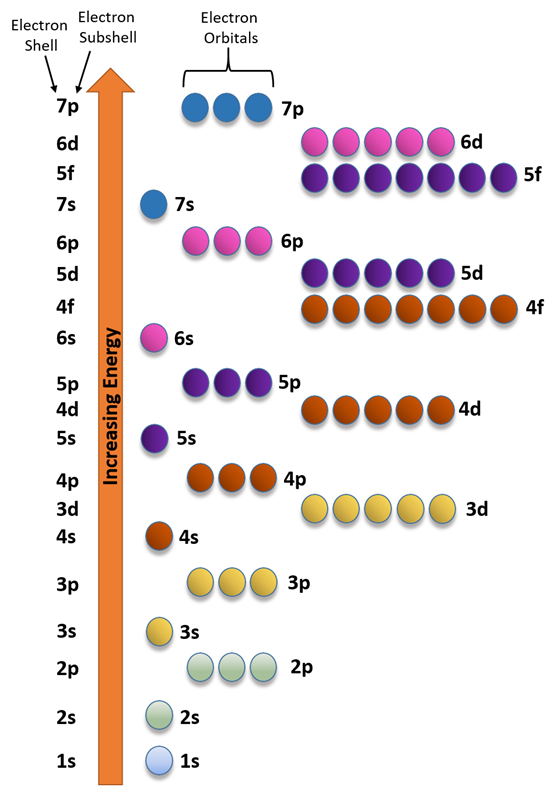
Note that if both the \(n\) and the \(l\) are the same, the energy of the orbitals is the same. For example, 2\(p_x\), 2\(p_y\), and 2\(p_z\) have same \(n\) = 2 and same \(l\) = 1, (different in \(l_m\)), are of equal energy.
Atomic orbitals with the same energy level are called degenerate orbitals. For example, three 2\(p\): 2\(p_x\), 2\(p_y\), and 2\(p_z\) orbitals are degenerate.
Filling atomic orbitals with electrons
The number of electrons in a neutral atom is equal to the number of protons in the nucleus, i.e., equal to the atomic number. These electrons occupy the atomic orbitals by the following three rules.
- The Aufbau Principle states that electron filling follows the order of orbital energies, starting with the lowest-energy 1\(s\) orbital and progressing to higher-energy orbitals.
- Pauli's exclusion principle states that each electron in an atom has a unique set of four quantum numbers. Since each atomic orbital has a unique set of three quantum nubmers \(n\), \(l\), and \(l_m\), it can take a maximum of two electrons: one with \(m_s = +\frac{1}{2}\), called "up spin" and represented as \(\uparrow\) or \(\upharpoonleft\) and the other with \(m_s = -\frac{1}{2}\), called "down spin" and represented as \(\downarrow\) or \(\downharpoonright\).
- Hund's rule states that when filling degenerate orbitals, the electrons occupy separate orbits with the same spins, usually represented as \(\uparrow\) or \(\upharpoonleft\), until no degenerate orbital is left empty. Then the additional electron pairs up with one of the singly occupied orbitals.
Two electrons in the same orbital are called paired electrons and represented as \(\uparrow\downarrow\) or \(\upharpoonleft\downharpoonright\).
One electron in a singly occupied orbital is called an unpaired electron and is usually represented as \(\uparrow\) or \(\upharpoonleft\).
The simplest and most common way of representing an atom in a subshell is as a superscript to the shell symbol \(s\), \(p\), \(d\), or \(f\). For example, the electron configuration of hydrogen, which has one electron, is 1\(s^1\). Similarly, the electron configuration of helium with two electrons is 1\(s^2\), lithium with three electrons is 1\(s^2\) 2\(s^1\), beryllium with four electrons is 1\(s^2\) 2\(s^2\), boron with five electrons is 1\(s^2\) 2\(s^2\) 2\(p^1\), and carbon with six electrons is 1\(s^2\) 2\(s^2\) 2\(p^2\). First shell has one orbital 1\(s\) and can take two electrons, second shell with four orbitals (2\(s\) and three 2\(p\) orbitals) and can take eight electrons, third has nine orbitals (3\(s\), three of 3\(p\) and five of 3\(d\)) and can take eighteen electrons, and so on. Table 1.2.5 below shows the electron configuration of the first 18 elements.
|
Group \(\rightarrow\) Rows \(\downarrow\) |
1 | 2 | 13 | 14 | 15 | 16 | 17 | 18 |
| 1 |
\(\Large_{1}\text{H}\) \(\textcolor{red}{\text{1}s^1}\) |
\(\Large_{2}\text{He}\) \(\textcolor{red}{\text{1}s^2}\) |
||||||
| 2 |
\(\Large_{3}\text{Li}\) \(\text{1}s^2\textcolor{red}{\text{2}s^1}\) |
\(\Large_{4}\text{Be}\) \(\text{1}s^2\textcolor{red}{\text{2}s^2}\) |
\(\Large_{5}\text{B}\) \(\text{1}s^2\textcolor{red}{\text{2}s^2\text{2}p^1}\) |
\(\Large_{6}\text{C}\) \(\text{1}s^2\textcolor{red}{\text{2}s^2\text{2}p^2}\) |
\(\Large_{7}\text{N}\) \(\text{1}s^2\textcolor{red}{\text{2}s^2\text{2}p^3}\) |
\(\Large_{8}\text{O}\) \(\text{1}s^2\textcolor{red}{\text{2}s^2\text{2}p^4}\) |
\(\Large_{9}\text{F}\) \(\text{1}s^2\textcolor{red}{\text{2}s^2\text{2}p^5}\) |
\(\Large_{10}\text{Ne}\) \(\text{1}s^2\textcolor{red}{\text{2}s^2\text{2}p^6}\) |
| 3 |
\(\Large_{11}\text{Na}\) \(\text{1}s^2\text{2}s^2\text{2}p^6\textcolor{red}{\text{3}s^1}\) |
\(\Large_{12}\text{Mg}\) \(\text{1}s^2\text{2}s^2\text{2}p^6\textcolor{red}{\text{3}s^2}\) |
\(\Large_{13}\text{Al}\) \(\text{1}s^2\text{2}s^2\text{2}p^6\textcolor{red}{\text{3}s^2\text{3}p^1}\) |
\(\Large_{14}\text{Si}\) \(\text{1}s^2\text{2}s^2\text{2}p^6\textcolor{red}{\text{3}s^2\text{3}p^2}\) |
\(\Large_{15}\text{S}\) \(\text{1}s^2\text{2}s^2\text{2}p^6\textcolor{red}{\text{3}s^2\text{3}p^3}\) |
\(\Large_{16}\text{P}\) \(\text{1}s^2\text{2}s^2\text{2}p^6\textcolor{red}{\text{3}s^2\text{3}p^4}\) |
\(\Large_{17}\text{Cl}\) \(\text{1}s^2\text{2}s^2\text{2}p^6\textcolor{red}{\text{3}s^2\text{3}p^5}\) |
\(\Large_{18}\text{Ar}\) \(\text{1}s^2\text{2}s^2\text{2}p^6\textcolor{red}{\text{3}s^2\text{3}p^6}\) |
The electron configurations shown above are simple, but when degenerate orbitals are filled, the paired and unpaired electrons are not distinguished. For example, the electron configuration of \(\ce{_{6}C}\) 1\(s^2\) 2\(s^2\) 2\(p^2\), does not show the electrons in 2\(p\) orbital are unpaired. They are unpaired based on Hund's rule. To clarify, electron configurations are shown in a box diagram, with boxes representing orbitals and electrons, indicated by an up arrow for unpaired electrons and by a pair of up and down arrows for paired electrons. For example, the electron configuration of \(\ce{_{6}C}\) \(\underset{1s}{\boxed{\uparrow\downarrow}}\,\underset{2s}{\boxed{\uparrow\downarrow}}\, \underset{2p}{\boxed{\;\uparrow\;}\!\boxed{\;\uparrow\;}}\); of \(\ce{_{7}N}\) \(\underset{1s}{\boxed{\uparrow\downarrow}}\,\underset{2s}{\boxed{\uparrow\downarrow}}\, \underset{2p}{\boxed{\;\uparrow\;}\!\boxed{\;\uparrow\;}\!\boxed{\;\uparrow\;}}\), and of \(\ce{_{8}O}\) \(\underset{1s}{\boxed{\uparrow\downarrow}}\,\underset{2s}{\boxed{\uparrow\downarrow}}\, \underset{2p}{\boxed{\uparrow\downarrow}\!\boxed{\;\uparrow\;}\!\boxed{\;\uparrow\;}}\).
The electrons in the outermost shell, which participate in chemical reactions, are called valence electrons, and the rest in the inner orbitals that do not directly participate in chemical reactions are called core electrons. The shell containing the valence electrons is called the valence shell, and the rest of the inner shells are called core shells.
Table 1.2.5 shows valence electrons in red and core electrons in black. If the outermost shell is \(n\), the \(ns\;np\) shell of the main group elements is a partially filled valence shell. The valence shells of noble gases are completely filled and do not usually take part in chemical reactions. A filled shell is also called a closed shell. The valence shell of transition metals is \((n-1) d\ \; ns\ \; np\). The \((n-1)d\) subshell of transition metals is partially filled and takes part in chemical reactions along with their \(ns\;np\). Similarly, the valence shell of inner transition metals is \((n-2)f\; (n-1) d \; ns\ \; np\).
To write the electron configuration of an ion, first write the electron configuration of the neutral atom, then
- add one electron in the outermost orbital for each negative charge for anions, or
- remove an electron for each positive charge in the following order: first from \(np\), then from \(ns\), then from \((n-1)d\), irrespective of their order of filling.
For example
- The electron configuration of \(\ce{_{6}O}\) is \(\text{1}s^2\text{2}s^2\text{2}p^4\). For anion \(\ce{_{6}O^{2-}}\) two electrons are added in the outermost orbital for 2- charge, resulting in: \(\text{1}s^2\text{2}s^2\text{2}p^6\).
- The electron configuration \(\ce{_{11}Na}\) is \(\text{1}s^2\text{2}s^2\text{2}p^6\text{3}s^1\). One electron is removed from \(ns\), for 1+ charge resulting in: \(\ce{_{11}Na^{+}}\) is \(\text{1}s^2\text{2}s^2\text{2}p^6\).
- The electron configuration of \(\ce{_{26}Fe}\) is filled in this order \(\text{1}s^2\text{2}s^2\text{2}p^6\text{3}s^2\text{3}p^6\text{4}s^2\text{3}d^6\) but usually written, as: \(\text{1}s^2\text{2}s^2\text{2}p^6\text{3}s^2\text{3}p^6\text{3}d^6\text{4}s^2\).
- For \(\ce{_{26}Fe^{2+}}\) two electrons are removed from the \(ns\) resulting in: \(\text{1}s^2\text{2}s^2\text{2}p^6\text{3}s^2\text{3}p^6\text{3}d^6\), and
- for \(\ce{_{26}Fe^{3+}}\), three electrons are removed, two from the \(ns\) and one from \((n-1)d\), resulting in: \(\text{1}s^2\text{2}s^2\text{2}p^6\text{3}s^2\text{3}p^6\text{3}d^5\).
The electron configuration is abbreviated by replacing core electrons with the symbol of the noble gas having the same electron configuration, followed by the valence shell. For example the elctron configuraiton of \(\ce{_{26}Fe}\): \(\text{1}s^2\text{2}s^2\text{2}p^6\text{3}s^2\text{3}p^6\text{3}d^6\text{4}s^2\) is abbreviated as \(\ce{[Ar]}\) \(\text{3}d^6\text{4}s^2\). Note that the noble gas symbol is placed in square brackets.
Figure 1.2.6 shows electron configurations of all elements. Note: there are some anomalies in the electron configuration, especially when valence \(d\) or \(f\) orbitals are near half-filled or near filled, they may draw an electron from the next \(s\) orbital to become half-filled or filled. Further details of the anomalies are beyond the scope of this book.

This page titled 1.2: Structure of an atom was last modified on Sun, 24 May 2026 23:04:16 GMT and is shared under a Public Domain license and was authored, remixed, and/or curated by Muhammad Arif Malik.
The book could not be loaded just now.