Opening the book…
- Compare the boiling points of amides with alcohols of similar molar mass.
- Compare the solubilities in water of amides of five or fewer carbon atoms with the solubilities of comparable alkanes and alcohols in water.
With the exception of formamide (HCONH2), which is a liquid, all simple amides are solids (Table \(\PageIndex{1}\)). The lower members of the series are soluble in water, with borderline solubility occurring in those that have five or six carbon atoms. Like the esters, solutions of amides in water usually are neutral—neither acidic nor basic.
| Condensed Structural Formula | Name | Melting Point (°C) | Boiling Point (°C) | Solubility in Water |
|---|---|---|---|---|
| HCONH2 | formamide | 2 | 193 | soluble |
| CH3CONH2 | acetamide | 82 | 222 | soluble |
| CH3CH2CONH2 | propionamide | 81 | 213 | soluble |
| CH3CH2CH2CONH2 | butyramide | 115 | 216 | soluble |
| C6H5CONH2 | benzamide | 132 | 290 | slightly soluble |
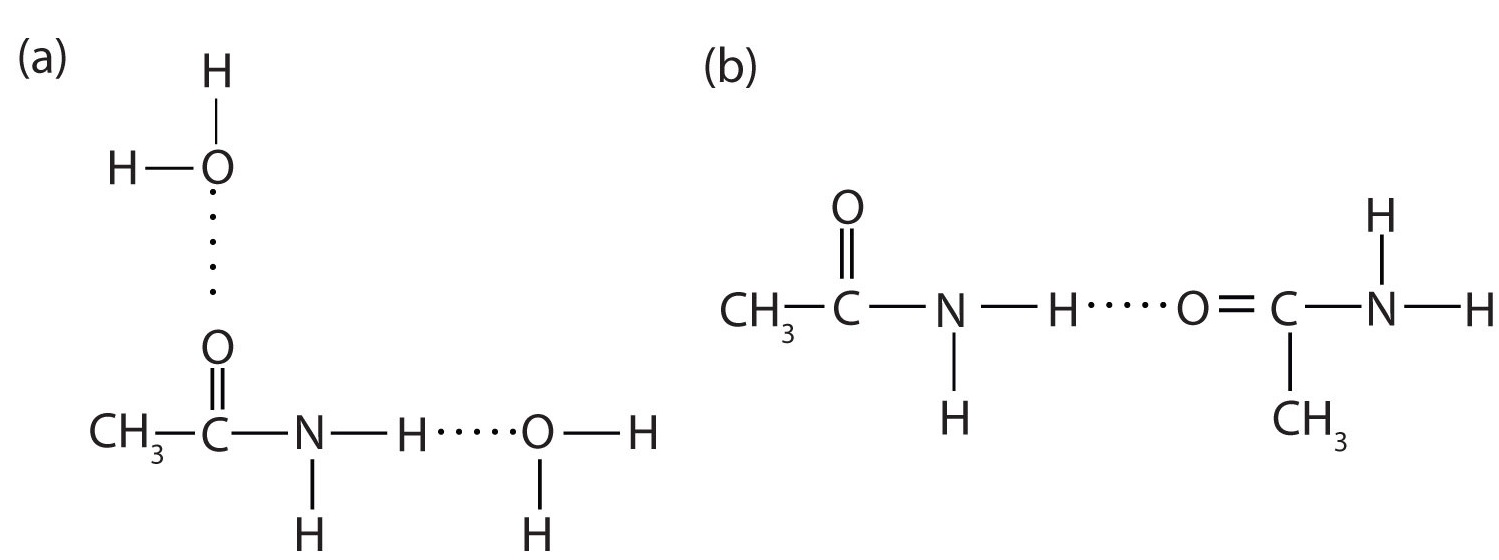
The amides generally have high boiling points and melting points. These characteristics and their solubility in water result from the polar nature of the amide group and hydrogen bonding (Figure \(\PageIndex{1}\)). (Similar hydrogen bonding plays a critical role in determining the structure and properties of proteins, deoxyribonucleic acid [DNA], ribonucleic acid [RNA], and other giant molecules so important to life processes.
Key Takeaways
- Most amides are solids at room temperature; the boiling points of amides are much higher than those of alcohols of similar molar mass.
- Amides of five or fewer carbon atoms are soluble in water?.
This page titled 6.10: Physical Properties of Amides was last modified on Sat, 22 Feb 2025 20:56:19 GMT and is shared under a mixed 3.0 license and was authored, remixed, and/or curated by Staff via source content that was edited to the style and standards of the LibreTexts platform.
The book could not be loaded just now.