Opening the book…
Overview
As we have already seen, H2O is an amphoteric substance which means it can donate a proton act as an acid or accept a proton and act as a base. Within any given sample of water, some \(\ce{H2O}\) molecules are acting as acids, and other \(\ce{H2O}\) molecules are acting as bases.
About one water molecule in half a billion dissociates into an OH- ion by losing a proton to another water molecule. The molecule that receives a proton becomes H3O+.
The chemical equation is as follows:
\[\color{red}{\underbrace{\ce{H2O(l)}}_{\text{acid}}} + \color{blue}{\underbrace{\ce{H2O(l)}}_{\text{base}}} \color{black} \ce{<=> H3O^{+}(aq) + OH^{−}(aq)} \nonumber \]
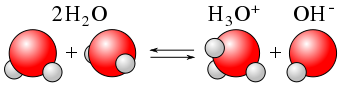
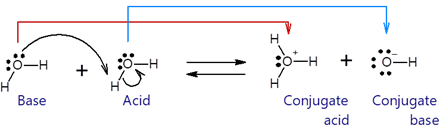
The dissociation of water is an equilibrium reaction in which one water molecule donates its proton to another water molecule (Figure \(\PageIndex{1}\)). The water molecule that receives proton is acting as a base, and it converts to conjugate acid H3O+. The other water molecule that donates a proton is acting as an acid, and it converts to conjugate base OH-. The arrows in the reaction show that the base uses one of its lone pairs of electrons to make a bond with proton, and the previous bond pair of electrons turns into a third lone pair of electrons on the oxygen atom of the base. The reaction is reversible, i.e., the conjugate acid (H3O+) and the conjugate base (OH-) react to re-form the two water molecules as illustrated in Figure \(\PageIndex{2}\).
The Dissociation Constant for Water, Kw
The ion-product of water, also known as the dissociation constant for water (Kw) is the mathematical product of the concentration of hydrogen ions and hydroxide ions.
\[K_w = [\ce{H^{+}}][\ce{OH^{-}}] \nonumber \]
Note that H2O is not included in the ion-product expression because it is a pure liquid. The value of Kw is very small, in accordance with a reaction that favors the reactants.
At 25oC, the experimentally determined value of \(K_w\) in pure water is 1.0×10⁻¹⁴.
\[K_w = [\ce{H^{+}}][\ce{OH^{−}}] = 1.0 \times 10^{−14} \nonumber \]
At 25oC, the experimentally determined value of \(K_w\) in pure water is 1.0×10⁻¹⁴.
\[K_w = [\ce{H^{+}}][\ce{OH^{−}}] = 1.0 \times 10^{−14} \nonumber \]
In a sample of pure water, the concentrations of hydrogen and hydroxide ions are equal to one another. Pure water or any other aqueous solution in which this ratio holds is said to be neutral. To find the molarity of each ion, the square root of Kw is taken.
[H+] = [OH−] = 1.0×10⁻⁷
The product of these two concentrations is 1.0×10⁻¹⁴
\[\color{red}{\ce{[H^{+}]}} \color{black}{\times} \color{blue}{\ce{[OH^{-}]}} \color{black} = (1.0 \times 10^{-7})( 1.0 \times 10^{-7}) = 1.0 \times 10^{-14} \nonumber \]
Neutral, Acidic, or Basic Aqueous Solutions
A solution that has an equal concentration of H3O+ and OH-, each equal to 10-7 M, is a neutral solution.
An acidic solution has an acid dissolved in water. When an acid dissolves in water it dissociates adding more H3O+. The [OH-] must decrease to keep the Kw constant.
A solution that has [H3O+] more than 10-7, and [OH-] less than 10-7 is an acidic solution.
A basic solution has a base dissolved in water. When a base dissolves in water it dissociates adding more OH-. The [H3O+] must decrease to keep the Kw constant.
A solution that has [H3O+] less than 10-7, and [OH-] more than 10-7 is a basic solution.
Calculations of [H3O+] and [OH-] based on Kw
The water dissociation constant remains the same whether the aqueous solution is neutral, acidic, or basic, i.e.:
\begin{equation}
\mathrm{K}_{\mathrm{w}}=\left[\mathrm{H}_{3} \mathrm{O}_{-}^{+}\right]\left[\mathrm{OH}^{-}\right]=\left(10^{-7}\right)\left(10^{-7}\right)=10^{-14} \text { at } 25^{\circ} \mathrm{C}\nonumber
\end{equation}
Therefore, if the molar concentration of hydronium ions [H3O+] is known, the molar concentration of hydroxide ions [OH-] can be calculated using the following formula:
\[\left[\mathrm{H}_{3} \mathrm{O}^{+}\right]=\frac{\mathrm{K}_{w}}{[\mathrm{OH}^{-}]}=\frac{10^{-14}}{[\mathrm{OH}^{-}]}\nonumber\]
Similarly, if the molar concentration of hydroxide ions [OH-] is known, the molar concentration of hydronium ions [OH-] can be calculated using the following formula:
\[\left[\mathrm{OH}^{-}\right]=\frac{K_{w}}{\left[\mathrm{H}_{3} \mathrm{O}^{+}\right]}=\frac{10^{-14}}{\left[\mathrm{H}_{3}\mathrm{O}^{+}\right]}\nonumber\]
When a strong acid like HCl dissolves in water, it dissociates ~100% into ions. Therefore, the [H3O+] is equal to the molar concentration of the acid. The amount H3O+ added by dissociation of water molecules is very small compared to that coming from the dissociation of a strong acid and can be neglected. Similarly, when a strong base like NaOH dissolves in water, it dissociates ~100% into ions. Therefore, the [OH-] is equal to the molar concentration of the base.
When a weak acid or a weak base dissolves in water, it partially dissociates into ions. Therefore, the [H3O+] or the [OH-] in the cases of weak acids and weak bases has to be determined experimentally for the calculations.
Calculate the concentration of OH- ions in a 0.10 M HNO3 solution?
Solution
The HNO3 is a strong acid. Therefore, [HNO3] = 0.10 M = [H3O+]. Desired [OH-] = ?
Formula: \(\left[\mathrm{OH}^{-}\right]=\frac{10^{-14}}{\left[\mathrm{H}_{3}\mathrm{O}^{+}\right]}\)
Plug in values an calculate: \(\left[\mathrm{OH}^{-}\right]=\frac{10^{-14}}{0.10}=10^{-13}\mathrm{~M}\)
A vinegar solution has [H3O+] = 2.0 x 10⁻³. a) What is the hydroxide ion concentration in the vinegar solution? b) is the solution acidic, basic, or neutral?
Solution
a) Given [H3O+] = 2.0 x 10⁻³. Desired [OH-] = ?
Formula: \(\left[\mathrm{OH}^{-}\right]=\frac{10^{-14}}{\left[\mathrm{H}_{3}\mathrm{O}^{+}\right]}\)
Plug in values and calculate: \(\left[\mathrm{OH}^{-}\right]=\frac{10^{-14}}{2.0 \times 10^{-3}}=5.0 \times 10^{-12} \mathrm{M}\)
b) The solution is acidic because [H3O+] > [OH-].
Calculate the value of [H3O+] and [OH-] in a 0.010 M NaOH solution?
Solution
The NaOH is a strong base. Therefore [NaOH] = 0.010 M = [OH-]. Desired [H3O+] = ?
Formula: \(\left[\mathrm{H}_{3} \mathrm{O}^{+}\right]=\mathrm{K}_{\mathrm{w}} /\left[\mathrm{OH}^{-}\right]=10^{-14} /\left[\mathrm{OH}^{-}\right]\)
Calculations: \(\left[\mathrm{H}_{3} \mathrm{O}^{+}\right]=10^{-14} / 0.010=10^{-12} \mathrm{M}\)
- Calculate the [H3O+] in an ammonia solution that has [OH-] = 4.0 x 10⁻⁴ M? b) Is the solution acidic, basic, or neutral?
Solution
- Given [OH-] = 4.0 x 10⁻⁴. Desired [H3O+] = ?
Formula:\(\left[\mathrm{H}_{3} \mathrm{O}^{+}\right]=\mathrm{K}_{\mathrm{w}} /\left[\mathrm{OH}^{-}\right]=10^{-14} /\left[\mathrm{OH}^{-}\right]\)
Calculations: \(\left[\mathrm{H_3O}^{+}\right] = \frac{10^{-14}}{4.0 \times 10^{-4}} = 2.5 \times 10^{-11} \, \text{M}\)
- The solution is basic because [H3O+] < [OH-].
The pH Scale
One qualitative measure of the strength of an acid or a base solution is the pH scale, which is based on the concentration of the hydronium (or hydrogen) ion in aqueous solution.
\[pH = -\log[H^+] \nonumber \]
or
\[pH = -\log[H_3O^+] \nonumber \]
Figure \(\PageIndex{3}\) illustrates this relationship, along with some examples of various solutions. Because hydrogen ion concentrations are generally less than one (for example \(1.3 \times 10^{-3}\,M\)), the log of the number will be a negative number. To make pH even easier to work with, pH is defined as the negative log of \([H_3O^+]\), which will give a positive value for pH.
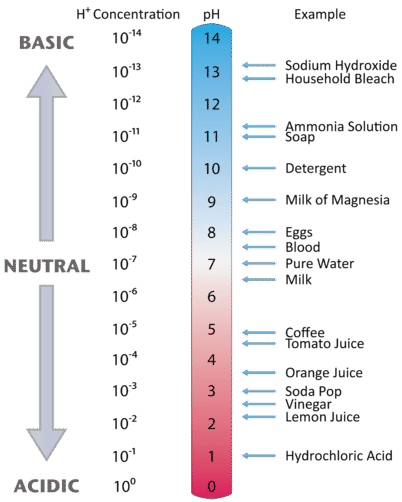
A neutral (neither acidic nor basic) solution has a pH of 7. A pH below 7 means that a solution is acidic, with lower values of pH corresponding to increasingly acidic solutions. A pH greater than 7 indicates a basic solution, with higher values of pH corresponding to increasingly basic solutions. Thus, given the pH of several solutions, you can state which ones are acidic, which ones are basic, and which are more acidic or basic than others. These are summarized in Table \(\PageIndex{1}.
| Classification | Relative Ion Concentrations | pH at 25 °C |
|---|---|---|
| acidic | [H+] > [OH−] | pH < 7 |
| neutral | [H+] = [OH−] | pH = 7 |
| basic | [H+] < [OH−] | pH > 7 |
Find the pH, given the \([H^+]\) of the following:
- 1 ×10⁻³ M
- 2.5 ×10⁻¹¹ M
- 4.7 ×10⁻⁹ M
Solution
pH = - log [H3O+]
Substitute the known quantity into the equation and solve. Use a scientific calculator for b and c.
- pH = - log [1 × 10⁻³ ] = 3.0 (1 decimal place since 1 has 1 significant figure)
- pH = - log [2.5 ×10⁻¹¹] = 10.60 (2 decimal places since 2.5 has 2 significant figures)
- pH = - log [4.7 ×10⁻⁹] = 8.33 (2 decimal places since 4.7 has 2 significant figures)
Note on significant figures:
Because the number(s) before the decimal point in the pH value relate to the power on 10, the number of digits after the decimal point (underlined) is what determines the number of significant figures in the final answer.
Significance of pH Scale
As mentioned above, the pH scale varies from ~0 to ~14. The pH of 7 is neutral, pH more than 7 is basic, and pH less than 7 is acidic, as illustrated in Table \(\PageIndex{1}\) Different foods have different pH values, as shown in Figure \(\PageIndex{4}\). Similarly, several of the acids and bases in household use have a specific pH range, as shown in Figure \(\PageIndex{4}\).
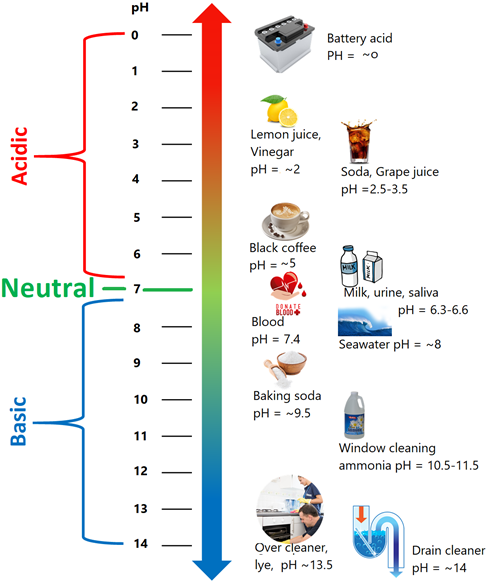
The control of pH is essential in the proper functioning of biological systems. Plants thrive if the soil does not have too acidic or too basic a pH. Lacks and revers have a specific range of pH in which the aquatic life can survive. US natural water has a pH in the range of 6.5 to 8.5 range. Seawater has a specific narrow range of pH 7.5 to pH 8.4 in which the life in the sea can function correctly.
The pH of body fluids
Human body fluids vary in pH, as shown in Figure \(\PageIndex{5}\). Saliva in the mouth is slightly acidic, but the stomach has the lowest pH in the body. The strongly acidic pH in the stomach helps in digesting some foods, and it also helps in killing bacteria that may enter the stomach through the foods. When the food enters the large intestine, the pH changes to basic which helps in digesting the foods that could not be digested in the acidic environment of the stomach. The pH changes to more basic in the small intestine.
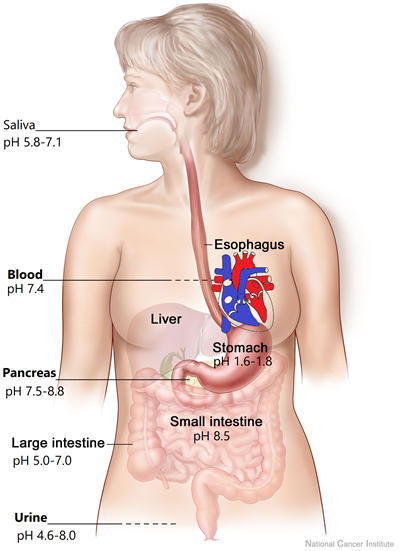
The blood has a pH of 7.4, and it can vary in a small range of 7.35 to 7.45. If the blood pH goes outside of the 7.35 to 7.45 range it can result in medical problems. Enzymes in the body need a specific pH range because hydrogen bonding plays a vital role in the structures needed for proper functioning. pH changes affect the hydrogen bonding and can make the enzymes less active or may inactivate them. The pH of blood is maintained by a complex action of buffers that are described in the later sections. The pH of urine can vary over a broad range from 4.6 to 8, depending on the recent diet and exercises.
Key Takeaways
- Water molecules can act as both an acid and a base, depending on the conditions.
- The pH scale is used to succinctly communicate the acidity or basicity of a solution.
This page titled 11.5: Dissociation of Water was last modified on Sat, 16 May 2026 05:14:17 GMT and is shared under a CC BY-NC-SA 4.0 license and was authored, remixed, and/or curated by Burçak Artun, Gorkem Ermut, and Semere Bairu.
The book could not be loaded just now.