Opening the book…
Introduction
Not all acids and bases behave the same way in solution. Some release many ions, while others release only a few. This difference is what we refer to as acid strength. A strong acid or strong base breaks apart almost completely in water, producing a high concentration of ions. In contrast, weak acids and weak bases only partially break apart, leaving a mixture of ions and unreacted molecules.
Understanding the strength of acids and bases is important because it affects how substances react in the body, how medications are absorbed, and how chemical reactions proceed in biological systems. The strength of acid HA is the extent to which the acid dissociates into H+ and A- ions, and it is illustrated in Figure \(\PageIndex{1}\).
 (a)
 (b)


Strong acids
Strong acids, like HCl, almost 100% dissociate into ions when they dissolve in water.
\begin{equation}
\mathrm{HCl}(\mathrm{g})+\mathrm{H}_{2} \mathrm{O}(\mathrm{l}) \rightarrow \mathrm{H}_{3} \mathrm{O}^{+}(\mathrm{aq})+\mathrm{Cl}^{-}(\mathrm{aq})\nonumber\end{equation}
One arrow is used to indicate that the reaction is nearly 100% complete.
Strong acids include HClO4, H2SO4, HI, HBr, HCl, and HNO3
Weak acids
Weak acids dissolve in water but partially dissociate into ions.
For example, acetic acid (CH3COOH) is a weak acid, 1 M acetic acid dissolves in water, but only 0.4% of the dissolved molecules dissociate into ions, the remaining 99.6% remain undissociated. The chemical equation of the acid dissociation is shown below.
\begin{equation}
\mathrm{CH}_{3} \mathrm{COOH}(\mathrm{aq})+\mathrm{H}_{2} \mathrm{O}(\mathrm{I}) \stackrel{\rightarrow}{\longleftarrow} \mathrm{H}_{3} \mathrm{O}^{+}(\mathrm{aq})+\mathrm{CH}_{3} \mathrm{COO}^{-}(\mathrm{aq})\nonumber
\end{equation}
Two arrows pointing in opposite directions are used for the dissociation of weak acids to indicate that the reaction is an equilibrium, i.e., two ways.
Often the arrows are not equal in size -the longer arrow points to acid-base pair that is weaker and present in a larger concentration at equilibrium than their conjugate pair.
Figure \(\PageIndex{2}\) illustrates the extent of the dissociation of strong acid like HCl and a weak acid like HAc into their ions.

Strong bases
Strong bases almost %100 dissociate into ions when dissolved in water. For example, NaOH is a strong base, and it dissociates almost 100% into ions in water.
\begin{equation}
\mathrm{NaOH}(\mathrm{s}) \stackrel{\text { Water }}{\longrightarrow} \mathrm{Na}^{+}(\mathrm{aq})+\mathrm{OH}^{-}(\mathrm{aq})\nonumber
\end{equation}
One arrow is used for the dissolution of strong bases to indicate that the reaction is almost complete.
Strong bases include hydroxides of alkali metals, i.e., LiOH, NaOH, KOH, RbOH, CsOH, and hydroxides of heavy alkaline earth metals, i.e., Ca(OH)2, Sr(OH)2, and Ba(OH)2. The last three, i.e., the hydroxides of heavy alkaline earth metals, have low solubility in water, but the dissolved fraction exists as ions.
Weak bases
Weak bases partially dissociate into ions when dissolved in water.
For example, ammonia is a weak base –only 0.42% of the dissolved ammonia molecules dissociate into ammonium ions and hydroxide ions in water from a 1 M solution of ammonia.
\begin{equation}
\mathrm{NH}_{3}(\mathrm{aq})+\mathrm{H}_{2} \mathrm{O}(\mathrm{I}) \stackrel{\rightarrow}{\longleftarrow} \mathrm{NH}_{4}{ }^{+}(\mathrm{aq})+\mathrm{OH}^{-}(\mathrm{aq})\nonumber\
\end{equation}
Weak bases in household use include ammonia (NH3) in window cleaners, NaClO in bleach, Na2CO3 and Na3PO4 in laundry detergent, NaHCO3 in tooth past, Na2CO3 in baking powder, CaCO3 for use in lawns, Mg(OH)2 and Al(OH)3 in antacids and laxatives.
The solubility and the strength of acids and bases are two different things. A strong base may be less soluble, and a weak base may be more soluble or vice versa, but a dissolved strong base exists as ions only, and a dissolved weak base exists both as molecules and ions.
The relative strength of acid-conjugate base pair
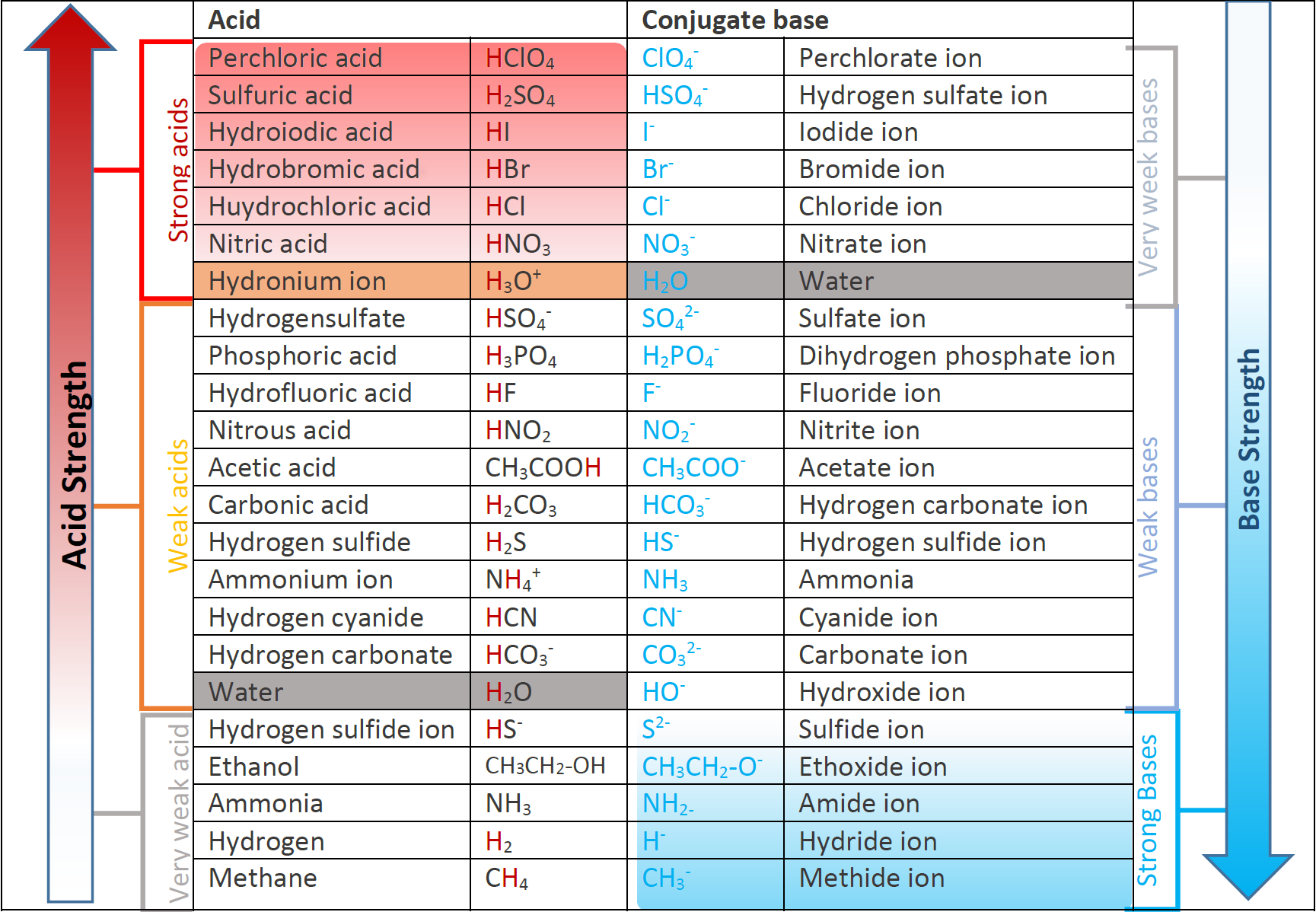
A general rule is that the stronger the acid, the weaker the conjugate base, and vice versa.
The conjugate bases of strong acids have negligible base strength, and the conjugate acids of strong basses have negligible acid strength. Figure \(\PageIndex{3}\) illustrates the relative strengths of some acids and their conjugated bases.
Many household products are acids or bases. For example, the owner of a swimming pool may use muriatic acid to clean the pool. Muriatic acid is another name for hydrochloric acid [\(\ce{HCl(aq)}\)]. Vinegar has already been mentioned as a dilute solution of acetic acid [\(\ce{HC2H3O2(aq)}\)]. In a medicine chest, one may find a bottle of vitamin C tablets; the chemical name of vitamin C is ascorbic acid (\(\ce{HC6H7O6}\)).
One of the more familiar household bases is ammonia (NH3), which is found in numerous cleaning products. As we mentioned previously, ammonia is a base because it increases the hydroxide ion concentration by reacting with water:
\[\ce{NH3(aq) + H2O(ℓ) \rightarrow NH^{+}4(aq) + OH^{−}(aq)} \nonumber \]
Many soaps are also slightly basic because they contain compounds that act as Brønsted-Lowry bases, accepting protons from water and forming excess hydroxide ions. This is one reason that soap solutions are slippery.
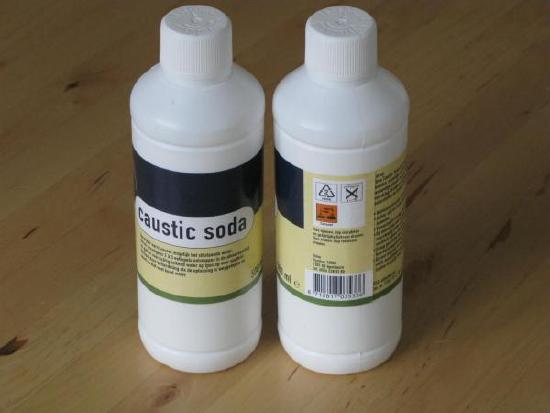
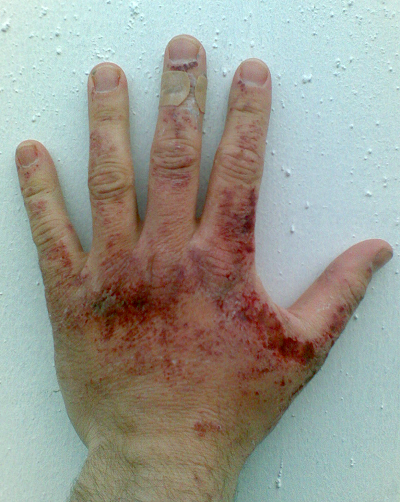
Perhaps the most dangerous household chemical is the lye-based drain cleaner . Lye is a common name for sodium hydroxide, although it is also used as a synonym for potassium hydroxide. Lye is an extremely caustic chemical that can react with grease, hair, food particles, and other substances that may build up and form a clog in a pipe. Unfortunately, lye can also attack tissues and other substances in our bodies. Thus, when we use lye-based drain cleaners, we must be very careful not to touch any of the solid drain cleaner or spill the water it was poured into as seen in Figure \(\PageIndex{4}\). Safer, nonlye drain cleaners use peroxide compounds to react on the materials in the clog and clear the drain.
(a)
(b)


The behavior of weak acids and bases illustrates a key concept in chemistry.
Does the chemical reaction describing the ionization of a weak acid or base just stop when the acid or base is done ionizing?
Actually, no. Rather, the reverse process—the reformation of the molecular form of the acid or base—occurs, ultimately at the same rate as the ionization process. For example, the ionization of the weak acid \(\ce{HC2H3O2 (aq)}\) is as follows:
\[\ce{HC2H3O2(aq) + H2O(ℓ) \rightarrow H3O^{+}(aq) + C2H3O^{−}2(aq)} \nonumber \]
The reverse process also begins to occur:
\[\ce{H3O^{+}(aq) + C2H3O^{−}2(aq) \rightarrow HC2H3O2(aq) + H2O(ℓ)} \nonumber \]
Eventually, there is a balance between the two opposing processes, and no additional change occurs. The chemical reaction is better represented at this point with a double arrow:
\[\ce{HC2H3O2(aq) + H2O(ℓ) <=> H3O^{+}(aq) + C2H3O^{-}2(aq)} \nonumber \]
The \(\rightleftharpoons\) implies that both the forward and reverse reactions are occurring, and their effects cancel each other out. A process at this point is considered to be at chemical equilibrium (or equilibrium). It is important to note that the processes do not stop. They balance out each other so that there is no further net change; that is, chemical equilibrium is a dynamic equilibrium.
Write the equilibrium chemical equation for the partial ionization of each weak acid or base.
- HNO2(aq)
- C5H5N(aq)
Solution
-
\[\ce{HNO2(aq) + H2O(ℓ) \rightarrow H3O^{+}(aq) + NO2^{−}(aq)} \nonumber \]
-
\[\ce{C5H5N(aq) + H2O(ℓ) \rightarrow OH^{-}(aq) + C5H5NH^{+}(aq)} \nonumber \]
Acid Dissociation Constant, \(K_\text{a}\)
The dissociation for a general weak acid, \(\ce{HA}\), can be written as follows:
\[\ce{HA} \left( aq \right) \rightleftharpoons \ce{H^+} \left( aq \right) + \ce{A^-} \left( aq \right) \nonumber \]
Because the acid is weak, an equilibrium expression can be written. An acid dissociation constant \(\left( K_\text{a} \right)\) is the equilibrium constant for the ionization of an acid.
\[K_\text{a} = \frac{\left[ \ce{H^+} \right] \left[ \ce{A^-} \right]}{\left[ \ce{HA} \right]} \nonumber \]
The acid ionization represents the fraction of the original acid that has been ionized in solution.
Therefore, the numerical value of \(K_\text{a}\) is a reflection of the strength of the acid. Weak acids with relatively higher \(K_\text{a}\) values are stronger than acids with relatively lower \(K_\text{a}\) values.
Because strong acids are essentially \(100\%\) ionized, the concentration of the acid in the denominator is nearly zero and the \(K_\text{a}\) value approaches infinity. For this reason, \(K_\text{a}\) values are generally reported for weak acids only.
The table below (Table \(\PageIndex{1}\)) is a listing of acid ionization constants for several acids. Note that polyprotic acids have a distinct ionization constant for each ionization step, with each successive ionization constant being smaller than the previous one.
| Name of Acid | Ionization Equation | \(K_\text{a}\) |
|---|---|---|
| Sulfuric acid |
\(\ce{H_2SO_4} \rightleftharpoons \ce{H^+} + \ce{HSO_4^-}\) \(\ce{HSO_4} \rightleftharpoons \ce{H^+} + \ce{SO_4^{2-}}\) |
very large \(1.3 \times 10^{-2}\) |
| Hydrofluoric acid | \(\ce{HF} \rightleftharpoons \ce{H^+} + \ce{F^-}\) | \(7.1 \times 10^{-4}\) |
| Nitrous acid | \(\ce{HNO_2} \rightleftharpoons \ce{H^+} + \ce{NO_2^-}\) | \(4.5 \times 10^{-4}\) |
| Benzoic acid | \(\ce{C_6H_5COOH} \rightleftharpoons \ce{H^+} + \ce{C_6H_5COO^-}\) | \(6.5 \times 10^{-5}\) |
| Acetic acid | \(\ce{CH_3COOH} \rightleftharpoons \ce{H^+} + \ce{CH_3COO^-}\) | \(1.8 \times 10^{-5}\) |
| Carbonic acid |
\(\ce{H_2CO_3} \rightleftharpoons \ce{H^+} + \ce{HCO_3^-}\) \(\ce{HCO_3^-} \rightleftharpoons \ce{H^+} + \ce{CO_3^{2-}}\) |
\(4.2 \times 10^{-7}\) \(4.8 \times 10^{-11}\) |
Hydrofluoric acid \(HF_{(aq)}\) reacts directly with glass (very few chemicals react with glass). Hydrofluoric acid is used in glass etching.
Strong and Weak Bases and Base Ionization Constant, Kb
As with acids, bases can either be strong or weak, depending on their extent of dissociation.
- A strong base is a base, which dissociates completely in an aqueous solution. The most common strong bases are soluble metal hydroxide compounds such as potassium hydroxide.
- A weak base is a base that ionizes only slightly in an aqueous solution.
\[\ce{NH_3} \left( aq \right) + \ce{H_2O} \left( l \right) \rightleftharpoons \ce{NH_4^+} \left( aq \right) + \ce{OH^-} \left( aq \right) \nonumber \]
The equilibrium greatly favors the reactants and the extent of ionization of the ammonia molecule is very small.
An equilibrium expression can be written for the reactions of weak bases with water. Because the concentration of water is extremely large and virtually constant, the water is not included in the expression. A base dissociation constant \(\left( K_\text{b} \right)\) is the equilibrium constant for the ionization of a base. For ammonia the expression is:
\[K_\text{b} = \frac{\left[ \ce{NH_4^+} \right] \left[ \ce{OH^-} \right]}{\left[ \ce{NH_3} \right]} \nonumber \]
The numerical value of \(K_\text{b}\) is a reflection of the strength of the base. Weak bases with relatively higher \(K_\text{b}\) values are stronger than bases with relatively lower \(K_\text{b}\) values. Table \(\PageIndex{2}\) is a listing of base ionization constants for several weak bases.
| Name of Base | Ionization Equation | \(K_\text{b}\) |
|---|---|---|
| Methylamine | \(\ce{CH_3NH_2} + \ce{H_2O} \rightleftharpoons \ce{CH_3NH_3^+} + \ce{OH^-}\) | \(5.6 \times 10^{-4}\) |
| Ammonia | \(\ce{NH_3} + \ce{H_2O} \rightleftharpoons \ce{NH_4^+} + \ce{OH^-}\) | \(1.8 \times 10^{-5}\) |
| Pyridine | \(\ce{C_5H_5N} + \ce{H_2O} \rightleftharpoons \ce{C_5H_5NH^+} + \ce{OH^-}\) | \(1.7 \times 10^{-9}\) |
| Acetate ion | \(\ce{CH_3COO^-} + \ce{H_2O} \rightleftharpoons \ce{CH_3COOH} + \ce{OH^-}\) | \(5.6 \times 10^{-10}\) |
| Fluoride ion | \(\ce{F^-} + \ce{H_2O} \rightleftharpoons \ce{HF} + \ce{OH^-}\) | \(1.4 \times 10^{-11}\) |
| Urea | \(\ce{H_2NCONH_2} + \ce{H_2O} \rightleftharpoons \ce{H_2NCONH_3^+} + \ce{OH^-}\) | \(1.5 \times 10^{-14}\) |
Key Takeaways
- Acids and bases can be strong or weak depending on the extent of ionization in solution.
- Most chemical reactions reach equilibrium at which point there is no net change.
This page titled 11.4: Strength of Acids and Bases was last modified on Sat, 16 May 2026 05:02:26 GMT and is shared under a CC BY-NC-SA 4.0 license and was authored, remixed, and/or curated by Burçak Artun, Gorkem Ermut, and Semere Bairu.
The book could not be loaded just now.