Opening the book…
Car damage can be very expensive, especially if the driver who did the damage does not have car insurance. Many people have had the experience of backing up while parallel parking and hearing that "bump". Fortunately, cars are often not going fast enough to do any damage. Every once in a while, though, there is a rearrangement of the body parts of a car when it is hit with sufficient speed; then things need to be fixed.
Collision Theory
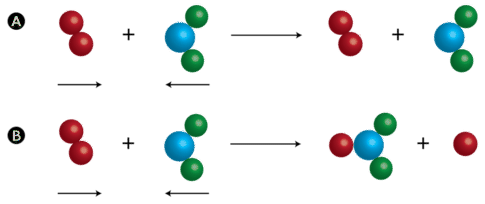
The behavior of the atoms, molecules, or ions that comprise the reactants is responsible for the rates of a given chemical reaction. Collision theory is a set of principles that states that the reacting particles can form products when they collide with one another, provided those collisions have enough kinetic energy and the correct orientation. Particles that lack the necessary kinetic energy may collide, but the particles will simply bounce off one another unchanged. The figure below illustrates the difference. In the first collision, the particles bounce off one another, and no rearrangement of atoms has occurred. The second collision occurs with greater kinetic energy, and so the bond between the two red atoms breaks. One red atom bonds with the other molecule as one product, while the single red atom is the other product. The first collision is called an ineffective collision, while the second collision is called an effective collision.
Summary
- Collision theory explains how materials can collide and become new materials.
- Effective collisions result in product formation.
- Ineffective collisions do not result in product formation.
This page titled 10.3.2: Collision Theory was last modified on Sat, 17 Aug 2024 02:56:00 GMT and is shared under a CC BY-NC-SA 4.0 license and was authored, remixed, and/or curated by Matthew Ku via source content that was edited to the style and standards of the LibreTexts platform.
The book could not be loaded just now.