Opening the book…
Organic chemistry is typically done in a ventilated hood for safety. Every group will have their own designated hood throughout the semester. The hoods contain lattice-work of metal bars (Figure 4.1) secured to the bottom that can be used for clamping apparatuses. The hoods also contain small drains (in the back), and multiple spigot (vacuum- yellow, air-orange, gas-blue, CW-green=coldwater) (Figure 4.2)

Figure 4.1: a) Hood with metal lattice-work for clamping apparatuses. b) Spigots on the side of the hood for vacuum, air, gas, and cold water (CW)
Metal clamps are used to connect glassware to ring stands or the metal lattice work. Two common types of clamps are "extension clamps" and "three-fingered clamps" (Figure 4.2a). The clamp should securely grasp the neck of a round bottom flask below the glass protrusion (Figure 4.2b, not Figure 4.2c). For condensers, suction flasks (Figure 4.3a), and chromatography columns (Figure 4.3b) the clamps should be positioned to to hold the glassware securely.
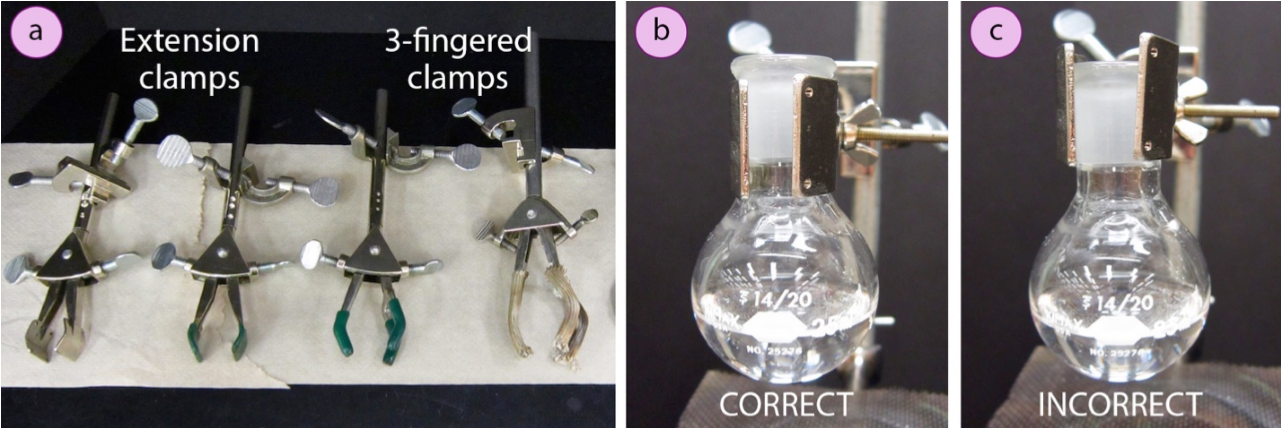
Both types of clamps often come with vinyl sleeves that may be removed if desired. The vinyl sleeves provide a gentle grasp for glassware, but should not be used with hot pieces as they may melt or catch on fire. Sometimes fire-resistant sleeves are also provided with clamps as an alternative (right-most clamp in Figure 4.2a).

Ring clamps (or iron rings) are also commonly used in the organic lab. They are used to hold separatory funnels (Figure 4.4a) and to secure funnels when filtering or pouring liquids into narrow joints (Figure 4.4b).

Plastic clips (sometimes called "Keck clips") are also commonly used to secure the connections between joints (Figure 4.5). The clips are directional, and if they don't easily snap on, they are probably upside down. Plastic clips should not be used on any part of an apparatus that will get hot, as they may melt at temperatures above 140 ˚C (Figure 4.5b). Clips should not be relied upon to hold any substantial weight, as they can easily fail (especially if they have been warmed). Therefore, reaction flasks should not be held with just clips, but always be supported in some more significant way (e.g. with an extension clamp attached to a ring stand).

This page titled 4.4: Hood and Clamping was last modified on Wed, 14 Aug 2024 01:44:38 GMT and is shared under a CC BY-NC-SA 4.0 license and was authored, remixed, and/or curated by Lisa Nichols via source content that was edited to the style and standards of the LibreTexts platform.
The book could not be loaded just now.