Opening the book…
Catalytic Deuteration of Benzene
Combinations of oxidative additions and reductive eliminations have many applications in the synthesis of organic molecules using an organometallic reactant.
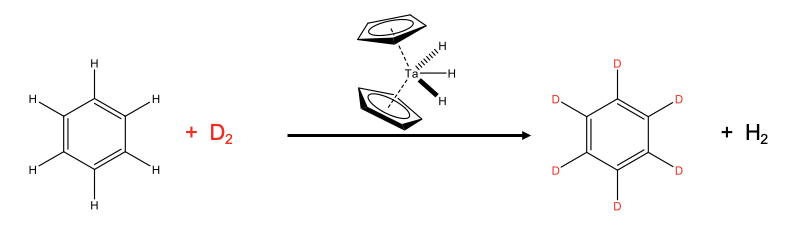
An example is the deuteration of benzene (Fig. \(\PageIndex{1}\)). Deuterated benzene is an important solvent in NMR spectroscopy. Industrially, the deuteration is done using a dicyclopentadienyltrihydridotantalum(V) catalyst starting out from benzene and D2. The D2 is provided in excess to drive the chemical equilibrium to the right side.
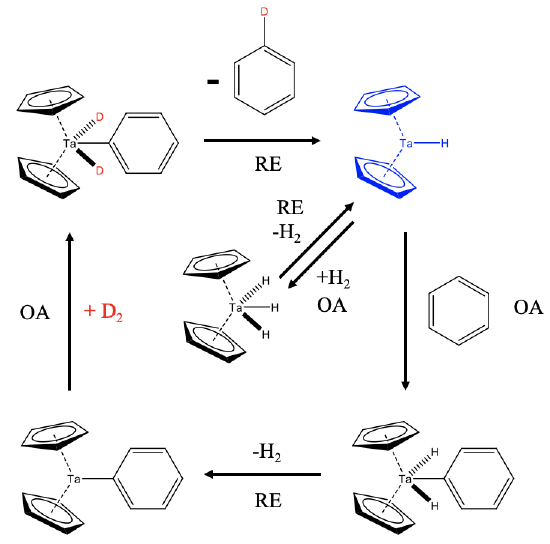
How does this reaction work mechanistically? This 18e Cp2TaH3 is actually a precatalyst that is in chemical equilibrium with H2 and the 16e dicyclopentadienylhydrido tantalum(III) which is the actual catalyst (Fig. \(\PageIndex{2}\)). Elimination of H2 from the Ta(V) catalyst is a reductive elimination (RE) and the re-addition of H2 to the Ta(III) species an oxidative addition (OA). In the presence of benzene, the Ta(III) species can oxidatively add benzene to form an 18e Ta(V) complex. This complex can reductively eliminate H2 to form a 16e Cp2Ta(III)-Ph complex. In the presence of deuterium this complex can add D2 oxidatively to form an 18e Cp2D2Ta(V)-Ph complex. This species can then reductively eliminate a monodeuterated benzene molecule under formation of Cp2Ta(III)-D. In the presence of enough D2 this monodeuterated benzene can be further deuterated in subsequent catalytic cycles.
This page titled Section 11.3.1: Catalytic Deuteration was last modified on Tue, 20 Jun 2023 15:55:53 GMT and is shared under a CC BY-NC-SA license and was authored, remixed, and/or curated by Kathryn Haas.
The book could not be loaded just now.