Opening the book…
Catalytic Olefin Hydroformylation
An important industrial reaction is the catalytic hydroformylation reaction, also known as oxo-process (Figure \(\PageIndex{1}\)). It was discovered in 1938 by Otto Roelen at BASF. In the hydroformylation reaction an H atom and a formyl group are added to an alkene to form aldehydes. The reaction can produce both branched an linear aldehydes from terminal alkenes, CO, and H2 using a carbonyl hydrides such as HCo(CO)4 as a catalyst. The reaction is performed at about 100°C at a pressure of up to 100 atm.
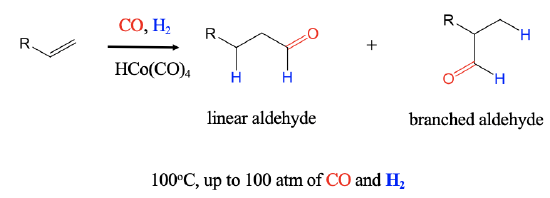
Mechanism of the Catalytic Olefin Hydroformylation by HCo(CO)4
How does the hydroformylation work mechanistically?
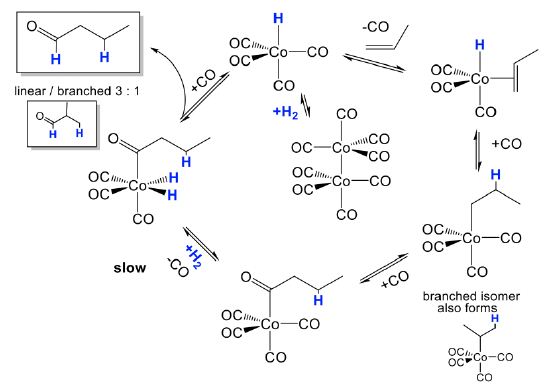
The mechanism is illustrated for the hydroformylation of propene (Fig. \(\PageIndex{2}\):). The actual catalyst HCo(CO)4 is first formed from its precatalyst Co2(CO)8 in the presence of H2 in a dinuclear oxidative addition reaction. The catalyst can undergo a substitution reaction in which a CO ligand is replaced by the olefin that binds side-on to the cobalt. This species can then undergo a migratory olefin insertion reaction. This leads to a mixture of linear and branched alkyl groups attached to the Co. A new CO ligand can add to the vacant site. The alkyl group can then insert into a carbonyl group in another migratory insert step, and the vacant site can be reoccupied by a new CO molecule. Then, H2 is added in an oxidative addition. This is the slowest and rate-limiting step in the catalytic cycle. From the addition product the aldehyde can then be eliminated in a reductive elimination reaction. Addition of CO regenerates the catalyst, and the catalytic cycle can begin again.
Hydrocarbonylations
After the hydroformylation, a number of other hydrocarbonylations were developed, and industrially deployed.
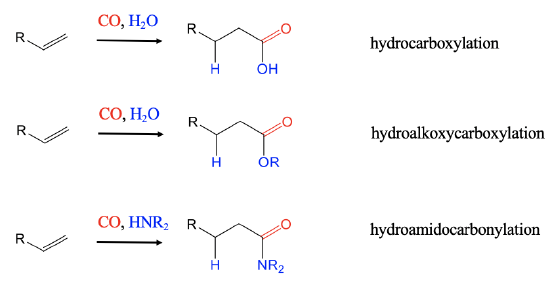
When hydrogen is replaced by H2O hydrocarboxylations of alkenes lead to carboxylic acids (Fig. \(\PageIndex{3}\):). With an alcohol instead of H2 hydroalkoxycarbonylcations lead to esters. The employment of amines instead of H2 leads to amides in hydroamidocarbonylation reactions.
This page titled Section 11.3.2: Hydroformylation was last modified on Tue, 20 Jun 2023 15:55:55 GMT and is shared under a CC BY-NC-SA license and was authored, remixed, and/or curated by Kathryn Haas.
The book could not be loaded just now.