Opening the book…
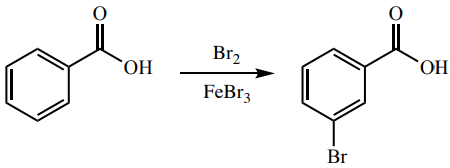
If the crude product of a chemical reaction is a solid, it may be crystallized in order to remove impurities. For example, benzoic acid can be brominated to produce m-bromobenzoic acid (Figure 3.4). The crude solid product could very likely contain unreactive benzoic acid, and this impurity could be removed through crystallization.
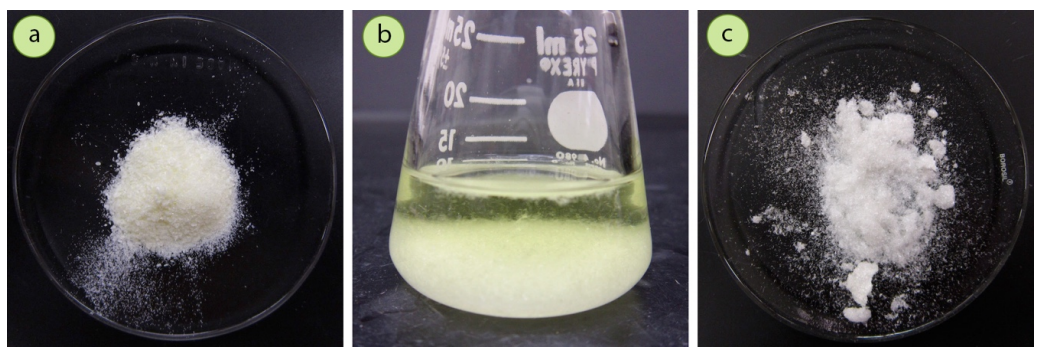
To demonstrate, a mixture containing roughly \(85 \: \text{mol}\%\) p-bromobenzoic acid\(^1\) (a solid) contaminated with \(15 \: \text{mol}\%\) benzoic acid (another solid) had a yellow tint (Figure 3.5a), and after crystallization the resulting solid was pure white (Figure 3.5c). The crystallization appeared to purify the mixture based on the slight improvement in color.
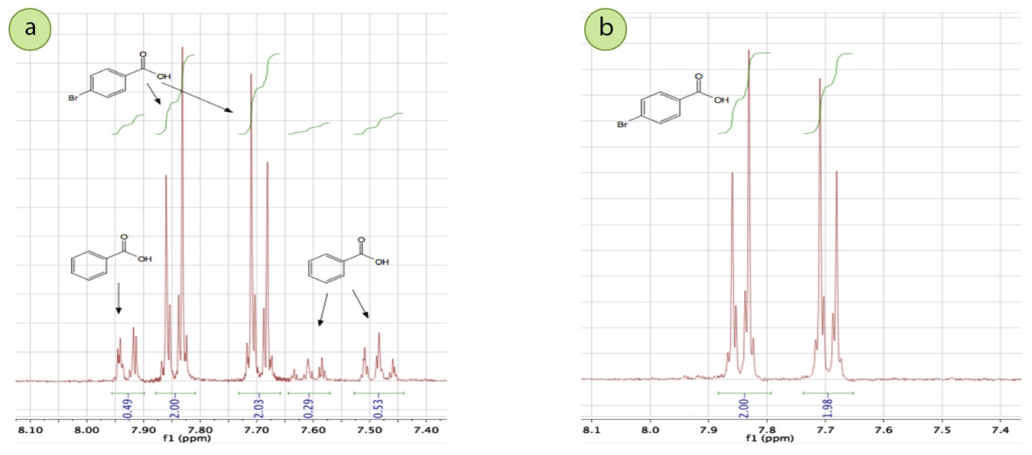
More reliable than appearance, the crystallization was proven to have indeed purified the mixture through melting point and \(\ce{^1H}\) NMR analysis of the crude and crystallized solids. The melting point of the crude solid was \(221\)-\(250^\text{o} \text{C}\) while the melting point of the purified solid was \(248\)-\(259^\text{o} \text{C}\) (literature melting point of p-bromobenzoic acid from Aldrich is \(252\)-\(254^\text{o} \text{C}\)). The melting point of the crystallized solid sharpened significantly, indicating greater purity. Additionally, in the crude solid's \(\ce{^1H}\) NMR spectrum (Figure 3.6a), there are signals from both p-bromobenzoic acid and benzoic acid, and the integrations correlate reasonably well with the original composition of the mixture. In the crystallized solid's \(\ce{^1H}\) NMR spectrum (Figure 3.6b), the benzoic acid signals are entirely gone, demonstrating that the crystallization successfully purified the p-bromobenzoic acid. An analogous purification could be done if a bromination reaction produced a mixture of m-bromobenzoic acid and benzoic acid.
\(^1\)p-Bromobenzoic acid was used instead of m-bromobenzoic acid for analysis purposes.
This page titled 3.2B: Purification of Product Mixtures was last modified on Tue, 11 Aug 2020 09:35:46 GMT and is shared under a CC BY-NC-ND license and was authored, remixed, and/or curated by Lisa Nichols via source content that was edited to the style and standards of the LibreTexts platform.
The book could not be loaded just now.