Opening the book…
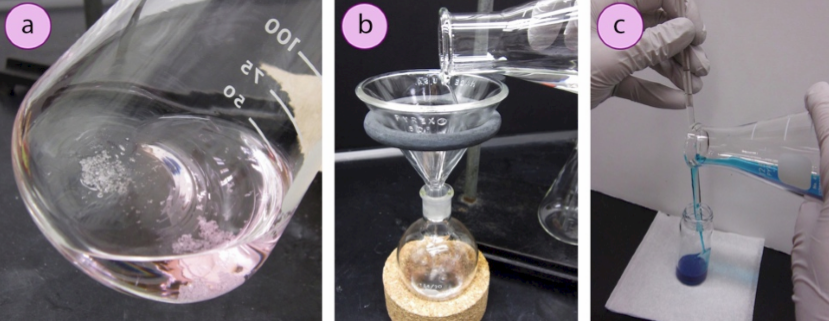
When there is a need to separate a solid-liquid mixture, on occasion it is possible to pour off the liquid while leaving the solid behind. This process is called decanting, and is the simplest separation method. Decanting is often used to remove hydrated sodium sulfate (\(\ce{Na2SO4}\)) from an organic solution. The sodium sulfate often clings to the glassware (Figure 1.67a), enabling the liquid to be poured off (Figure 1.67b). If liquid is to be poured into a small vessel, a funnel could be used or liquid poured down a glass stirring rod to direct the flow (Figure 1.67c). Unfortunately, there are many mixtures that do not decant well.
This page titled 1.5B: Decanting was last modified on Tue, 11 Aug 2020 09:35:22 GMT and is shared under a CC BY-NC-ND license and was authored, remixed, and/or curated by Lisa Nichols via source content that was edited to the style and standards of the LibreTexts platform.
The book could not be loaded just now.