Opening the book…
All of the factors that we have discussed for Brønsted acidity, or the ability of a compound to provide a proton to its surroundings, have an effect on basicity as well. In other words, factors like nuclear charge / electron affinity influence how strongly a compound will attract or bind a proton.
In summary:
- the higher the electron affinity or core charge of an atom, the less likely it is to donate its electrons to a proton.
- the greater the delocalization of electrons that could potentially donate to a proton, the less able they are to donate.
- the greater the electron-withdrawing effects in another part of a molecule, the less likely the electrons on a particular atom are to donate.
These factors are generally complementary to the effects on acidity. A factor that makes a Brønsted acid more acidic usually makes the corresponding conjugate base less basic.
However, sometimes things can be more subtle.
- the higher the polarizability of an atom (i.e. the larger an atom), the more easily it can donate to a Lewis acid (its electrons are not held very tightly because they are far from the nucleus, and so they can be donated easily).
- except: a larger atom cannot donate easily to a proton. In this specific case, the Lewis acid (the proton) is too small to get good covalent overlap with the Lewis base, so it can't form a very strong bond
Exercise \(\PageIndex{1}\)
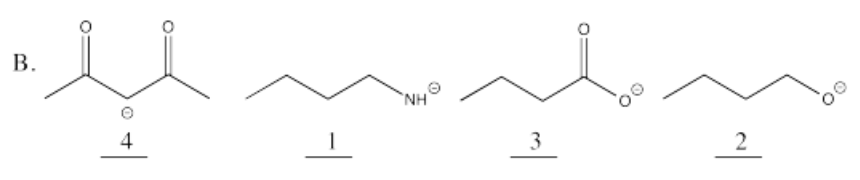
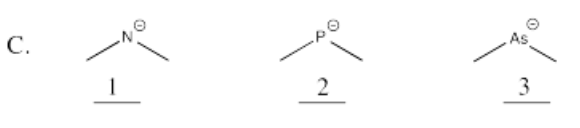
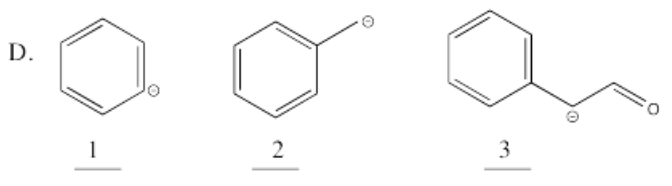
Rank the following in terms of base strength (1 = strongest base).
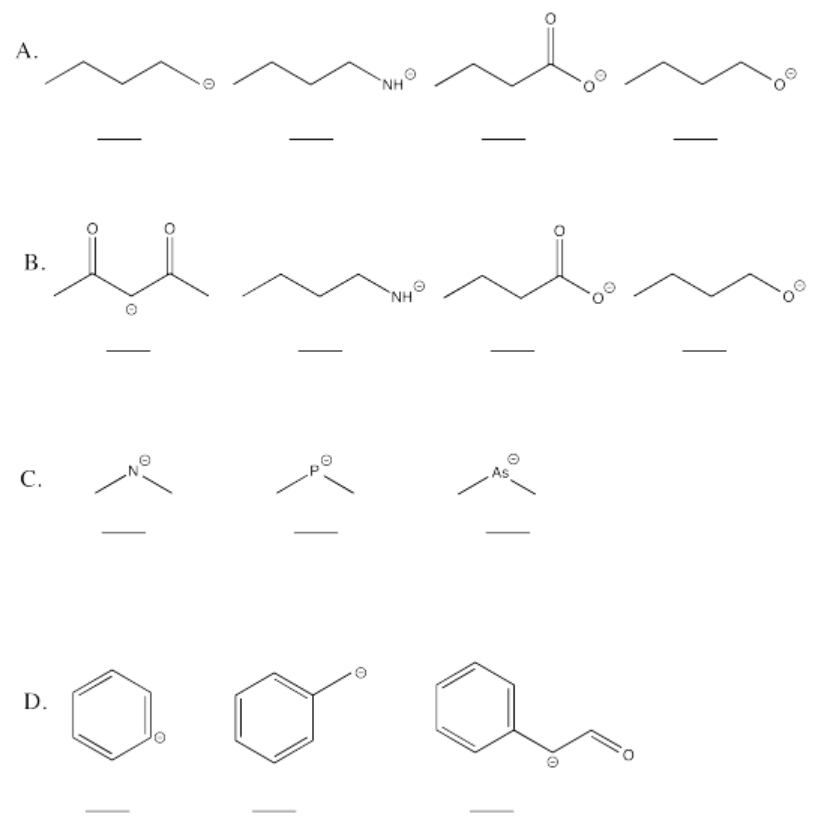
- Answer a
-

- Answer b
-
- Answer c
-
- Answer d
-
This page titled 14.13: Effects on Basicity (Attraction for Proton) was last modified on Tue, 04 Oct 2022 14:53:34 GMT and is shared under a CC BY-NC 3.0 license and was authored, remixed, and/or curated by Chris Schaller via source content that was edited to the style and standards of the LibreTexts platform.
The book could not be loaded just now.