Opening the book…
The combination of Lewis acids and chiral Brønsted acids affords LBA catalysts. In this system, the coordination of the Lewis acids to the heteroatom of the chiral Brønsted acid results in increase the acidity of the latter. For examples, the LBA, derived from optically active monoalkylated-1,2-diaryl ethane- 1,2-diol and SnCl4, has been found to be an effective catalyst for the enantioselective protonation of silyl enol ethers and ketene disilyl acetals (Scheme \(\PageIndex{1}\)).
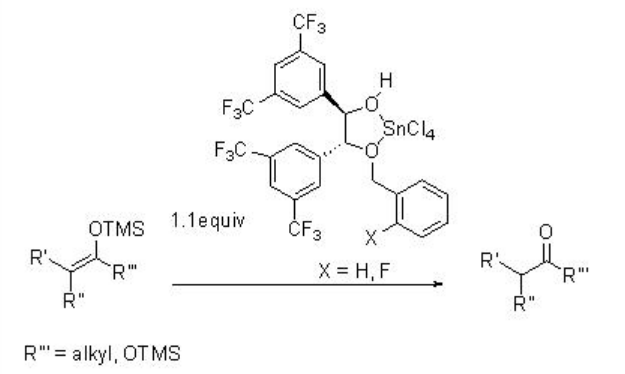
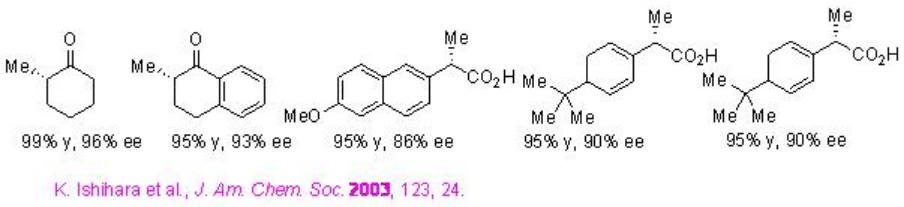
Examples:
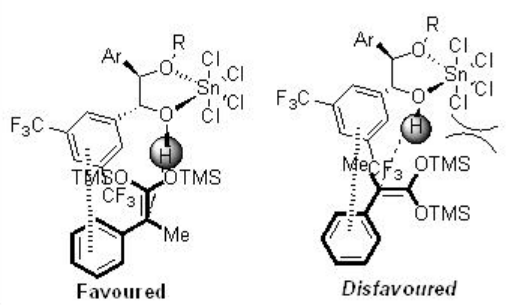
Based on the related X-ray crystal structure, the following transition states , controlled by a linear O-H— π bonding interaction, are proposed for the stereochemical course of the reactions (Scheme \(\PageIndex{2}\)).
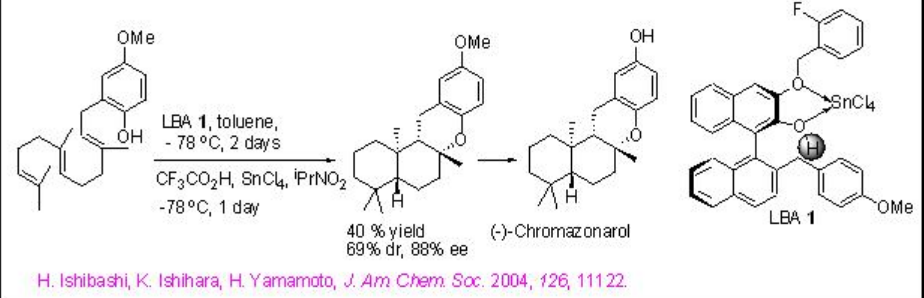
The chiral catechol-derived LBA 1 has been employed as an artificial cyclaze for the cyclization of various 2-(polyprenyl)phenol derivatives with good yield and enantioselectivity. For example, a short total synthesis of (-)-chromazonarol can be accomplished with 88% enantioselectivity (Scheme \(\PageIndex{3}\)).
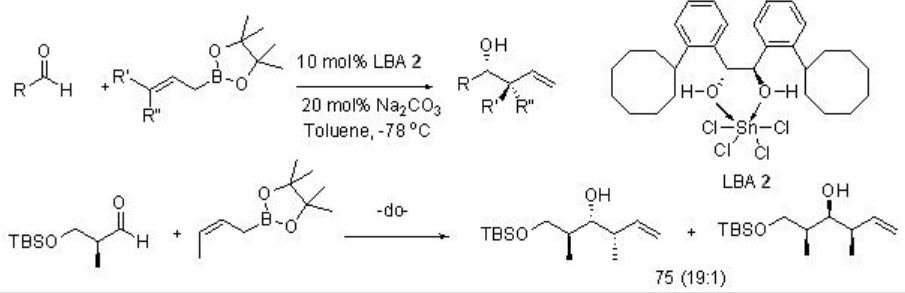
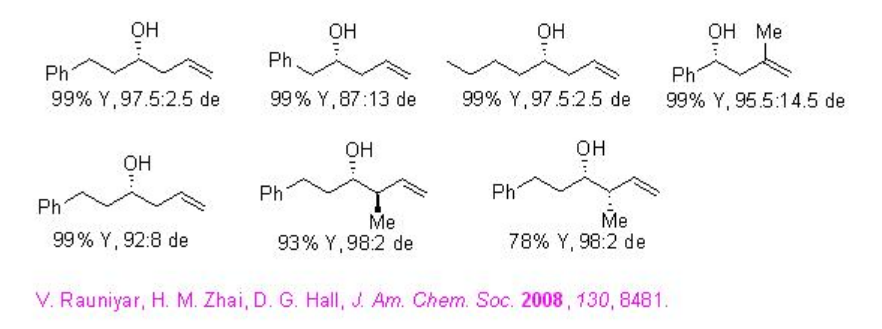
In addition, LBAs have been used as powerful catalysts for allylation reactions. For examples, LBA 2has been used as an effective catalyst for allylation of aldehydes with high diasterofacial selectivity (Scheme \(\PageIndex{4}\)).
This page titled 1.3: LBA Catalysts was last modified on Tue, 16 Mar 2021 20:56:51 GMT and is shared under a CC BY-SA license and was authored, remixed, and/or curated by Tharmalingam Punniyamurthy (National Programme on Technology Enhanced Learning (NPTEL)) .
The book could not be loaded just now.