Opening the book…
Among agriculturally important arthropods, insects cause the most crop damage as herbivorous pests. Chewing insects like beetles and caterpillars physically damage fruits, stems, and leaves. Piercing-sucking pests such as aphids and stink bugs extract plant fluids. Other insects mine tissues or transmit plant pathogens as vectors. Feeding reduces yields quantitatively through tissue loss and qualitatively through lost productivity.
Several factors make insects adept crop pests. Their small size allows access to protected plant parts. Short generation times and high fecundity enable rapid population growth. Physiological and behavioral adaptations amongst insects allows them to utilize diverse food sources. For example, some insects have specialized piercing mouthparts for precise extraction of sugars from phloem sap. Insects are also highly mobile which aids in dispersal and colonization.
Insect pest management relies on ecological and biological knowledge. Understanding life cycles and monitoring developmental stages informs optimal timing of control measures. Like with weed control a variety of control methods exist – cultural, mechanical, biological, and chemical. Cultural practices like crop rotation disrupt pest cycles. Use of resistant crop varieties utilize plant defenses against insects. Biological control makes use of natural predators, parasites, and pathogens. In small gardens, mechanical removal of larger pest may be feasible. When necessary, insecticides can be used to target vulnerable life stages. Effective, sustainable control is best achieved through Integrated Pest Management (IPM) which combines observation, critical threshold, and multiple control strategies.
Observation plays an important role in insect control. Some garden pests are not easy to spot. They are either well camouflaged or hide on the bottom sides of leaves. We can often spot evidence of their presence before we spot them. One thing all insects leave behind is frass. Frass is the excrement (poo) of the insects along with shed exoskeletons from previous molts. It can appear as just “dirt” on the leaves but often has a green tint if they insects are directly consuming the leaves. You can also pay attention to the leave surfaces. Piercing and sucking insects leave a sugary excretion called honeydew. This can coat the leaves and attract other pest such as molds. You may also see increased ant traffic. Some ants feed on this sugary reside and will defend the aphids from other predatory insects.
If the insects are feeding off the plant, there will be damage although again it may not be obvious. Insects that feed on plants can be categorized by their mouthparts and how they feed off the plant. The first group are those with chewing mouthparts. They cutaway sections of the leaf blade often leaving the major veins behind as a lacey skeleton (Figure 11-13). These would include beetles (such as the Japanese beetle), grasshoppers, grubs, and caterpillars. The second group are insects with rasping or saw-like mouthparts such as thrips and leaf-miners. They scrape way cells from the back side of the leaf and leave only the upper epidermis intact. Since the upper epidermis does not contain chloroplast, a whitish-yellow trail is left in their wake. The last group are those that have piercing-sucking mouthparts. These insects have specialized mouthparts that allow them to pierce phloem cells with amazing accuracy (we even still use them in research b/c they are better at doing this than our sophisticated equipment). The pressure of the phloem pushes the sap through the digestive track of the insect and out onto the leave as honeydew. While not doing any noticeable damage, they are siphoning off carbohydrates from the plant that thus are not being used for growth or reproduction. If the numbers are high enough, it can cause death of the plant. Some examples of piercing/sucking insects are aphids, scales, whiteflies, leafhoppers, and mites (technically arachnids).
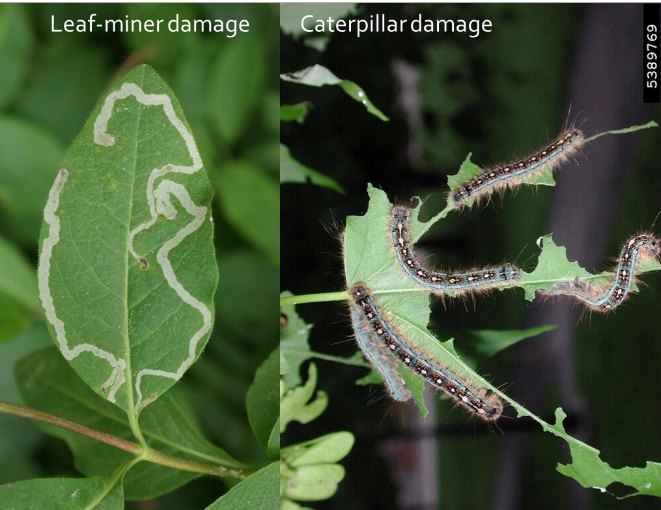
Insects can also cause damage to plants indirectly or in ways not associated with feeding. Some insects lay their eggs in plants. To do this they bore into the tissue leaving it vulnerable to infectious agents. Additionally, of course, once the eggs hatch, the larva will feed on the plant also.
As mentioned before, the honeydew excreted by the piercing-sucking insects can attract other pathogens. Fungi, specifically sooty mold (Figure 11-14), can grow rampant on leaves covered in honeydew. This black layer can minimize photosynthetic ability and between that and sap removal can be very detrimental to the plants. In this image you can see the black “sooty” appearance of the leaves as well as the glossiness that is associated with the honeydew. On the stem in the background, you can see the scale insects responsible for the honeydew.

This page titled 11.2.1: Insect Damage was last modified on Sat, 14 Nov 2026 18:08:30 GMT and is shared under a CC BY-NC-SA 4.0 license and was authored, remixed, and/or curated by Stephanie Harvey.
The book could not be loaded just now.