Opening the book…
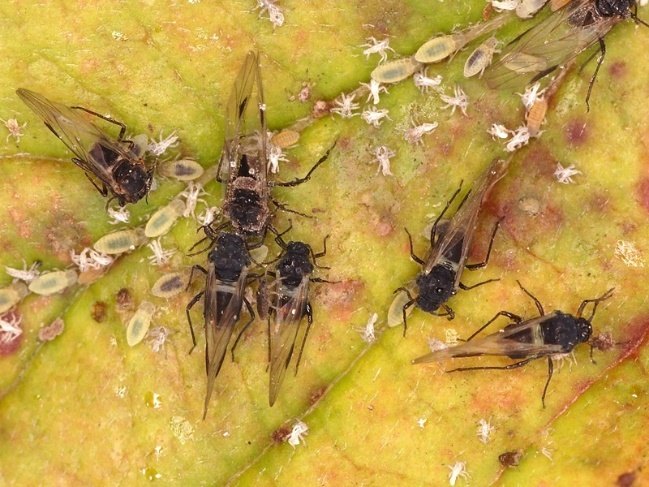
Aphids are small, soft-bodied insects that feed by sucking sap from stems and leaves of plants. They are pests of ornamental trees, shrubs, and flowers as well as many vegetable crops (Figure 11-15). They feed by inserting a microscopically thin mouthpart into the plant phloem and sucking the sap which is rich in sugars. As they feed, the aphids also inject saliva. This caused some plants to develop curled, hardened, or distorted growth. It is also how they can act as vectors for disease. Viruses, for example, can be transmitted from plant to plant by aphids. A single aphid would have little impact on plant vigor; however, populations of aphids can expand quickly and lead to significant losses in yields.
Spider-mites are a nearly microscopic pest (Figure 11-16). They are mites, so technically arachnids not insects. They have 4 sets of legs instead of 3. Spider mites are hard to spot not only b/c they are small but b/c they like the bottom side of the leaves near the apex of the plant. The environment is slightly warmer and drier at that location. Like aphids, they are piercing-sucking feeders so the damage can be difficult to spot initially. They produce golden freckles along the blade of the leaf. Eventually the entire leaf starts to go yellowish. The mites also produce a fine-silken web that can be seen when plants are heavily infested with the mites. The web catches the frass which makes the webbing more visible with time.

Caterpillars are the larvae form of butterflies and moths. They are the primary feeding stage for this group insects and do significant amounts of foliar damage (Figure 11-17). Smaller larva may remove only the most tender parts of the leaf, leaving the primary and secondary veins intact. Larger caterpillars can consume everything down to the leaf petiole. They are voracious consumers and leave large greenish fecal pellets on the foliage or under the infested plant. Common pest caterpillars are tomato hornworms, cabbage loopers, and corn earworms. Handpicking larger caterpillars, applying Bacillus thuringiensis, and encouraging natural predators like wasps and birds can protect plants from excessive defoliation by caterpillars.

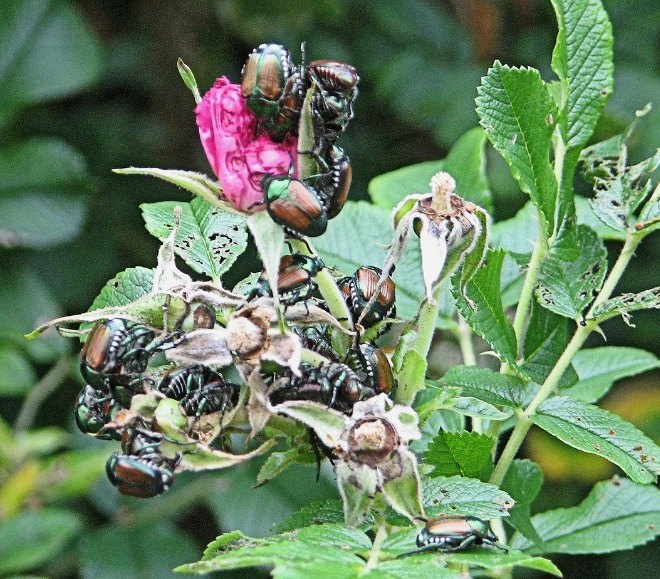
Japanese beetles are a highly destructive insect pest in North America. They are scarab beetles with iridescent copper-colored forewings (Figure 11-18). Larvae feed on plant roots and hibernate in the soil. The beetles emerge in the spring when soil temperature warms up. Adults feed voraciously on over 300 plant species. They use pheromones to attract other beetles and overwhelm plants, skeletonizing leaves and damaging fruits. Traps, physical barriers, microbial insecticides, and neonicotinoid treatments can reduce infestations of Japanese beetles in the garden.

Scale insects attach themselves to stems and leaves to suck plant fluids (Figure 11-19). Severe infestations can stunt or kill plants. They vary dramatically in appearance, from very small organisms (1–2 mm) that grow beneath wax covers, to shiny pearl-like objects (about 5 mm), to animals covered with mealy wax. Adult females are almost always immobile (apart from mealybugs) and permanently attached to the plant on which they are feeding. They secrete a waxy coating for defense making them difficult to control. Horticultural oils suffocate overwintering scales. Systemic insecticides applied early in the season can reduce scale populations.
Grasshoppers have had a long relationship with humans (Figure 11-20). Swarms of locusts can have devastating effects and cause famine, having done so since Biblical times. They chew on leaves, stems, and pods of crops. They are most problematic in hot, dry conditions and swarms can devastate pasture, grains, and other crops. Row covers can exclude grasshoppers. Reducing tall vegetation around gardens can remove egg-laying sites and minimize future population. Baits and insecticide application to foliage can protect plants from severe defoliation.

Stink bugs feed by sucking juices from fruits and seeds, causing ugly blemishes or distortion (Figure 11-21). They are a threat to cotton, corn, sorghum, soybeans, native and ornamental trees, shrubs, vines, weeds, and many cultivated crops. The shield-shaped adults and nymphs emit a foul odor when threatened, thus their common name. Traps, natural predators, and insecticides provide some control, but stink bugs can be difficult to manage as they are resistant to many insecticides. Removing alternate hosts weeds near the garden is recommended.

This page titled 11.2.2: Common Insect Pests was last modified on Sat, 14 Nov 2026 18:12:23 GMT and is shared under a CC BY-NC-SA 4.0 license and was authored, remixed, and/or curated by Stephanie Harvey.
The book could not be loaded just now.