Opening the book…
Stems are part of the aerial portion of the plant (the shoot) although there are some specialized stems that are underground and are referred to as Rhizomes. The function of the stem is structural in nature (Figure 3-18). It supports the leaves and puts them into positions that are advantageous for photosynthesis. The stems also are important for connecting the roots, where absorption is taking place, to the leaves which are very metabolically active.
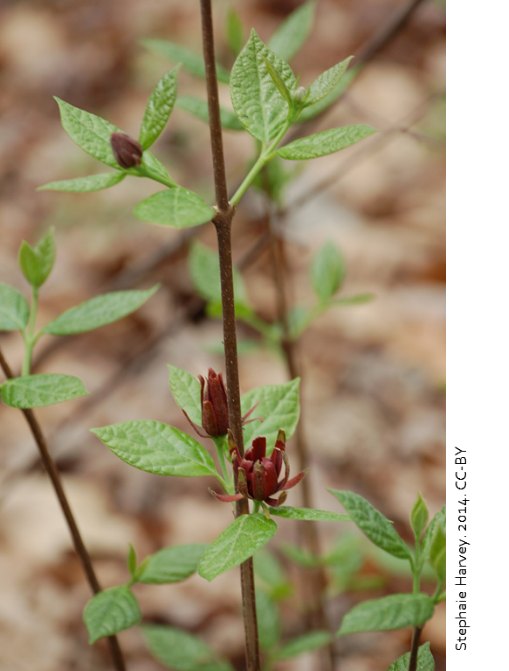
Stems can also act as storage tissues and may be photosynthetic depending on the species and age of the stem.
Stems are divided into regions called nodes and internodes (Figure 3-19). A node is where leaves (leaf scars – where leaves were attached), branches and axillary buds are attached. In between nodes are the internodes; only a few structures are associated with the internodes – prickles and lenticels. Stems increase in length primarily through internode elongation during early development and all lateral growth is associated with nodes. The pattern of nodes, leaves and branches is initiated in the terminal bud where the apical meristem is protected. The axillary buds also contain meristematic tissue and can give rise to lateral branches and other new growth.

When a twig (shoot without leaves) breaks dormancy in the spring, the terminal bud opens to allow the new nodes and internodes to expand. The scales of the terminal bud fall away leaving behind small scars. The tightness of the bud scales means the small scars are close together and ring the stem. This creates a mark called a growth ring. (Not to be confused with annual ring of a wood tree trunk). This new growth is often photosynthetic until the epidermis is replaced by bark.
With the loss of the epidermis with its stomata, a new structure is needed to allow gas exchange but limit water loss. Lenticels fulfill this need (Figure 3-20). A lenticel consists of porous tissue consisting of cells with large intercellular spaces in the bark of woody stems. The porous tissue provides a path for gas exchange while slowing the diffusion of water molecules into the atmosphere.

The arrangement of tissues in the herbaceous stems of monocots and eudicots differ (Figure 3-21). Monocot (as seen in the first photomicrograph) have vascular bundles that appear scattered through the ground tissue. The bundles themselves have a “face-like” appearance. The vascular bundles of eudicots have a more acorn shape and are capped with fibers. The vascular bundles are located in a ring that separates the ground tissue into two zones – cortex and pith tissue. The vascular bundles of the monocot may at first seem random, but a closer inspection will show they are arranged in a series of arches corresponding to the veins of the leaf bases.

Secondary growth occurs in wood stems of some eudicots, magnoliids and basal angiosperms as well as gymnosperm (Figure 3-22). It is conspicuously absent from monocot. It appears secondary growth evolved fairly early in plant history but was lost from the monocot branch. Secondary growth is responsible for the increase in the girth of a plant stem or root. This new growth is created by the vascular cambium (a lateral meristem). A single layer thin, a cambial cell divides, and one cell remains as a meristematic cell with the other differentiates into either 2nd xylem or 2nd phloem. In this way the vascular cambium can be maintained throughout the growth of the plant.

In temperate regions where growth slows considerably in the winter, the annual growth rings can easily be seen in the 2nd xylem which continues to accumulate year after year. 2nd phloem is eventually lost with the bark. Thus the “wood” of a tree trunk is 2nd xylem.
There are multiple directions for stem specialization (Figure 3-23). A common one seen in cacti, is that the stems become the primary photosynthetic organ. In cacti, leaves are highly reduced or loss to minimize surface area for water loss. The stem, with a lower surface area to volume ratio, is more able to retain water while providing some surface for light absorption.

Stems may also play a role in storage. Tubers (such as potatoes) are underground stems (not roots). They have nodes (“eye”) while roots lack nodes. Tubers are both storage organs and can be used for asexual reproduction. Tubers separated from the parent plant will sprout and produce new plants. The advantage in using tubers as storage organs is that their underground nature makes them less available to herbivores.
Rhizomes (like the bamboo rhizome seen in Figure 3-23)) are underground stems that give rise to above ground leaves and can be used to propagate a plant asexually. With the stem below ground it is, like the tuber, less available to predators. Additionally, it is less susceptible to the cold of winter. The above ground can die back, and the rhizome will produce new leaves above ground when conditions improve.
This page titled 3.4.2: Stems was last modified on Thu, 12 Nov 2026 19:14:18 GMT and is shared under a CC BY-NC-SA 4.0 license and was authored, remixed, and/or curated by .
The book could not be loaded just now.