Opening the book…
Roots provide vital functions for the plants. They provide anchorage to keep the plant upright. They counterbalance the shoot weight and thus have a biomass typically equivalent to the aerial shoot.
They are the site of water and nutrient absorption. Water absorption is critical to plant survival. Plants lose water via transpiration and must have a nearly continuous flow into the plants. If intake of water does not meet water loss, the plant will wilt and eventually die. The importance of this function is underscored during seed germination (Figure 3-13). The embryonic root, the radicle, is the first thing to emerge from the seed.

With the exception of CO2, the nutrients needed by the plant are absorbed from the soil matrix. This uptake and accumulation of nutrients in root tissue requires an elaborate system of passive and active transport.
Roots can also function in storage. Storage of high energy molecules underground is important b/c it provides a somewhat secure location for hording of energy because it is more difficult for herbivores to obtain. Root tissues typically store energy in the form of starch, but sugars and proteins are also used.
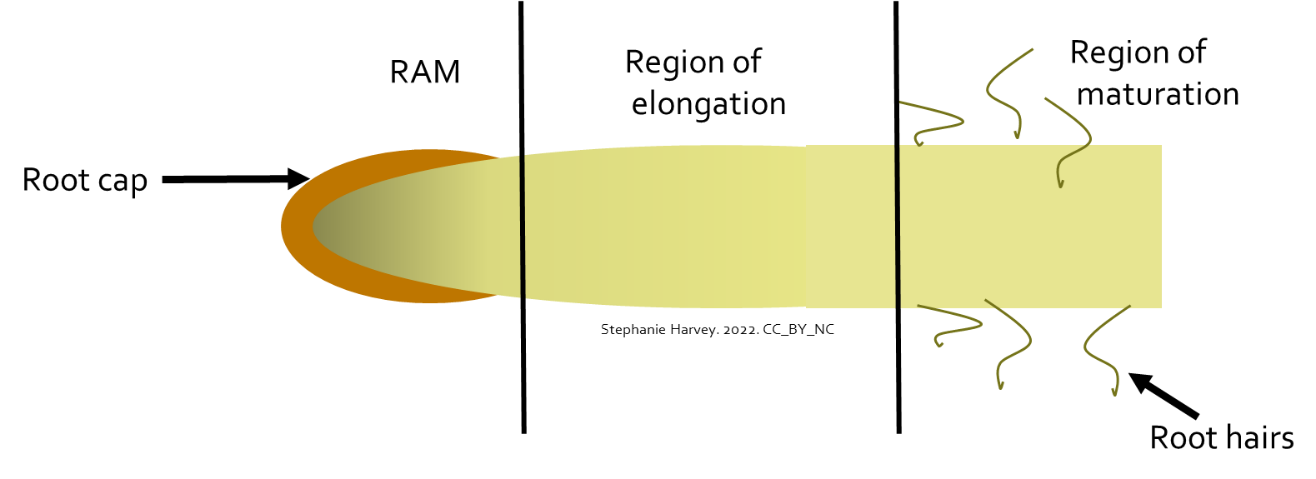
The features of a root, moving upward from the tip, include the root cap, root apical meristem, region of elongation and region of maturation (Figure 3-14). The root cap is a loose aggregation of cells that protect the meristematic tissues. As the root elongates, the tip pushes through the soil. This could damage the delicate meristem, so the root cap cells take the damage and are shed. The root cap also plays a role in sensing gravity. The root apical meristem is a region of cell division and above that is the region of elongation where cells begin to take on water and elongate. Some differentiation starts to take place. In the region of maturation, cells have differentiated into the three permanent tissues. This is visible by the presence of root hairs – hair-like extensions of some epidermal cells. They dramatically increase the surface area for water absorption. It is above this zone that lateral roots can emerge.
A cross-section of a root reveals three distinct areas – epidermis (outmost layer of cells), the cortex (ground tissue – generally parenchyma) and then the stele (Figure 3-15). The stele is a central column of vascular tissue. In Monocots (plants like grasses and lilies) the stele consists of a ring of vascular tissue (phloem and xylem) surrounding a pith area (ground tissue). In Eudicots (plants with broad leaves like maples, cotton), the stele lacks a pith. Instead the xylem is arranged at the center of the stele in a star shaped pattern with the phloem in between the arms.

In both cases, just outside of the stele is the endodermis - a single layer of cortex cells running between the cells of this layer is a waterproofing material called the Casparian strip (stains red in these images) (Figure 3-16). The strip prevents water from entering the stele except through the cytoplasm of endodermal cells. This allows for finer control of water/nutrients entering the stele. As you move upward along a root the Casparian strip eventually covers most of the surface of the endodermis and stops water leaking out of the stele. As the root ages, the cortex will be lost, and the endodermis will give rise to a new periderm.

“True” roots are derived from those original embryonic roots, the radical (Figure 3-13). Adventitious roots arise from non-root tissue such as stems, leaves and branches. All monocot roots are adventitious since their embryonic root is not maintained post germination. New roots develop from stem tissue.

Adventitious roots take many forms (Figure 3-17). The aerial roots like that of ivy and orchids that provide anchorage and water absorption above the ground. Arboreal roots like that of the Banyan Tree and other prop- or stilt roots help provide support for large branches or tall shoots.
This page titled 3.4.1: Roots was last modified on Thu, 12 Nov 2026 19:10:17 GMT and is shared under a CC BY-NC-SA 4.0 license and was authored, remixed, and/or curated by .
The book could not be loaded just now.