Opening the book…
As mentioned in the previous section, the physical properties of soil can impact plant growth. The chemical properties of soil can also impact growth in multiple ways. The chemical composition of the soil will determine what minerals are present. However, the presence of the minerals does not mean that they are available to the plants. Other factors such as soil pH and soil CEC can determine what is actually available to the plants.
In Figure 7-17, Zea mays or corn is grown in two different soil pH. The smaller plants to the left of the image are in acidic soil where the greener and taller plants are in a soil that has been limed to adjust the pH up. Soil pH can impact nutrient availability and thus plant growth.

Before we look at how soil pH impacts nutrient availability let us first look at pH itself. The pH scale is a logarithmic expression of the concentrations of hydrogen ions in a solution. Because it is a log scale, pH goes from 0 to 14 with seven being neutral. The lower the number the more acidic and the more hydrogen protons there are. The higher the pH the more basic or alkaline the soil is and thus the fewer hydrogen protons.
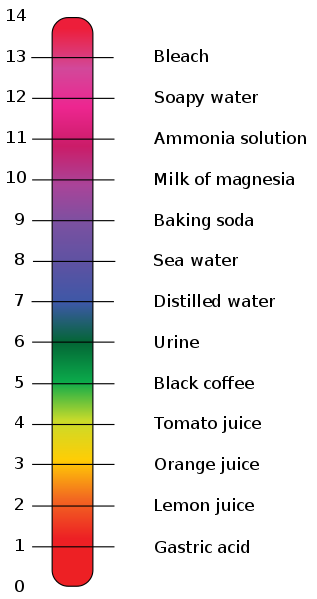
The scale of Figure 7-18, provides some common everyday items at their standard pH. At pH of one (1), there are gastric acids. Gastric acid is the acid in your stomach that helps break down food. If we move up our pH scale will notice that tomato juice has a pH of four (4) urine pH of six (6) and again our distilled water which is neutral at a pH of seven (7). At pH is above seven substances are said to be basic or alkaline. Milk of magnesia, for example, is often used as an antacid because it is basic nature. Notice that bleach has a pH of 13. People often associate low pH solutions – acids - with being dangerous however a high pH such as 12, 13 or 14 can be just as damaging as a low pH. It can cause severe chemical burns and even death.
The pH of the soil affects the availability of nutrients. The graph (Figure 7-19) depicts the essential nutrients that plants need for growth and their availability at different soil pHs. Along the bottom of the graph (x-axis) is the pH scale from 4.0 to 10.0. Each essential element is shown as a band. The wider the band the more available it is while the narrower the band the more difficult it is for the plants to extract from the soil.

At pH 7 most of the nutrients are fairly available particularly nitrogen, phosphorus, and potassium, the three primary macronutrients. However, if you look at iron, manganese, and boron you will notice that at pH 7 there is limited availability. The availability increases with shifts into more acidic conditions. In contrast molybdenum, and to some extent calcium, availability increases as the soil becomes more alkaline. At pH of 7.5 to 8, they are more available than at neutral or at more acidic pHs.
Soil pH can also impact pathogens and other diseases of crops. Blossom-end rot for example is typically seen when the soil pH is somewhat acidic. It is partly due to the low availability of calcium which causes the cell walls to be soft and vulnerable for fungal attack. In other cases, the pathogen itself flourishes in either higher or low pH soils.
Soil pH can be adjusted using amendments and selective fertilizers. It is typically easier to raise the pH than to lower it. For acidic soils, the pH can be raised by adding materials such as calcium or limestone. This is typically referred to as liming a field. For alkaline soils, the pH can be lowered by adding sulfur or sulfur compounds. The effect is not as immediate nor as extreme. Shifting a soil toward a more acidic pH may take several years. These types of adjustments to pH are typically done prior to planting and are done over a significant area.
This page titled 7.1.5: Soil pH was last modified on Sat, 14 Nov 2026 14:08:27 GMT and is shared under a CC BY-NC-SA 4.0 license and was authored, remixed, and/or curated by Stephanie Harvey.
The book could not be loaded just now.