Opening the book…
Depending on geological history, climate and land usage, soils can be very different in different locations and at different depths. In a given area, a soil profile can be determined based on the soil layers or horizons. Soil scientists, who are also called pedologists, look at the layers by digging pits. A profile can provide insight into the history of an area and about its potential for future land usage.
Soil horizons differ in a number of easily seen soil properties such as color, texture, structure, and thickness. Other properties are less visible. Properties, such as chemical and mineral content, consistency, and reaction require special laboratory tests. All these properties are used to define types of soil horizons.

Soil scientists use the capital letters O, A, B, C, and E to identify the master horizons, and lowercase letters for distinctions of these horizons (Figure 7-13). Most soils have three major horizons -- the surface horizon (A), the subsoil (B), and the substratum (C). Some soils have an organic horizon (O) on the surface, but this horizon can also be buried. The master horizon, E, is used for subsurface horizons that have a significant loss of minerals (eluviation). Hard bedrock, which is not soil, uses the letter R.
Not every soil contains every horizon and depth of each horizon varies between different soils.
O Horizon (Figure 7-14) represents the layer of accumulated organic matter such as leaves, grass twigs in various states of decomposition. In the O horizon, most organic material can still be matched to it source based on physical characteristics. In general, the layer color is dark and represents a zone of significant biological activity.

The A horizon has organic matter incorporated with the mineral soil. Decomposition is advanced enough that identification of organic sources cannot be achieved by the naked eye. This layer is general dark in color and often referred to as the topsoil. A is a surface horizon, and as such is also known as the zone in which most biological activity occurs. Soil organisms such as earthworms, potworms, arthropods, nematodes, fungi, and many species of bacteria and archaea are concentrated here, often in close association with plant roots. Thus, the A horizon may be referred to as the biomantle.
B Horizon is the zone of illuviation or deposition. Accumulation of materials “washed” from horizons above. This material is commonly clay, humus, sesquioxides, or a mixture of the three. Variable in color from red and yellow to brown and gray. The brownish or reddish tones are due to the iron oxides.
The C Horizon is dominated by unconsolidated material that has been affected a little by the soil formation process (Figure 7-15). There is no biotic activity and climate effects are minimal. Colors vary based on the parental material. This soft bedrock is described as paralithic. R is bedrock and is strongly cemented with no weather effect. It is described as lithic.

Example of a Soil Profile
Distinct profiles are given names and Figure 7-16 shows a profile called Bama. It is found in Alabama, as you might have guessed, and it is Alabama state soil profile. Georgia’s is the “Tift” profile. I selected the Bama profile because the horizons are clearer than with the Tift profile. The appearance of the profile is as follows: Surface layer: dark brown fine sandy loam (A). Subsurface layer: pale brown fine sandy loam (E). Subsoil: red clay loam and sandy clay loam (B)
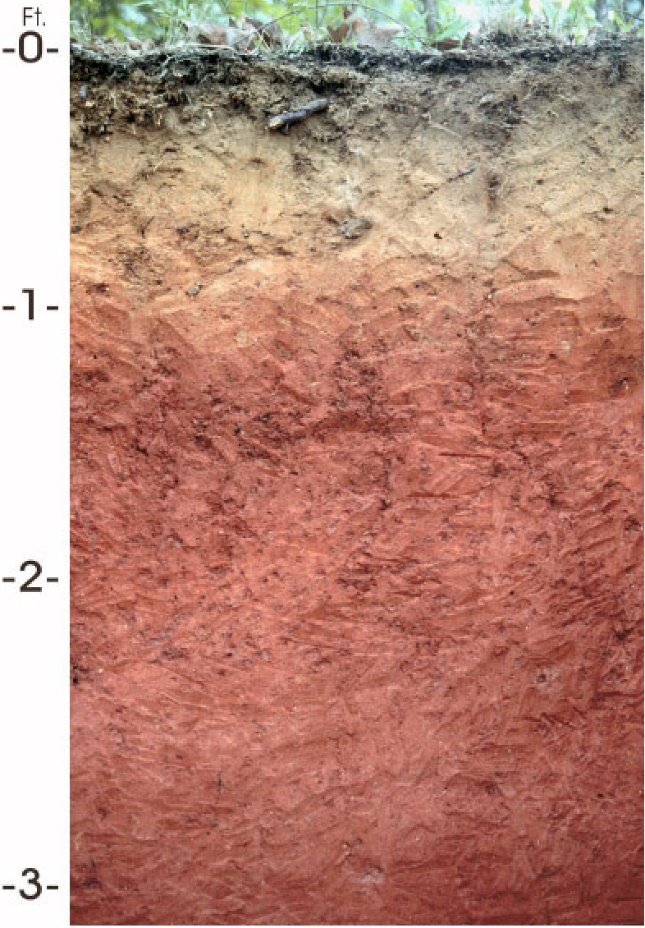
“The Bama series consists of very deep, well drained, moderately permeable soils on high stream or marine terraces. These soils formed in thick beds of loamy sediments. Near the “type” location, the average annual air temperature is about 67 degrees F, and the average annual precipitation is about 63 inches. Taxonomic class: Fine-loamy” (For more information: Link to BAMA [soilseries.sc.egov.usda.gov])
This page titled 7.1.4: Soil Horizons and Profiles was last modified on Fri, 13 Nov 2026 19:22:48 GMT and is shared under a CC BY-NC-SA 4.0 license and was authored, remixed, and/or curated by Stephanie Harvey.
The book could not be loaded just now.