Opening the book…
Layering is another propagation technique. It involved the productions of adventitious roots and removal of plantlet from a “mother” plant. The critical different between layering and cutting however, is that the production of adventitious roots it triggered first and then once there is enough root development is the explant cutaway from the supporting plant. There are several variations of layering techniques but we will focus on ground layering and air layering.
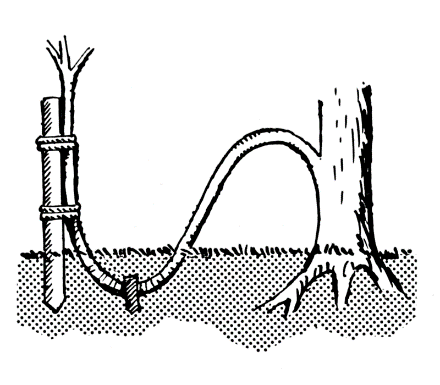
The first step in ground layering is to bring a branch of a tree or shrub into contact with the soil (Figure 9-25). This will need to be a new branch since it will still need to be flexible. Once you have located one that will work, you will need to abrade the bark on the part that will rest on the soil. You can carefully scrape away the bark using a knife or box cutter. Don’t go too deep. You only want to remove down to the cambial layer. Dusting the abraded area with rooting hormone will speed up the formation of roots. Position the branch so the abraded surface touches the soil. Then, using a u-shaped landscape pin or use a brick or other object, secure it to the ground. One way to increase soil contact it to bury the section under a pile of soil. A ground layering is typically started in early spring and is only cut away from the parent plant once they both have entered dormancy. The newly explant can be replanted in a desired location.
Instead of bring the branch down to the soil, in air layering the “rooting media” or soil is brought to the branch. A branch is selected and a region along its length is wounded by an upward 4 cm long cut and held open with a toothpick or similar, or a strip of bark is removed (Figure 9-26-AB). The wound is then surrounded with a lump water-retaining sphagnum moss or a cloth (Figure 9-26-C.) Then a moisture barrier such as plastic film tied or taped to the branch to prevent moisture loss or ingress of too much water as from rain (Figure 9-26-D). While clear plastic is a great covering b/c you can see when the roots have formed, is can also act like a greenhouse and introduce too much heat. A sunshield of aluminum foil is easy to wrap round the bundle to reflect the sun’s light. It can also be easily removed to check progress. When sufficient roots have grown from the wound, the stem is removed from the parent plant and planted, taking care to shield it from too much sun and to protect it from drying out until the new roots take hold.

This page titled 9.2.3: Layering was last modified on Sat, 14 Nov 2026 17:14:13 GMT and is shared under a CC BY-NC-SA 4.0 license and was authored, remixed, and/or curated by Stephanie Harvey.
The book could not be loaded just now.