Opening the book…
With the fundamentals of plants – diversity, structure and function complete. We can now take a look at how abiotic (non-living) components impact plants. In this chapter we will look at light.
As discussed previously, photosynthesis requires light as its energy source. Plants, as photoautotrophs, need light. It should be noted however that not all plants are photosynthetic. Some plants, like the American cancer-root (Conopholis americana) are achlorophyllous (Figure 5-1). That means they lack chlorophyll. Since these plants do not photosynthesis, they need another source of energy. They are chemoheterotrophs like fungi and animals. They get their energy and organic carbon by parasitizing other plants. They feed off the sugars stored in the roots of woody plants. So technically light does provide their energy but only indirectly through the food web.
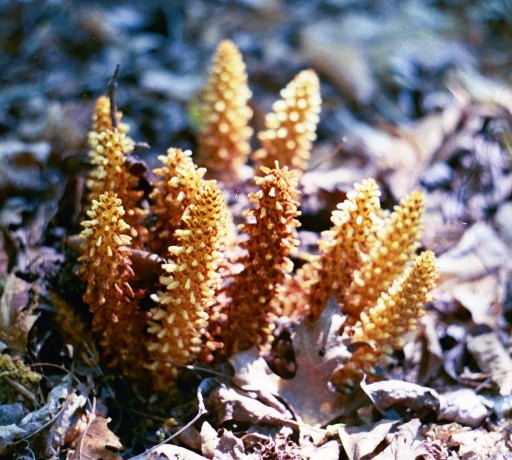
Since light is a critical abiotic factor for life on our plant, whether directly or indirectly, we will look at multiple aspects of light: physics of light, quality of light and the quantity of light. We will discuss some ways that plants respond to light and finish with how we as humans can manipulate light to impact plant growth and function.
- 5.1: Physics of Light
- This page covers the electromagnetic spectrum, detailing the various types of electromagnetic radiation such as radio waves, microwaves, and visible light, including their properties like wavelength, frequency, and energy. It explains that visible light, spanning 400-700 nm, contributes to color perception, while white light comprises all colors.
- 5.2: Light Quality
- This page discusses visible light's varying wavelengths and energies, focusing on photosynthetically active radiation (PAR) from 400 nm to 700 nm. It highlights that not all wavelengths in the PAR range are equally effective for photosynthesis, indicating differing absorption and utility for plant growth.
- 5.3: Light Quantity
- This page discusses the impact of light quality and quantity on plant growth, emphasizing the importance of different measurement units such as lumens, lux, and foot-candles for human clarity. It highlights photosynthetic active radiation (PAR) and its measurement via photosynthetic photon flux density (PPFD) in micromoles per meter squared per second as crucial for optimizing light conditions to enhance plant health and productivity.
- 5.4: Plant Responses to Light
- This page discusses how plants use light for various functions beyond photosynthesis, including morphological changes and reproductive success. It outlines four key mechanisms of light response: photosynthesis for energy conversion, phototropism for directional growth, photoperiodism affecting flowering and seasonal behaviors, and photomorphogenesis for growth and development influenced by light conditions.
- 5.5: Light Manipulation
- This page highlights the importance of plants in ecosystems and the impact of light on their growth. It explains how manipulating light can boost crop yields to fulfill human demands. Additionally, it categorizes plants into four groups based on their light needs: Full Shade, Filtered Light, Partial Shade, and Full Sun, offering examples for improved landscaping and gardening choices.
- 5.6: End of Chapter Review
- This page discusses the properties of light as electromagnetic radiation, emphasizing wavelength, frequency, and energy, particularly in relation to photosynthetically active radiation (PAR) essential for photosynthesis. It examines light's effects on plant growth, including phototropism and photoperiodism, and explains phytochromes' roles. Measurement and manipulation of light levels are covered, along with key terms and self-review questions for better comprehension.
This page titled 5: Light- An Abiotic Influence on Plants was last modified on Thu, 12 Nov 2026 21:28:00 GMT and is shared under a CC BY-NC-SA 4.0 license and was authored, remixed, and/or curated by Stephanie Harvey.
The book could not be loaded just now.