Opening the book…
An apparently necessary step in the origin of life was the generation of a discrete boundary layer that separates the living non-equilibrium reaction system from the rest of the universe. This boundary layer, the precursor of the plasma membrane, maintains the integrity of the intracellular environment and mediates the movement of molecules and energy into and out of the cell. So how is this membrane built and maintained, and how does it work? Simply put, when a cell divides, the plasma membrane of the "new" cell forms by budding off from the pre-existing membrane.
 As a cell grows, new molecules are added into the existing membrane increasing its surface area. Biological membranes are composed primarily of two general classes of molecules, proteins (discussed in the next chapter) and lipids. Lipids are not a structurally coherent group, that is they do not have one common structure. Structurally distinct molecules, such as cholesterol and phospholipids, are both lipids (→). Lipids have two distinct domains: a hydrophilic domain (circled in red) characterized by polar regions and one or more hydrophobic domains that are usually made up of C and H atoms. While there is a relatively small set of common lipid types, there are many different lipids found in biological systems and the characterization of their structures and functions has led to a new area of analysis known as lipidomics.[231]
Lipids are amphipathic. In aqueous solution, entropic effects act to drive the hydrophobic parts of the lipid out of an aqueous solution. In contrast to totally non-polar molecules, like oils, the hydrophobic part of the lipid is attached to a hydrophilic domain. Lipid molecules deal with this structural dichotomy by associating with other lipid molecules in multimolecular structures in which the interactions between the hydrophilic parts of the lipid molecule and water molecules are maximized and the interactions between the lipid’s hydrophobic parts and water are minimized. Many such multi-molecular structures can fulfill these constraints (→). The structures that form depend upon the details of the system, including the shapes of the lipid molecules involved and the relative amounts of water and lipid present. In every case, the self-assembly of these structures involves an increase in the total overall entropy of the system, a perhaps counterintuitive result. For example, in a micelle the hydrophilic region is in contact with the water, while the hydrophobic regions are inside, away from direct contact with water. This leads to a more complete removal of the lipid’s hydrophobic domain from contact with water than can be arrived at by a purely hydrophobic oil molecule, so unlike oil, lipids can form stable  structures in solution. The diameter and shape of the micelle is determined by the size of its hydrophobic domain. As this domain gets longer, the center of the micelle becomes more crowded. A type of organization that avoids “lipid-tail crowding” is known as a bilayer vesicle. Here there are two layers of lipid molecules, pointing in opposite directions. The inner layer surrounds a water-filled region, the lumen of the vesicle, while the outer layer interacts with the external aqueous environment. In contrast to the situation within a micelle, the geometry of a vesicle means that there is significantly less crowding as a function of lipid tail length. Crowding is further reduced as a vesicle increases in size to become a cellular membrane. Micelles and bilayer vesicles can form colloid-like systems with water; they exist as distinct structures that can remain suspended in a stable state. We can think of the third type of structure, the planar membrane, as an expansion of the vesicle to a larger and more irregular size. Both surfaces of the membrane face aqueous environments, the cytoplasm and the extracellular environment. For the cell to grow, new lipids need to be inserted into both inner and outer layers. Since lipids are synthesized in the cytoplasm, they are generally initially inserted into the cytoplasmic-facing membrane layer and then "flipped" to the extracellular-facing layer, an event that involves interactions with proteins, known as flippases. When we consider proteins, consider the energetics of this reaction and plausible flipping mechanisms.
A number of mechanisms are used to insert molecules into membranes, but they all involve a pre-existing membrane – another aspect of the continuity of life. Totally new cellular membranes generally do not form. For example, a vesicle is a spherical lipid bilayer that can fuse into or emerge from a planar bilayer membrane. These processes are typically driven by protein-based molecular machines coupled to thermodynamically favorable reactions. When the membrane involved is the plasma (boundary) membrane, these processes are known as endocytosis and exocytosis (into and out of the cell), respectively. These terms refer explicitly to the fate of the material within the vesicle. Exocytosis releases material in the vesicle interior into the outside world, whereas endocytosis captures material from outside of the cell and brings it into the cell. Within a cell, vesicles can fuse with and emerge from one another.
Cells contain many hundreds of different types of lipids, generated by a variety of biosynthetic pathways catalyzed by gene-encoded proteins. We consider two generic classes, the glycerol-based lipids (←) and cholesterol. Considerations of their structures illustrate general principles related to membrane behavior. In bacteria and eukaryotes, glycerol-based lipids are typically formed from the highly hydrophilic molecule glycerol combined with two or three fatty acid molecules
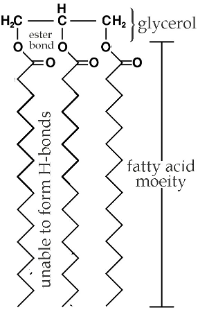 (a three fatty acid chain molecule →). Fatty acids contain a long hydrophobic hydrocarbon chain with a polar (carboxylic acid) head group. The molecular nature of these fatty acids influences the behavior of the membrane formed. Often these fatty acids have what are known as saturated hydrocarbon tails. A saturated hydrocarbon contains only single bonds between the
 carbon atoms of its tail domain. While these chains can bend and flex, they tend to adopt a more or less straight, closely packed configuration, that maximizes the lateral (side to side) LDF-mediated interactions between them. Because of the extended surface contact between the chains, lipids with saturated hydrocarbon chains are typically solid around room temperature. Solid means that the molecules rarely exchange positions with one another. On the other hand (←), there are cases where the hydrocarbon tails are “unsaturated”; they contain CC double bonds (–C=C–). Because unsaturated hydrocarbon chains have permanent kinks due to the rigid nature and geometry of C=C bonds they cannot pack as regularly as saturated hydrocarbon chains. The less regular packing means that there is less interaction area between the molecules, which lowers the strength of the LDF-mediated interactions between them. Lower LDF-mediated interaction energy in turn, lowers the temperature at which these bilayers change from a solid (no or little movement of the lipids relative to one another) to a more liquid state with relatively free movements within the plane of the membrane. Recall that the strength of interactions between molecules determines how much energy is needed to overcome the interactions between them.
Because LDF-mediated intermolecular interactions are relatively weak, changes in temperature influence the physical state of the membrane. The liquid-like state is often referred to as the fluid state. The membrane’s state is important because it can influence the movement, behaviors, and activities of proteins embedded in the membrane. If the membrane is in a solid state, proteins within the membrane will be relatively immobile. If it is in the liquid state, proteins can move by collision-driven movements within the plane of the membrane (diffusion). Since lipids and proteins closely associate with one another in the membrane, the physical state of the membrane can influence the activity of embedded proteins, a topic to which we will return.
Cells can manipulate the solid-to-liquid transition temperature of their membrane(s) by altering the membrane’s lipid composition. Increasing the ratio of saturated to unsaturated chains increases the melting temperature. Controlling chain saturation involves altering the activities of the enzymes involved in various saturation/desaturation reactions. That these enzymes can be regulated implies a feedback mechanism by which either temperature, membrane fluidity, or protein activity act to regulate metabolic processes and gene expression. This type of feed back mechanism is part of the homeostatic and adaptive systems of cells (and organisms), a topic we will return to repeatedly.
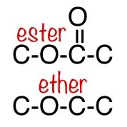 There are a number of differences between the lipids used by bacterial and eukaryotic organisms and archaea.[232] Most dramatically difference is found in archaea which use branched isoprene (CH2=C(CH3)CH=CH2) polymers, instead of straight chained hydrocarbons, that are linked to the glycerol group through an ether, rather than an ester linkage (→). The bumpy and irregular shape of the isoprene groups, compared to the relatively smooth saturated hydrocarbon chains, means that archaeal membranes tend to melt (go from solid to liquid) at lower temperatures.[233] At the same time the ether linkage is more stable (requires more energy to break) than the ester linkage. One speculation to explain this difference is that the archaea were originally (or became) adapted to living at higher temperatures, where the greater stability of the ether linkage would provide a critical advantage.
 Some archaea and bacteria, known generically as thermophiles and hyper-thermophiles, live (happily, apparently) at temperatures up to 110 ºC.[234] At the highest temperatures, thermal motion might be expected to disrupt membrane integrity, allowing small charged molecules (ions) and larger hydrophilic molecules to pass through the plasma membrane.[235] Given the importance of membrane integrity, you may not be surprised to find “double-headed” lipids in such thermophilic organisms (→). These molecules have two distinct hydrophilic glycerol
 "heads", one located at each end of the molecule. A single molecule can span the membrane. The presumption is that such lipids act to stabilize the membrane against the disruptive effects of high temperatures.
The solid-fluid nature of biological membranes, as a function of temperature, is complicated by the presence of cholesterol and structurally similar lipids. For example, in eukaryotes the plasma membrane can contain as much as 50% cholesterol, in terms of the number of molecules present. Cholesterol has a short bulky hydrophobic domain (hydrocarbon chain lipid left, cholesterol to the right →) that does not pack well with other lipids. The presence of cholesterol dramatically influences the solid-liquid behavior of the membrane. The various roles of lipids is complex and goes beyond our scope here.
References
[231] On the future of "omics": lipidomics & Lipidomics: new tools and applications
[232] A re-evaluation of the archaeal membrane lipid biosynthetic pathway
[233] The origin and evolution of Archaea: a state of the art
[234] You might consider how this is possible and under want physical conditions you might find these “thermophilic” archaea.
This page titled 6.1: Defining the Cell’s Boundary was last modified on Thu, 08 Jan 2026 23:36:00 GMT and is shared under a CC BY-NC-SA 4.0 license and was authored, remixed, and/or curated by Michael W. Klymkowsky and Melanie M. Cooper.
The book could not be loaded just now.