Opening the book…
In animals sexual reproduction results in a diploid cell, a zygote, that goes on to generate an new organism. As development proceeds some cells differentiate into what is known as the germ line; the remainder of the organism is known as the soma or body. The germ line goes on to produce haploid cells known as gametes. In some organisms, the haploid (gametic) stage can persist and live independently,[444] but generally the haploid stage of the life cycle is short. After their formation haploid gametes, from two distinct "parents", fuse or die. In some, primarily unicellular, species there are multiple "mating types", and only gametes of different types can fuse. One aspect of the haploid state is that it can reveal the presence, and lead to the elimination, of deleterious recessive alleles. Haploid cells that contain, and are dependent upon the expression of such alleles will be eliminated, removing the alleles from the population, which can have a strong evolutionary effect.[445]
In organisms with multiple mating types, rather than two sexes, the gametes of different mating types are morphologically similar. The energetic investment to produce a gamete is the same for all mating types. The situation is different in multicellular organisms. The gametes of the male and female sex are morphologically different and differ is size. The sex that produces the larger, generally immobile gamete, an oocyte, is known as female (♀) while the sex that produces the smaller, often motile gamete, a sperm or spermatozoa, is male (♂). The difference in the size of the gametes is an example of a sexual dimorphism with evolutionary implications. The two sexes have, from the start discordant investments in the production of gametes (large versus small). This difference can become more pronounced when the two parents differ in their investment in the growth and nuturing of offspring, a fact that underlies sexual selection, a feature of modern (Darwinian) evolutionary theory.[446]
 In females meiosis typically generates a single gamete, known as an oocyte or egg, and three non-viable mini-cells, known as polar bodies. In males, meiosis produces four gametes - sperm. Each gamete contains one and only one copy of each autosomal chromosome present in the original diploid cell. Historically, chromosomes were numbered based on their apparent size in histologically stained specimens. In humans, the largest chromosome, chromosome 1, contains ~250 million base pairs of DNA and over 2000 polypeptide-encoding genes, while the smallest, chromosome 22 contains ~52 million based pairs of DNA and ~500 polypeptide encoding genes (→). Homologous chromosomes are also defined by the order of genes found along their length. Human chromosome #5 contains different genes than are found on chromosome #6. Moreover, the maternal (from the mother) version of each chromosome can contain different alleles of these genes compared to those found in the paternal version.
In mammals (humans) males have both an X and a Y chromosome; meiosis generates four gametes that each contain one copy of each autosomes and either an X or a Y 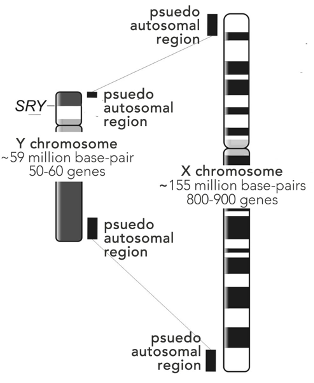 chromosome. Females have two X chromosomes, so all gametes they produce contain an X chromosome. A male gamete fuses with a female gamete to form a new diploid cell, a new organism. If the male gamete contains a Y chromosome, the new (diploid) organism is chromosomally male, if the male gamete contains an X chromosome, the new organism is chromosomally female.[447] The fusion event, known as fertilization, is the most discontinuous event in the process of sexual reproduction. Even so, fertilization does not represent a true discontinuity, at least with respect to life – both sperm and egg are alive, as is the fertilized egg.[448] In a critical sense life (in the post-LUCA world) never begins – it continues and is transformed. That said, fertilization is the start of a new, genetically distinct organism. The fused cell that results from fertilization is known as a zygote. Through somatic (asexual) cell division (mitosis and cytokinesis) the zygote will develop into an adult, composed of diploid cells. To repeat, the cells that produce gametes are known as germ cells, and are produced by the organism’s germ line. The rest of the adult is composed of somatic cells, cells that divide (if they divide) by mitosis. Meiosis is restricted to the germ line cells that produce gametes.
References
[444] see wikipedia – gametophyte: https://en.wikipedia.org/wiki/Gametophyte
[445] see: Evolution of haploid selection in predominantly diploid organisms and Haploid selection in animals
[446] How Darwin arrived at his theory of sexual selection and Mate choice and sexual selection since Darwin?
[447] While we not deal in detail with this topic, aspects of gender are complex traits: see Beyond XX and XY: The Extraordinary Complexity of Sex Determination
[448] In fact, there are examples of cell fusion within organisms - as an example, during the development of skeletal muscle, muscle precursor cells fused to generate large multi-nuclear cells, known as myotubes.
This page titled 12.4: Steps in meiosis- from diploid to haploid was last modified on Thu, 08 Jan 2026 23:39:13 GMT and is shared under a CC BY-NC-SA 4.0 license and was authored, remixed, and/or curated by Michael W. Klymkowsky and Melanie M. Cooper.
The book could not be loaded just now.