Opening the book…

We begin by distinguishing between the macroscopic world that we perceive directly and the molecular world that we can come to understand through scientific observations and experimentation. Perhaps the best example of the connection between the two was Albert Einstein's (1879–1955) explanation of Brownian motion, named after the botanist Robert Brown (1773-1858). In 1827 Brown described the jiggly movement of pollen grains in water viewed using a microscope. In 1905 Einstein recognized that the "random" movements of the pollen grain (→) was evidence for the existence of atoms (and molecules) and the transfer of energy associated with collisions between water molecules and pollen grains.[214] This type of movement continues even though the system is at thermodynamic equilibrium, a state in which nothing macroscopic appears to be going on. This insight revealed the connection between temperature, energy, and molecular movements, the focus of the laws of thermodynamics.[215]
 To apply the laws of thermodynamics to life, we first need to define the system(s) we are considering. Our system of interest could range from the Universe as a whole to a single living cell or multicellular organism. Next, can energy and matter enter or leave the system? In a "closed" system, neither energy or matter can enter or leave. Matter and/or energy can enter an "open" system, typically in a controlled manner. The laws of thermodynamics enable us to predict the behavior closed systems; a closed system will, over time, come to equilibrium, a state in which there are no more macroscopic changes. In an open system, the system's behavior will depend upon the degree to which energy and matter are exchanged with the external world, the world outside the system's boundary. Organisms and the cells that composed them are obligate open systems. They require the exchange of matter and energy with the external world to maintain their non-equilibrium living state.
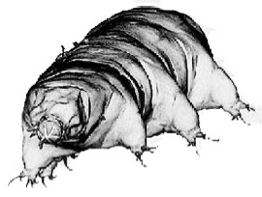
Cryptobiosis: We have characterized organisms as dynamic, open, non-equilibrium systems. An apparent exception to the dynamic aspect of life are organisms that display a rather special phenotypic adaptation, known as cryptobiosis. Some organisms, such as the tardigrad or water bear (→), can be freeze-dried and persist in a state of suspended animation for decades.[216] What is critical, however, is that when the organism is in this cryptobiotic state it is not at equilibrium, in much the same way that a battery is not at equilibrium, but can be reanimated when returned to normal conditions, specifically by the addition of water.[217] Cryptobiosis is a genetically-based adaptation that takes energy to produce and energy is needed to emerge from stasis. While the behavior of tardigrads is extreme, many organisms display a range of adaptive behaviors that enable them to survive hostile environmental conditions.
References
[214] Albert Einstein: The Size and Existence of Atoms http://youtu.be/nrUBPO6zZ40
[215] Laws of thermodynamics (Wikipedia) https://en.wikipedia.org/wiki/Laws_of_thermodynamics
[216] Everything you need (and want) to know about tardigrades
[217] On dormancy strategies in tardigrades & Towards decrypting cryptobiosis
This page titled 5.1: Approaching Thermodynamics was last modified on Thu, 08 Jan 2026 23:35:15 GMT and is shared under a CC BY-NC-SA 4.0 license and was authored, remixed, and/or curated by Michael W. Klymkowsky and Melanie M. Cooper.
The book could not be loaded just now.