Opening the book…
Today, there are three distinct, although related families of organisms: the bacteria, the archaea, and the eukaryotes. While the exact nature of LUCA is unclear, it is likely that it was single celled and relatively simple in general organization (→) consisting of a boundary membrane that controlled the movement of molecules into and out of the cell, a cytoplasm in which various biosynthetic reactions took place, and molecules of the genetic material, DNA, located within the cytoplasm. Both bacteria and archaea share this type of cellular organization and basic molecular mechanisms, although they differ in a number of molecular details.[74]
Eukaryotes are structurally more complex; they contain internal membrane systems. Their genetic material is located within a double membrane-bounded compartment, the nucleus, located within the cytoplasm. Movement between nuclear interior and cytoplasm is facilitated by complex molecular machines, known as nuclear pores. How the nucleus came to be remains, not surprisingly, unclear. We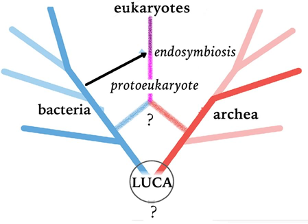 do not have direct evidence, just informed guesses. What is now clear, however, is that the formation of eukaryotes involved a symbiotic event in which a α-proteobacterium (a type of bacteria) was engulfed by a proto-, pre-nuclear eukaryote (→).[75] This “endogenous bacterium” was not digested (and destroyed) but became the eukaryotic mitochondrion. Essentially all eukaryotes (the protozoa, fungi, animals, and plants) have mitochondria, descended from this event. Later on in the history of life, a second endosymbiotic event occurred in which a mitochondria-containing eukaryote engulfed but did not digest a second type of bacteria, a photosynthetic cyanobacterium-like organism, leading to the algae and the plants.
The first "life-derived pollutant" molecular oxygen
While the earliest organisms likely used energy released in the course of thermodynamically favorable chemical reactions to maintain their structural integrity and to grow, relatively soon bacterial-type organisms appeared that could capture the energy in light and use it to drive various thermodynamically unfavorable chemical reactions. A major class of such reactions involves combining CO2 (carbon dioxide), H2O (water), and other small molecules to form carbohydrates (sugars) and biologically important molecules, such as lipids, amino acids, and nucleotides (from which proteins, and nucleic acids are built). At some point light-eating organisms began to release molecular oxygen (O2), a waste product of the oxygenic photosynthesis process. These oxygen-releasing organisms became so numerous that they began to change Earth’s surface chemistry - they represent the first life-driven ecological catastrophe or opportunity, depending on your perspective.
The level of O2 in the atmosphere represents a balance between its production, primarily through oxygenic photosynthesis, and its bre akdown through various chemical reactions. As O2 first appeared, it reacted with iron to form deposits of water-insoluble Fe(III) oxide (Fe2O3) – that is, rust. This rust reaction removed large amounts of O2 from the atmosphere, keeping levels of free O2 low for a long time (↓). The rusting of iron in the oceans is thought to be responsible for the massive banded iron
 deposits found around the world.[76] O2 also reacts with organic matter, as in the burning of wood. When large amounts of organic matter are buried before they can react with O2, as occurs with the formation of coal, more O2 accumulates in the atmosphere. Although O2 was probably being generated and released earlier, by ~2 billion years ago, atmospheric O2 had appeared in detectable amounts and by ~850 million years ago O2 had risen to significant levels (←). Atmospheric O2 levels have changed significantly over time since then, based on the relative rates of its synthesis and breakdown. Around ~300 million years ago, atmospheric O2 levels reached ~35%, almost twice the current level. It has been suggested that these high levels of atmospheric O2 made the evolution of giant insects possible.[77]
Although we tend to think of O2 as a natural and benign substance, it is in fact highly reactive and potentially toxic; its production and accumulation posed serious challenges and unique opportunities to organisms. O2 can be “detoxified” through reactions that lead to the formation of water; this type of thermodynamically favorable reaction has been co-opted for a wide range of biological purposes. For example, through coupled reactions O2 can be used to capture the maximum amount of energy from the breakdown of complex molecules (food), leading to the generation of CO2 and H2O, both of which are stable.
Around the time that O2 levels were first rising, that is ~109 years ago, the first trace fossil burrows appeared in the fossil record. These were likely to have been produced by simple worm-like, macroscopic (that is, large enough to see without magnification) multicellular organisms. These were animals capable of moving along and through the mud on the ocean floor. Around a billion years ago, new and more complex structural fossils (←) began to appear.[78] The first of these are the Ediacaran organisms, named after the geological formation in which their fossils were first found.[79] Current hypotheses suggest they were immotile, like modern sponges but flatter; it remains unclear how or if they are related to later animals.
Since the fossil record does not contain all organisms, we are left to speculate on what earlier metazoans looked like. By the beginning of the Cambrian age (~545 x 106 years ago), a wide variety of organisms had appeared in the fossil record, many clearly related to modern animals. Molecular level data suggests that their ancestors originated more than ~30 million years earlier. These Cambrian organisms show a range of body types. Most significantly, many were armored. Building armor involves capturing and expending the energy needed to synthesize these structures. The presence of armor suggests the presence of predators, and a need for a defensive response.
This page titled 2.10: Life's impact on earth was last modified on Thu, 08 Jan 2026 23:33:40 GMT and is shared under a CC BY-NC-SA 4.0 license and was authored, remixed, and/or curated by Michael W. Klymkowsky and Melanie M. Cooper.
The book could not be loaded just now.