Opening the book…
How do we know that evolution has occurred?
The evidence for evolution is compelling and extensive. Looking at every level of organization in living systems, biologists see the signature of past and present evolution. Darwin dedicated a large portion of his book, On the Origin of Species, identifying patterns in nature that were consistent with evolution and since Darwin our understanding has become clearer and broader.
Evidence from Fossils
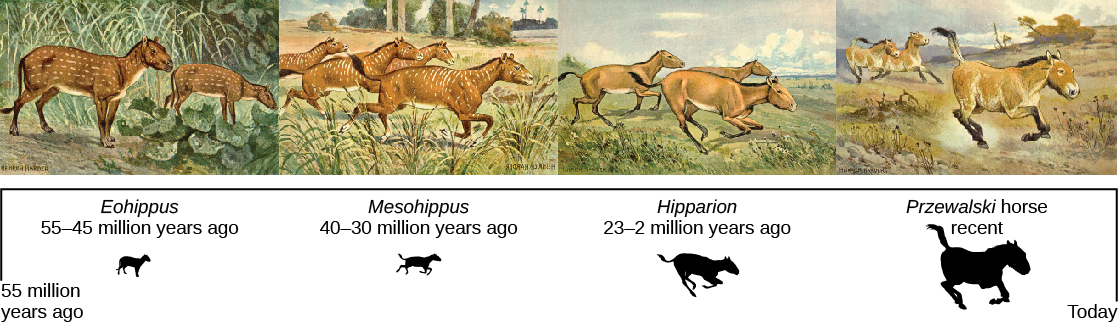
Fossils provide evidence that organisms living today are different from those that lived in the past. Scientists use fossils to reconstruct Earth's biological history and observe how species have changed over time. Some fossils show intermediate forms between ancestral and modern organisms.
For example, the fossil record of horses documents gradual changes in body size, teeth, and leg structure as environments shifted from forests to grasslands (figure \(\PageIndex{a}\)). Fossils provide strong evidence that populations change over time and adapt to changing environmental conditions.
Evidence from Comparative Anatomy
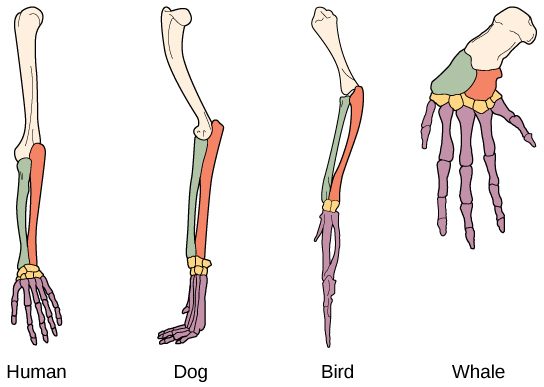
Many organisms share similar anatomical structures because they inherited them from a common ancestor. For example, the bones in the forelimbs of humans, whales, bats, and dogs have the same basic arrangement even though they perform different functions (Figure \(\PageIndex{b}\)).
These shared structures are called homologous structures and provide evidence of common ancestry. Some organisms also possess vestigial structures, which are inherited features that have lost most or all of their original function.
Examples include:
- Pelvic bones in whales
- Small leg bones in some snakes
- Wings of flightless birds
These structures suggest that modern species evolved from ancestral species with different characteristics.
Evidence from Biogeography
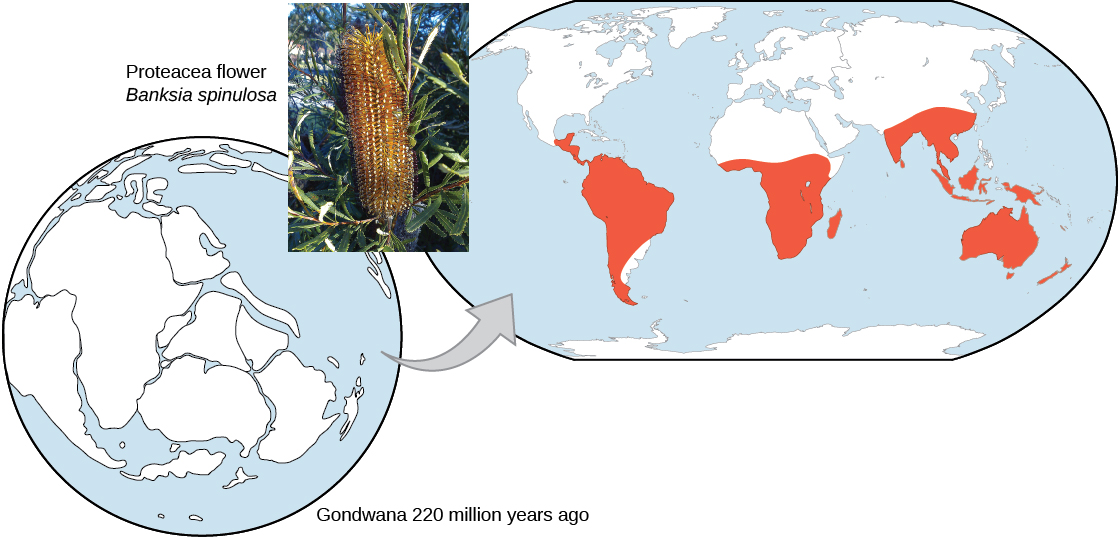
The geographic distribution of species (biogeography) provides evidence for evolution. Island species are often closely related to species on nearby continents but have evolved unique adaptations after becoming isolated (figure \(\PageIndex{c}\)).
Examples include:
- Galápagos finches
- Hawaiian honeycreepers
- Australian marsupials
- Proteacea plant family
These patterns suggest that populations change over time as they adapt to different environments.
Evidence from DNA
All living organisms use DNA to store genetic information. When scientists compare DNA sequences, closely related species have more similar DNA than distantly related species. These patterns support the idea that modern species share common ancestors and have diversified through evolution.
Attributions
Modified by Erin Rempala.
Samantha Fowler (Clayton State University), Rebecca Roush (Sandhills Community College), James Wise (Hampton University). Original content by OpenStax (CC BY 4.0; Access for free at https://cnx.org/contents/b3c1e1d2-83...4-e119a8aafbdd).
This page titled 4.3: Evidence for Evolution was last modified on Mon, 27 Jul 2026 19:56:15 GMT and is shared under a CC BY-NC-SA 4.0 license and was authored, remixed, and/or curated by OpenStax.
The book could not be loaded just now.