Opening the book…
Other Sources of Evolutionary Change
Natural selection is the primary mechanism discussed in this chapter, but populations can also change through other evolutionary processes.
Mutation
A mutation is a change in DNA. Mutations create new genetic variation within populations and are the ultimate source of new inherited traits.
Most mutations have little or no effect on an organism. Some are harmful, while others may be beneficial under certain environmental conditions.
Without mutation, new genetic variation would not arise, and natural selection would have less variation to act upon.
Genetic Drift
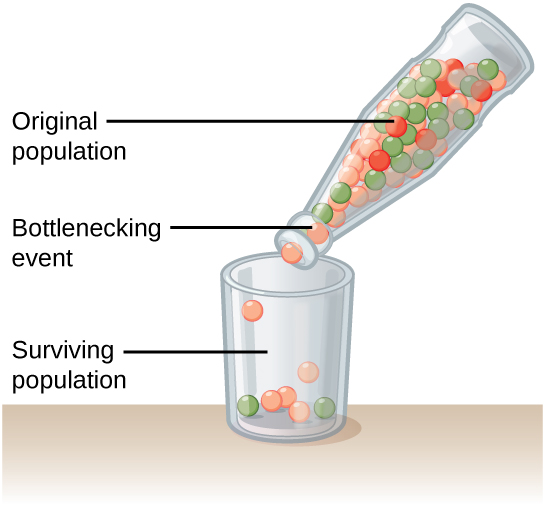
Genetic drift is a random change in the genetic makeup of a population caused by chance events (figure \(\PageIndex{a}\). Genetic drift has the greatest effect in small populations. For example, a wildfire, flood, or disease outbreak may randomly eliminate individuals regardless of their traits. As a result, some genetic variation may be lost simply by chance.
Small populations often have lower genetic diversity and may be more vulnerable to environmental change. This is one reason conservation biologists are concerned about endangered species with small populations.
Gene Flow
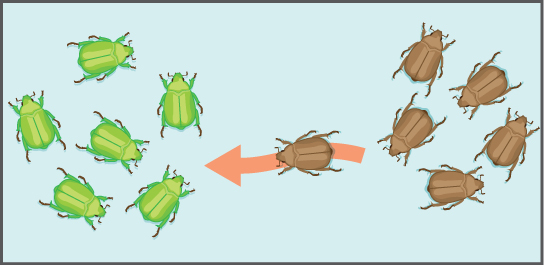
Gene flow occurs when individuals move into or out of a population and bring their genes with them (figure \(\PageIndex{b}\)). For example, seeds may be dispersed by wind, animals may migrate between habitats, or pollen may be carried long distances. Gene flow can increase genetic diversity and introduce new traits into a population.
Summary
Natural selection is not the only process that causes populations to change over time. Mutation introduces new genetic variation, genetic drift changes populations through chance events, and gene flow moves genetic variation between populations.
Together with natural selection, these processes influence how populations respond to environmental change.
Attributions
Modified by Erin Rempala.
Samantha Fowler (Clayton State University), Rebecca Roush (Sandhills Community College), James Wise (Hampton University). Original content by OpenStax (CC BY 4.0; Access for free at https://cnx.org/contents/b3c1e1d2-83...4-e119a8aafbdd).
This page titled 4.2: Other Mechanisms of Evolution was last modified on Mon, 27 Jul 2026 19:49:29 GMT and is shared under a CC BY-NC-SA 4.0 license and was authored, remixed, and/or curated by OpenStax.
The book could not be loaded just now.