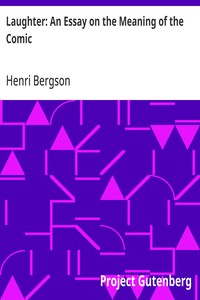
Laughter: An Essay on the Meaning of the Comic
Translated by Cloudesley Brereton · Translated by Fred Rothwell
"Laughter: An Essay on the Meaning of the Comic" by Henri Bergson is a collection of three essays first published in 1900. This groundbreaking philosophical work explores why humans laugh and what makes things funny. Bergson examines laughter as a distinctly human and social phenomenon, arguing that comedy arises from rigidity interrupting life's natural flexibility. He investigates how laughter serves as a moral corrective, forcing people to recognize their vices and conform to social norms. Through analyzing comic situations, movements, and characters, Bergson develops a scientific method for understanding the laws governing humor.
Summary written by Project Gutenberg, by machine.
- Language
- English
- On Project Gutenberg since
- 1 August 2003
- Read in the last 30 days
- 3,196 times at Project Gutenberg
More by Henri Bergson
See all: More by Henri Bergson



More from the shelf “Philosophy”
See all: More from the shelf “Philosophy”
The Prince

Second Treatise of Government
Thus Spake Zarathustra: A Book for All and None
Beyond Good and Evil

The Republic

On Liberty

Apology
The Nicomachean ethics of Aristotle

The Problems of Philosophy

The Critique of Pure Reason

The Communist Manifesto

The Poetics of Aristotle

Ethics

Discourse on the Method of Rightly Conducting One's Reason and of Seeking Truth in the Sciences

Democracy and Education: An Introduction to the Philosophy of Education

Utilitarianism
An Enquiry Concerning Human Understanding

Tractatus Logico-Philosophicus
A System of Logic, Ratiocinative and Inductive