Window mode follows your eyes with your camera, in this browser only: no picture or position leaves your device.
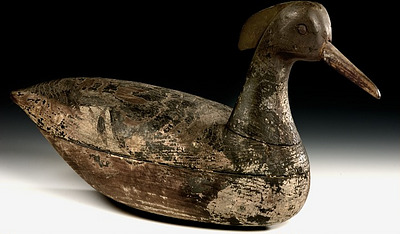
Prairie Chicken
Edward Kemeys (born Savannah, GA 1843-died Washington, DC 1907)
ca. 1870s
- Medium
- bronze
- Classification
- Sculpture
- Dimensions
- 15 1/2 x 8 x 8 in.
- Museum
- Smithsonian Institution, Smithsonian American Art Museum, Painting and Sculpture
- Credit line
- Smithsonian American Art Museum, Gift of Charlotte J. Patterson and Herbert L. Patterson in memory of Elizabeth Z. Patterson
- Rights
- CC0 (Smithsonian Open Access), as the museum states it.
- Who can see it
- Little Ones profiles and older: it shows gentle subjects for the very young. How works are placed
View at the Smithsonian Institution
About this work
In the 1860s and 1870s, prairie chicken leks, or breeding grounds, were a common sight across the Midwest. As more settlers moved westward, however, farmers converted tall-grass prairie to cropland. Edward Kemeys's sculpting career began just before prairie chicken populations shrank from habitat loss. Here he preserves and celebrates the male of the species by accurately depicting the bird's form, paying particular attention to the characteristic eyebrow texture and long pointed neck feathers, called pinnae. Kemeys also took care when modeling the bird's posture. The angled pinnae show this male poised for display or attack.