Window mode follows your eyes with your camera, in this browser only: no picture or position leaves your device.
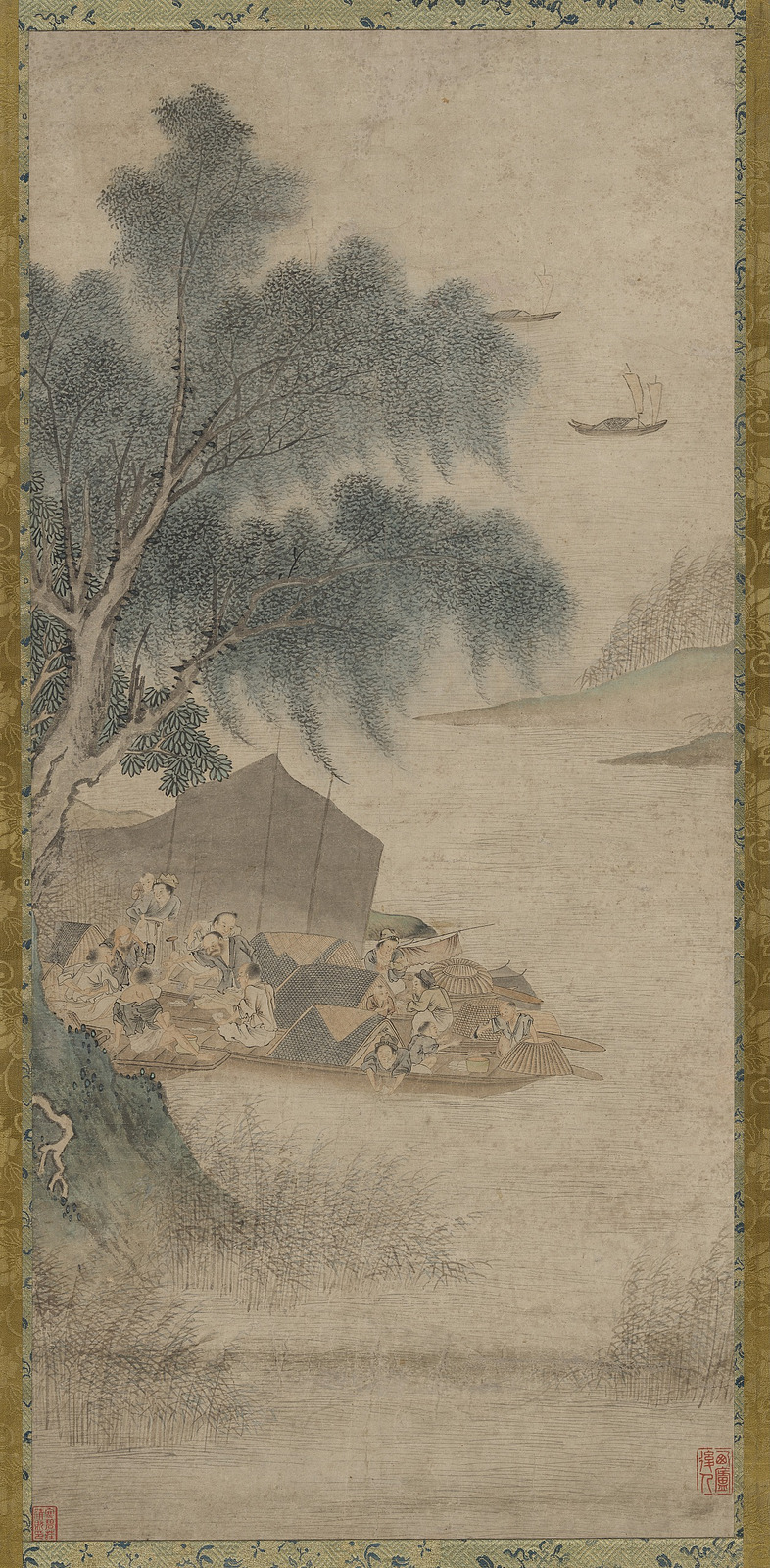
Fisher folk moored under trees
Formerly attributed to Liu Songnian (傳)劉松年 (ca. 1150-after 1225)
16th-17th century
- Medium
- Ink and color on paper
- Classification
- Paintings
- Dimensions
- H x W (image): 101.9 x 47.6 cm (40 1/8 x 18 3/4 in)
- Culture
- Chinese
- Museum
- Smithsonian Institution, National Museum of Asian Art
- Credit line
- Gift of Charles Lang Freer
- Rights
- CC0 (Smithsonian Open Access), as the museum states it.
- Who can see it
- Tweens profiles and older: its subjects are known and suit older children. How works are placed
View at the Smithsonian Institution
About this work
While scenes of everyday family life are rare in Chinese painting, the families of ordinary fishermen are frequently shown both at work and leisure. Generally depicted leading a healthy, carefree existence with the bounty of nature at their feet, fishing families came to symbolize the welfare enjoyed by society under the aegis of an enlightened ruler. Starting in the Southern Song dynasty (1127-1279), such depictions became a subgenre of their own, known as "the joys of fishermen." In this typical example, several families moor closely together by a riverbank behind a screen of drying nets. With the day's work done, the men are drinking and relaxing. One man conceals something behind his back, as the fellow opposite stretches out his hand, wishing to see it. Three of the women attend young children, while a fourth washes a cup over the side of a boat. Nearby, two older children take fish from a large bamboo basket and drop them into a pot.