Window mode follows your eyes with your camera, in this browser only: no picture or position leaves your device.
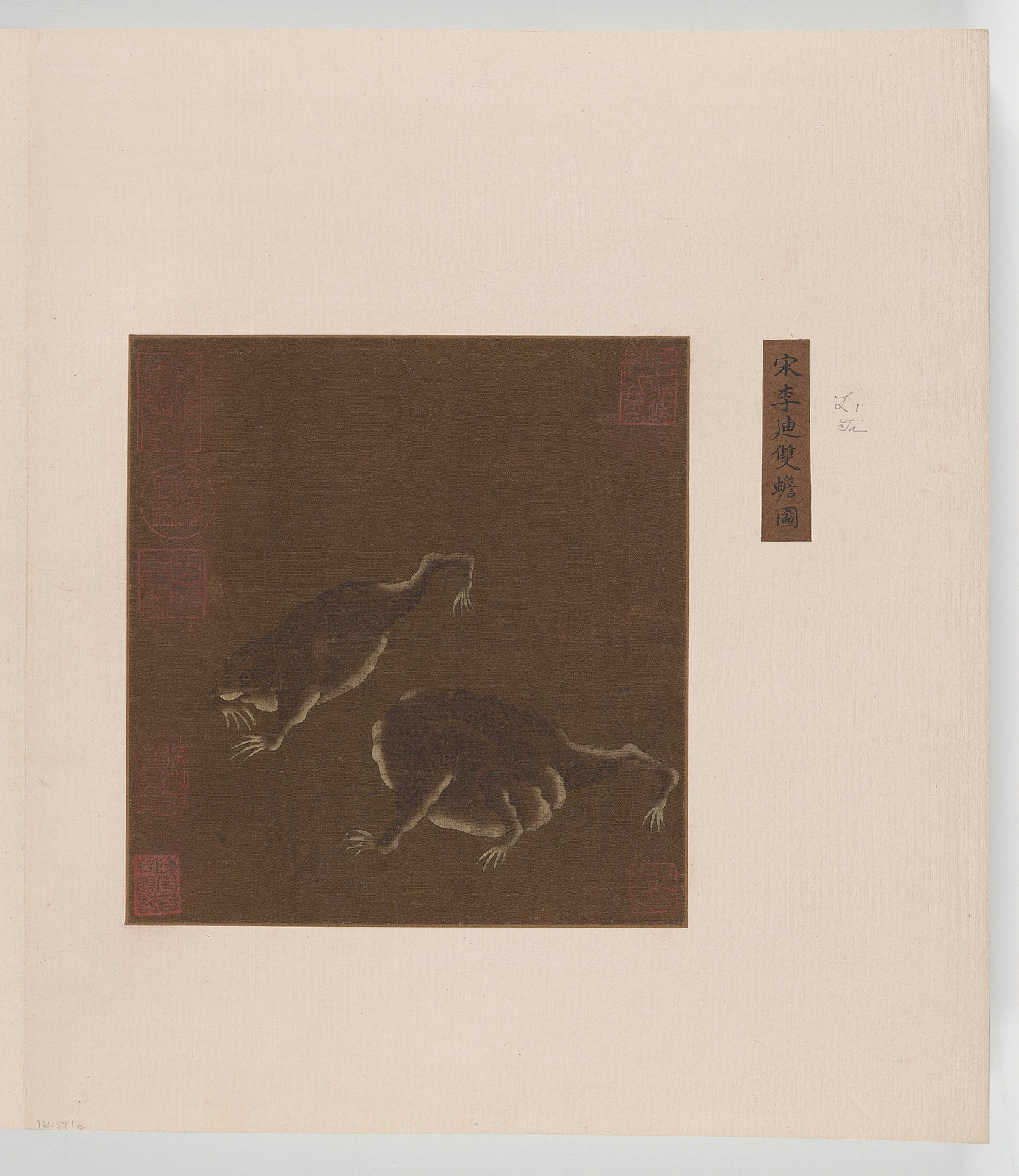
A pair of three-legged toads
Formerly attributed to Li Di (active late 12th-early 13th century)
1368-1644
- Medium
- Ink and color on silk
- Classification
- Paintings
- Dimensions
- H x W: 21.1 x 20.1 cm (8 5/16 x 7 15/16 in)
- Culture
- Chinese
- Museum
- Smithsonian Institution, National Museum of Asian Art
- Credit line
- Gift of Charles Lang Freer
- Rights
- CC0 (Smithsonian Open Access), as the museum states it.
- Who can see it
- Little Ones profiles and older: it shows gentle subjects for the very young. How works are placed
View at the Smithsonian Institution
About this work
The magic toad, which represents the “essence” (zhenjing) in internal elixir (neidan) practices, was believed to appear whenever Daoist immortal Liu swung a string of coins. The coins signify Liu’s enlightenment by an immortal who stacked ten eggs on one coin by way of alluding to the precariousness of human existence. In the late Qing period (1644– 1911), a three-legged toad was also used to pray for beneficial rain.