Window mode follows your eyes with your camera, in this browser only: no picture or position leaves your device.
Ryogoku Bridge
early 19th century
- Medium
- Ink and color on silk
- Classification
- Paintings
- Dimensions
- H x W (image): 72.6 × 186 cm (28 9/16 × 73 1/4 in)
- Culture
- Japanese
- Museum
- Smithsonian Institution, National Museum of Asian Art
- Credit line
- Gift of Charles Lang Freer
- Rights
- CC0 (Smithsonian Open Access), as the museum states it.
- Who can see it
- Little Ones profiles and older: it shows gentle subjects for the very young. How works are placed
View at the Smithsonian Institution
About this work
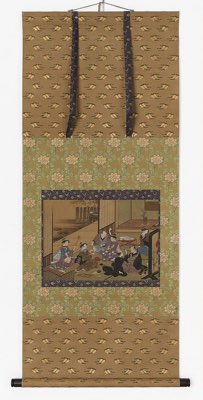
Spanning the broad Sumida River, the Ryogoku Bridge was a popular site for entertainment in Edo (modern Tokyo). In this detailed panoramic view, the artist Toyoharu focuses on activities along the west bank of the river, where people representing many classes of society and whose status is distinguished by their dress, stroll to and from the bridge along a roadway lined with shops. Pleasure boats make their way beneath the bridge. The pagoda and roof of the Sensoji, a temple in Asakusa dedicated to the Buddhist deity Kannon, appears in the distance to the left of the bridge. Although space is compressed in this view, the artist endeavored to render a contemporary scene with realism and accuracy. He employs some of the principles of perspective found in European art that had begun to interest Japanese artists beginning in the eighteenth century.