Window mode follows your eyes with your camera, in this browser only: no picture or position leaves your device.
Shawl
ca. 1800
- Medium
- Medium: wool, cashmere Technique: tapestry weave, interlocking twill and embroidery Weave: single faced 2/2 twill tapestry, double interlocked, two color complimentary weave
- Classification
- Shawls
- Dimensions
- H x W: 147 x 144 cm (57 7/8 x 56 11/16 in.)
- Culture
- India
- Museum
- Smithsonian Institution, Cooper Hewitt, Smithsonian Design Museum
- Credit line
- Gift of Lea S. Luquer
- Rights
- CC0 (Smithsonian Open Access), as the museum states it.
- Who can see it
- Tweens profiles and older: its subjects are known and suit older children. How works are placed
View at the Smithsonian Institution
About this work
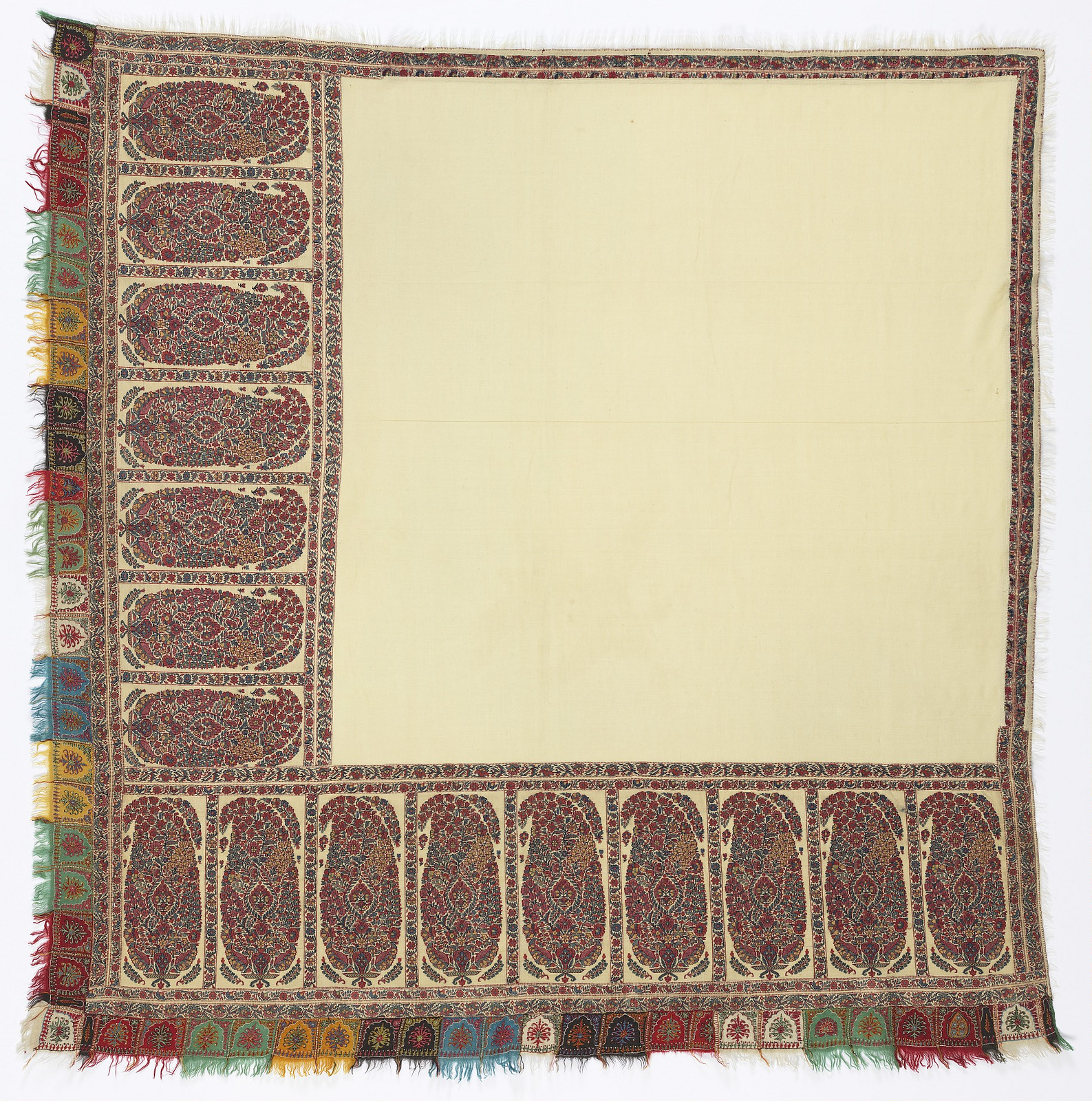
Square Kashmir shawl with a design of cones primarily in reds, with an open ivory field. Each cone is 10 1/2 inches high, and is compartmented by a narrow border of floral vines. Currently the shawl has wide borders on two adjacent sides and narrow borders on the two remaining sides. It has been re-made from fragments of a long shawl. Originally each end would have had a wide border nine cones in width: one side of the square version has the full nine cone pattern, the other has seven cones. The two remaining cones exist as a separate fragment (1958-148-5b). The narrow guard border of a similar floral vine has been stitched to the two remaining sides. In this way the shawl could be folded diagonally to form the triangular shawl popular in the mid-19th century.












