Window mode follows your eyes with your camera, in this browser only: no picture or position leaves your device.
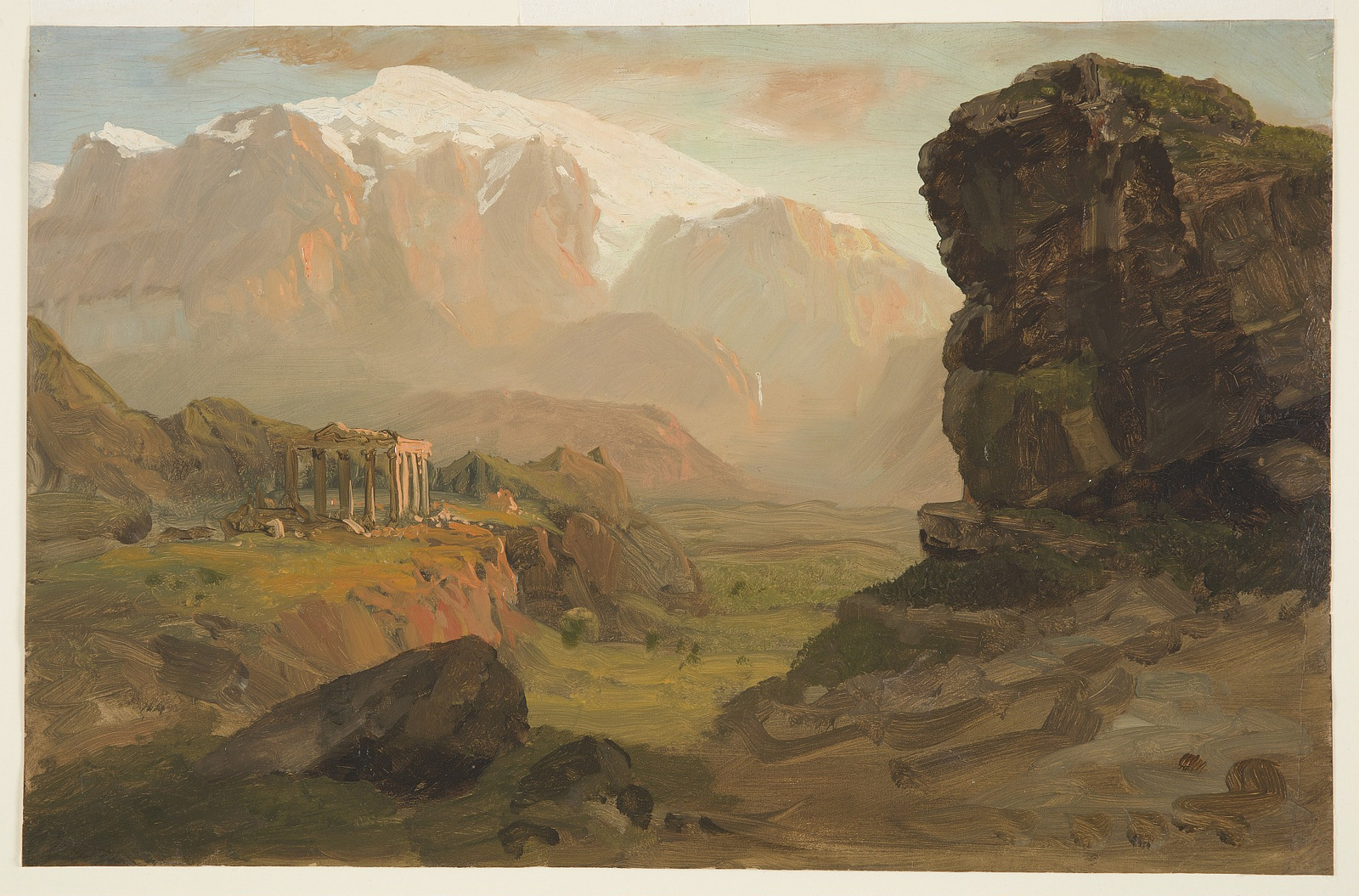
Imagined Landscape with Ruined Temple
Frederic Edwin Church (American, 1826–1900)
1868–69
- Medium
- Brush and oil on thin, tan paperboard
- Classification
- Drawings
- Dimensions
- 33 × 51 cm (13 × 20 1/16 in.)
- Culture
- Greece
- Museum
- Smithsonian Institution, Cooper Hewitt, Smithsonian Design Museum
- Credit line
- Gift of Louis P. Church
- Rights
- CC0 (Smithsonian Open Access), as the museum states it.
- Who can see it
- Little Ones profiles and older: it shows gentle subjects for the very young. How works are placed
View at the Smithsonian Institution
About this work
Landscape sketch showing an imagined view of an ancient, ruined temple on a plateau in an extremely rugged, mountainous landscape that is likely a composite view of scenery from Jordan, Syria, Lebanon, Greece, and the European Alps. In the foreground at right, a tall, dark, rough, and rocky outcropping frames the scene. Interestingly, the darker hue of brown pigment here was used by the artist to paint over an ancient temple facade with two-and-a-half columns. Its entablature (above) and stylobate (or base, below) are visible, having not been fully covered. The linear elements of the columns are still discernable beneath the paint. In the middle distance at left, a ruined temple with a four-column facade is situated upon a flat prominence or plateau. Its cliffside at center left is colored red and orange by the light of the setting sun. A lush, green, and narrow valley is visible at center that extends into the background, where a range of immense and towering mountains forms a high, undulating horizon. The tallest peak, at upper left, is snow-capped while its abrupt mountainsides also catch the sunset light. Above, rosy clouds hang in an otherwise blue-green sky.