Window mode follows your eyes with your camera, in this browser only: no picture or position leaves your device.
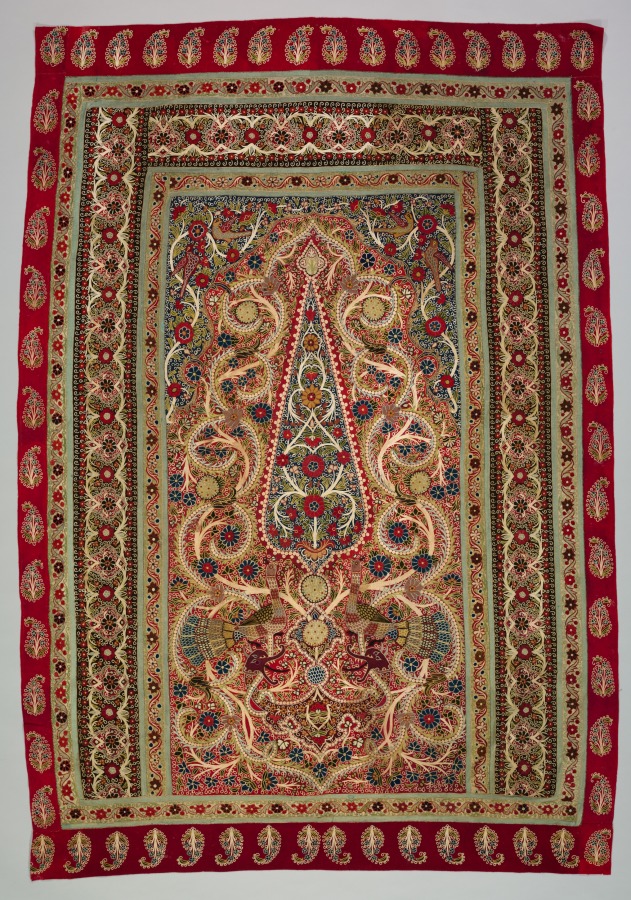
Tent Wall Panel(?)
1800s
- Medium
- Wool: inlaid work; silk: embroidery, chain stitch
- Classification
- Embroidery
- Dimensions
- Overall: 194.9 x 132.7 cm (76 3/4 x 52 1/4 in.)
- Culture
- Iran, Rasht, Qajar period (1779-1925)
- Museum
- Cleveland Museum of Art, Textiles
- Credit line
- Gift of Mr. and Mrs. J. H. Wade
- Rights
- Public domain (CC0), as the museum states it.
- Who can see it
- Teens profiles and older: its museum says too little about what it shows to place it for younger viewers. How works are placed
View at the Cleveland Museum of Art
About this work
Elaborate arched panels with multiple borders similar to this textile formed the mosaic-like interior walls of imperial tents. Here, the field is dominated by a richly decorated cypress tree above peacocks and dragon heads on an ornate foliate ground. We look upon the gardenscape through a niche (mihrab) formed by this foliage. Bright white silk “pearl” outlines, vines, and ringlets in chain-stitch embroidery enliven the pattern on contrasting colors of fulled wool. Internationally fashionable botehs, or paisleys, decorate the outer red borders.This technique has been referred to by many different names including: Rasht work, Resht work, Rashti-duzi, Rachti-douzi, embroidery applique, mosaic embroidery, piecework, patchwork, embroidery brocade, and inlaid patchwork. Many of these terms are to various degrees inaccurate descriptions of this technique. Perhaps the most practical term is Rasht work, named for the town in Iran where the technique was popularized. It begins as a ground of felted plain weave wool. Desired shapes are then punched out of the ground with a metal die and hammer. The same is done with wool of an alternating color. The edges of the different cut pieces are…