Window mode follows your eyes with your camera, in this browser only: no picture or position leaves your device.
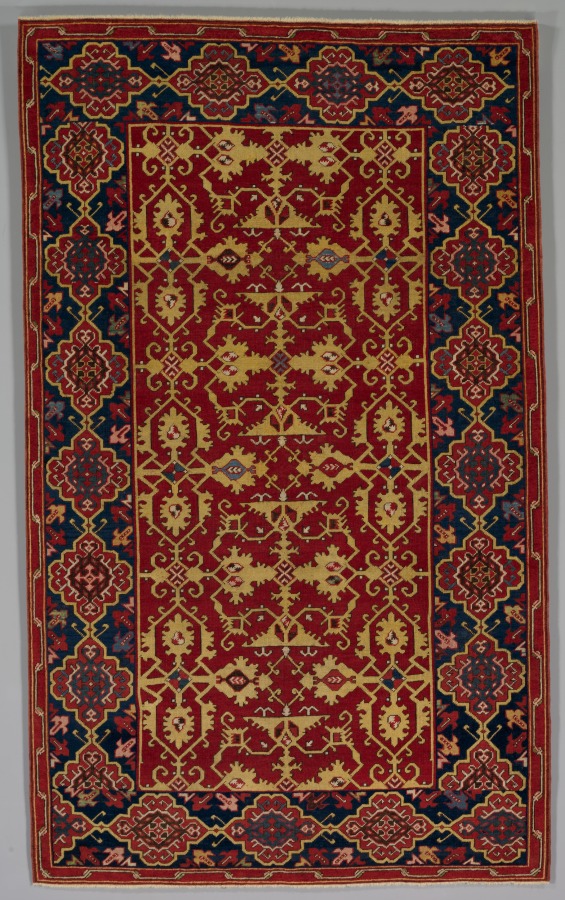
Classical Turkish Carpet with the Lotto Pattern
1600–1650
- Medium
- wool: symmetrical rug knot
- Classification
- Textile
- Dimensions
- Overall: 172.1 x 104.1 cm (67 3/4 x 41 in.)
- Culture
- Turkey, Ushak, Ottoman period
- Museum
- Cleveland Museum of Art, Textiles
- Credit line
- Purchase from the J. H. Wade Fund
- Rights
- Public domain (CC0), as the museum states it.
- Who can see it
- Little Ones profiles and older: it shows gentle subjects for the very young. How works are placed
View at the Cleveland Museum of Art
About this work
Lotto carpets have consistent color combinations and striking designs traceable to sources in Central Asia. In the central field, stylized yellow leaf patterns stand out against a red ground. The border is filled with cartouches on a dark blue background, and a simplified vine meanders along the outermost edge. In Islamic contexts, these vegetal patterns evoke paradise.
Made primarily for export in the western Turkish center of Ushak between the 1400s and 1600s, Lotto carpets were named after the Venetian painter Lorenzo Lotto (1480–1556), who amply documented in oil paintings the way Europeans displayed this type of Turkish carpet as a sign of wealth and prestige. To preserve them, Europeans displayed Lotto carpets on tables, though they were originally made for use on the floor.