Window mode follows your eyes with your camera, in this browser only: no picture or position leaves your device.
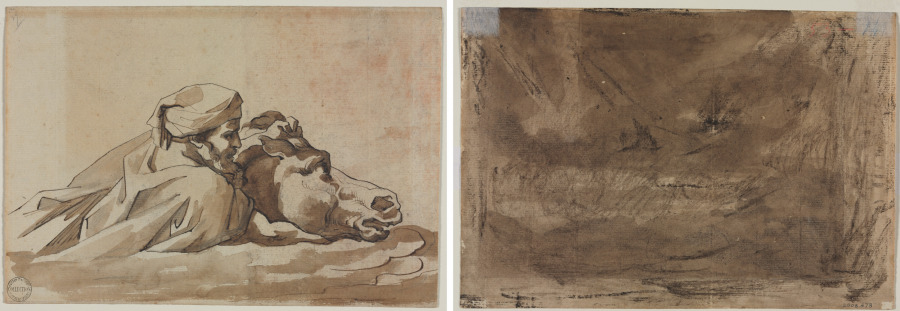
Man Clutching a Horse in Water, after Poussin's "Deluge" (recto); Compositional Study? (possibly for "Poussin's Deluge") (verso)
Théodore Géricault (French, 1791–1824)
after Nicolas Poussin (French, 1594–1665)
c. 1816
- Medium
- pen and brown ink and brush and brown wash over graphite
- Classification
- Drawing
- Dimensions
- Sheet: 18 x 26.2 cm (7 1/16 x 10 5/16 in.)
- Culture
- France
- Museum
- Cleveland Museum of Art, Drawings
- Credit line
- Bequest of Muriel Butkin
- Rights
- Public domain (CC0), as the museum states it.
- Who can see it
- Tweens profiles and older: its subjects are known and suit older children. How works are placed
View at the Cleveland Museum of Art
About this work
Géricault's drawing of a man clutching the mane of a horse as they struggle together to stay afloat is a direct copy of a detail from one of Nicolas Poussin's (1594-1665) most celebrated paintings, The Deluge, or Winter (see photo). Small in scale but monumental in feeling, the sheet exemplifies the artist's "antique manner" of drawing, which he began to develop around 1815. This style, with its heavy contour lines and broad washes, developed in tandem with Géricault's renewed interest in copying works of art from the past, such as prints after ancient sculpture and works by Raphael (1483-1520), Michelangelo (1475-1564), and Poussin.