Window mode follows your eyes with your camera, in this browser only: no picture or position leaves your device.
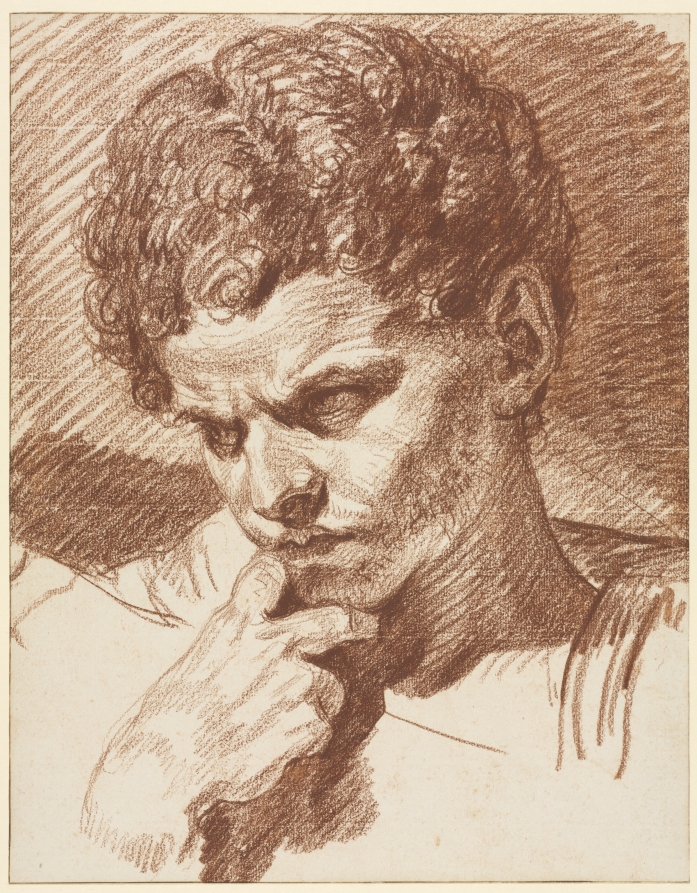
Head of Caracalla
Jean-Baptiste Greuze (French, 1725–1805)
c. 1768
- Medium
- Red chalk on cream laid paper
- Classification
- Drawing
- Dimensions
- Sheet: 38.8 x 30.3 cm (15 1/4 x 11 15/16 in.); Secondary Support: 45.6 x 37.1 cm (17 15/16 x 14 5/8 in.)
- Culture
- France
- Museum
- Cleveland Museum of Art, Drawings
- Credit line
- Purchase from the J. H. Wade Fund
- Rights
- Public domain (CC0), as the museum states it.
- Who can see it
- Tweens profiles and older: its subjects are known and suit older children. How works are placed
View at the Cleveland Museum of Art
About this work
As part of their training in the late 18th century, French artists practiced drawing têtes d'expression, or expressive heads, that display subtleties of human emotion. Greuze made this chalk study in preparation for a painting in which the Roman emperor Septimius Severus rebukes his notoriously ruthless son, Caracalla, for attempting to assassinate him. Although Greuze based this face for the figure of Caracalla on a Roman portrait bust, he imaginatively adapted the facial expression to dramatize Caracalla’s resentment and humiliation during the confrontation.