Window mode follows your eyes with your camera, in this browser only: no picture or position leaves your device.
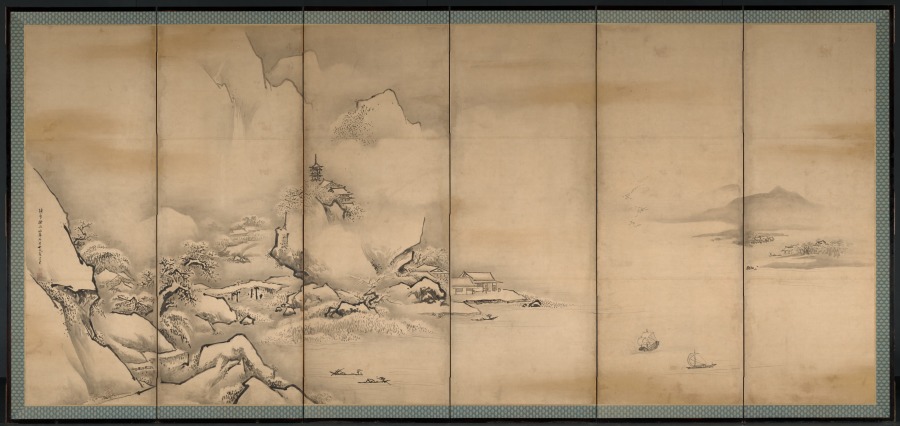
The Four Seasons
Kano Tan’yū (Japanese, 1602–1674)
1668
- Medium
- Six-panel folding screen, ink and slight color on paper
- Classification
- Painting
- Dimensions
- Image: 174 x 381 cm (68 1/2 x 150 in.)
- Culture
- Japan, Edo period (1615–1868)
- Museum
- Cleveland Museum of Art, Japanese Art
- Credit line
- Bequest of Maud Eells Corning
- Rights
- Public domain (CC0), as the museum states it.
- Who can see it
- Teens profiles and older: its museum says too little about what it shows to place it for younger viewers. How works are placed
View at the Cleveland Museum of Art
About this work
Tan'yū's skills were honed early within the regimen of the Kano family's painting studio. His grandfather, Eitoku (1543–1590) was the Momoyama period's most sought-after painter, a champion of colorful, large-scale painting compositions who worked for several of the country's most powerful leaders. When the young Tan'yū was summoned to Edo in 1617 by the shogun to become a member of the new capital's official painting studio, few opportunities to work on similarly ambitious projects existed. Yet by the end of his career, Tan'yū had supervised the execution and installation of linked mural painting compositions in several of Japan's most prestigious residences and castles. As an official court painter to the first shogun, Tokugawa Ieyasu (reigned 1603–5), and then his successors, Tan'yū appears to have successfully juggled his official duties with private activities as a teacher, as the era's leading connoisseur of classic Chinese and Japanese painting, and as a practicing artist. His surviving compositions as well as thousands of sketches far surpass the oeuvre of any of his contemporaries. While studio assistants surely contributed to his oeuvre, just as later imitators…