Window mode follows your eyes with your camera, in this browser only: no picture or position leaves your device.
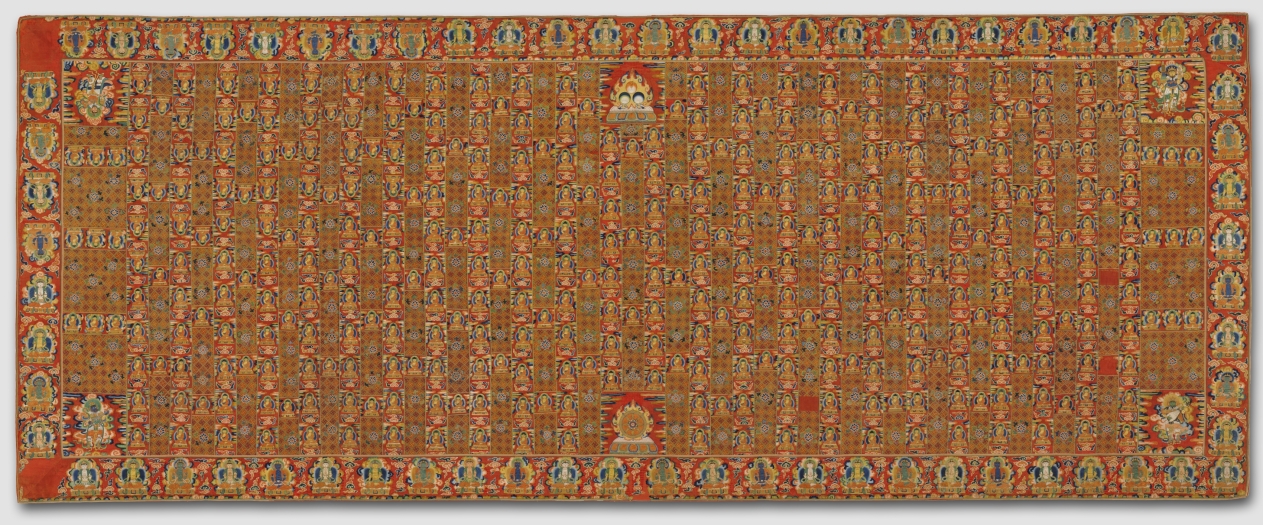
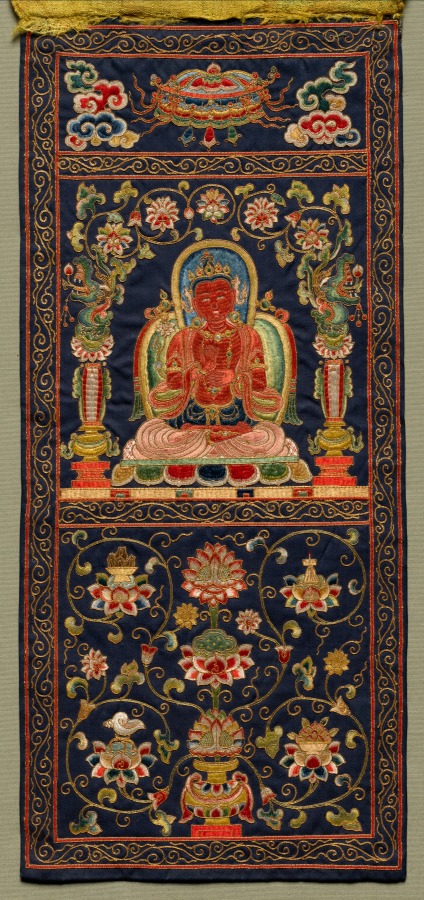
Thangka with the Seventh Bodhisattva
1368–1424
- Medium
- Silk and gold thread on silk satin ground, embroidery
- Classification
- Embroidery
- Dimensions
- Overall: 43.8 x 19.5 cm (17 1/4 x 7 11/16 in.); Mounted: 56.8 x 31.8 cm (22 3/8 x 12 1/2 in.)
- Culture
- China, Ming dynasty (1368–1644)
- Museum
- Cleveland Museum of Art, Textiles
- Credit line
- Purchase from the J. H. Wade Fund
- Rights
- Public domain (CC0), as the museum states it.
- Who can see it
- Tweens profiles and older: its subjects are known and suit older children. How works are placed
View at the Cleveland Museum of Art
About this work
In remarkably pristine condition, this embroidery is from a dispersed set that included images of protectors and bodhisattvas. The embroidery technique and pictorial style are Chinese, but the subject matter and the type of devotional hanging called a thangka are associated with Tibetan Buddhism. Historical records state that during the early Ming dynasty (1368–1644), gifts of Buddhist art were sent from China to Tibet, since relationships between Chinese rulers and Tibetan monastic patriarchs were strong and amicable during this time. A Tibetan inscription on the back notes that this figure is the “seventh bodhisattva,” indicating the position in which it would have hung in a temple hall. Odd-numbered works were hung on one side of the main image, and even-numbered works on the other, counting from the center.