Window mode follows your eyes with your camera, in this browser only: no picture or position leaves your device.
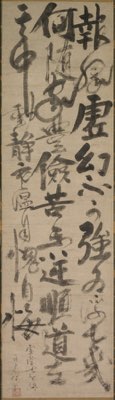
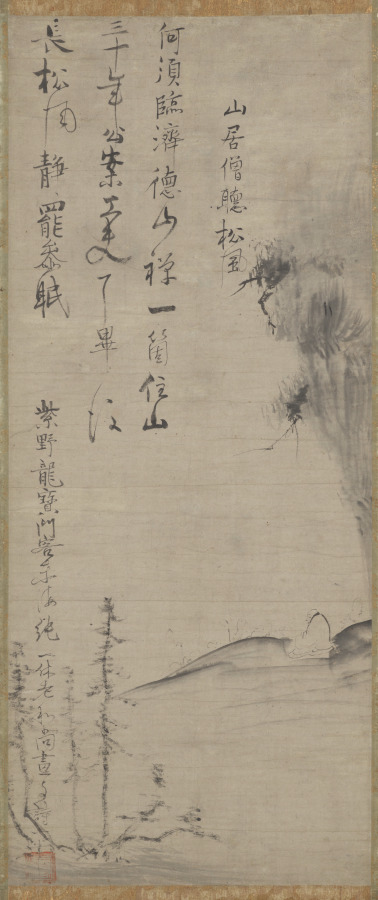
Listening to the Wind in the Pines
Ikkyū Sōjun (Japanese, 1394–1481)
1400s
- Medium
- hanging scroll; ink on paper
- Classification
- Painting
- Dimensions
- Painting only: 76.8 x 32 cm (30 1/4 x 12 5/8 in.); Including mounting: 153.7 x 38.1 cm (60 1/2 x 15 in.)
- Culture
- Japan, Muromachi period (1392–1573)
- Museum
- Cleveland Museum of Art, Japanese Art
- Credit line
- Mr. and Mrs. William H. Marlatt Fund
- Rights
- Public domain (CC0), as the museum states it.
- Who can see it
- Little Ones profiles and older: it shows gentle subjects for the very young. How works are placed
View at the Cleveland Museum of Art
About this work
A monk sits in contemplation below an overhang covered with pine. The poem, titled "Monk in the Mountains Listening to the Wind in the Pines," refers to two Chinese Chan (Zen) Buddhist monks active in the ninth century. It may be translated as follows:
Why must the Zen of Rinzai (Linji Yixuan) and Tokusan (Deshan Xuanjian) reside in a single temple for thirty years? Once he's solved his kōan, (the monk) ends his practice and falls asleep in the quietness of the wind among the tall pines. (translated by Osvaldo Mercuri)
According to an inscription following the poem, both painting and verse were done by an eminent Japanese Buddhist monk known for revitalizing the Kyoto temple Daitokuji.