Window mode follows your eyes with your camera, in this browser only: no picture or position leaves your device.
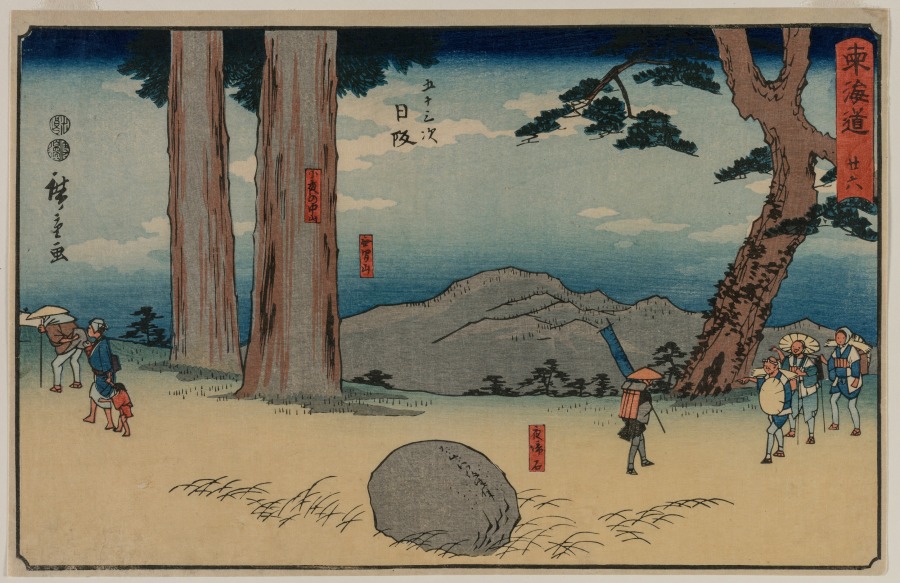
Nissaka: The Night-Weeping Stone at Sayo no Nakayama, from the series The Fifty-Three Stations of the Tōkaidō
Utagawa Hiroshige (Japanese, 1797–1858)
c. 1848–50
- Medium
- Color woodblock print
- Classification
- Dimensions
- Sheet: 22 x 34.7 cm (8 11/16 x 13 11/16 in.)
- Culture
- Japan, Edo period (1615–1868)
- Museum
- Cleveland Museum of Art, Japanese Art
- Credit line
- The Kelvin Smith Collection, given by Mrs. Kelvin Smith
- Rights
- Public domain (CC0), as the museum states it.
- Who can see it
- Kids profiles and older: it shows nature, places, still life or a children's book. How works are placed
View at the Cleveland Museum of Art
About this work
This print is an image of a mountain pass in Nissaka, one of the stops along the Tōkaidō, a road running from Kyoto to Edo (present-day Tokyo). This scene alludes to a legend in which bandits murdered a pregnant woman on that stretch of road, and her blood fell upon a stone. Shown in the foreground, the stone is said to contain the woman’s spirit, and so it weeps each night. In some versions of the story, the stone’s cry alerts a passing monk (really the disguised bodhisattva Kannon) to the presence of her infant, who survived the attack. The monk takes the child from the deceased mother’s body, and raises it as his own. The child goes on to avenge its mother.