Window mode follows your eyes with your camera, in this browser only: no picture or position leaves your device.
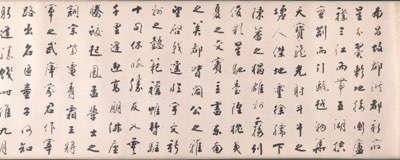
Sericulture (The Process of Making Silk)
attributed to Liang Kai (Chinese, mid-1100s–early 1200s)
early 1200s
- Medium
- Handscroll; ink and color on silk
- Classification
- Painting
- Dimensions
- First Section: 26.7 x 98.6 cm (10 1/2 x 38 13/16 in.); Second Section: 27.6 x 92.3 cm (10 7/8 x 36 5/16 in.); Third Section: 27.6 x 92.3 cm (10 7/8 x 36 5/16 in.)
- Culture
- China, Southern Song dynasty (1127-1279)
- Museum
- Cleveland Museum of Art, Chinese Art
- Credit line
- John L. Severance Collection
- Rights
- Public domain (CC0), as the museum states it.
- Who can see it
- Teens profiles and older: its museum says too little about what it shows to place it for younger viewers. How works are placed
View at the Cleveland Museum of Art
About this work
By the Southern Song period, the economic center of the silk industry had shifted to the lower Yangzi delta, while the north continued to be troubled by wars.
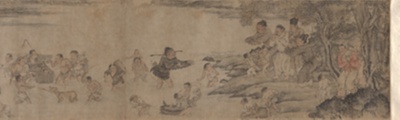
Divided into three sections, the handscroll illustrates 14 steps in the process of making silk, from the raising of silkworms to the weaving of silk cloth. The scroll’s scenes follow the illustrations of Lou Shou’s (1090–1162) Pictures of Tilling and Weaving (gengzhi tu), the first recorded painting of this genre, which was conceived in Hangzhou around 1145. However, in the Cleveland painting the artist groups several scenes of sericulture together under the roof of an open structure.