Window mode follows your eyes with your camera, in this browser only: no picture or position leaves your device.
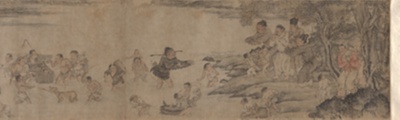
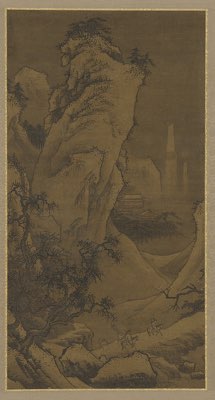
Water Buffalo and Herdboys
late 1200s–early 1300s
- Medium
- Hanging scroll; ink on silk
- Classification
- Painting
- Dimensions
- Painting: 23.7 x 50.5 cm (9 5/16 x 19 7/8 in.); Overall with knobs: 109 x 67.6 cm (42 15/16 x 26 5/8 in.)
- Culture
- China, Yuan dynasty (1271-1368)
- Museum
- Cleveland Museum of Art, Chinese Art
- Credit line
- Gift of Herbert F. Leisy in memory of his wife, Helen Stamp Leisy
- Rights
- Public domain (CC0), as the museum states it.
- Who can see it
- Teens profiles and older: its museum says too little about what it shows to place it for younger viewers. How works are placed
View at the Cleveland Museum of Art
About this work
In southern China, farmers use water buffalos to help plow their fields, which children often tend. In Buddhist teachings, the subject of herding or taming an ox was used to illustrate the 10 steps to enlightenment, or spiritual awakening. A single image may be read as a metaphorical representation of the Chan process of attaining enlightenment, the difficulty of which was likened to that of finding a strayed buffalo. Here, a buffalo is watered by a boy, another takes a bath in the pond. Chan paintings introduced to Japan were often remounted to fit them into niches for display (tokonoma), which explains the painting’s current format.