Window mode follows your eyes with your camera, in this browser only: no picture or position leaves your device.
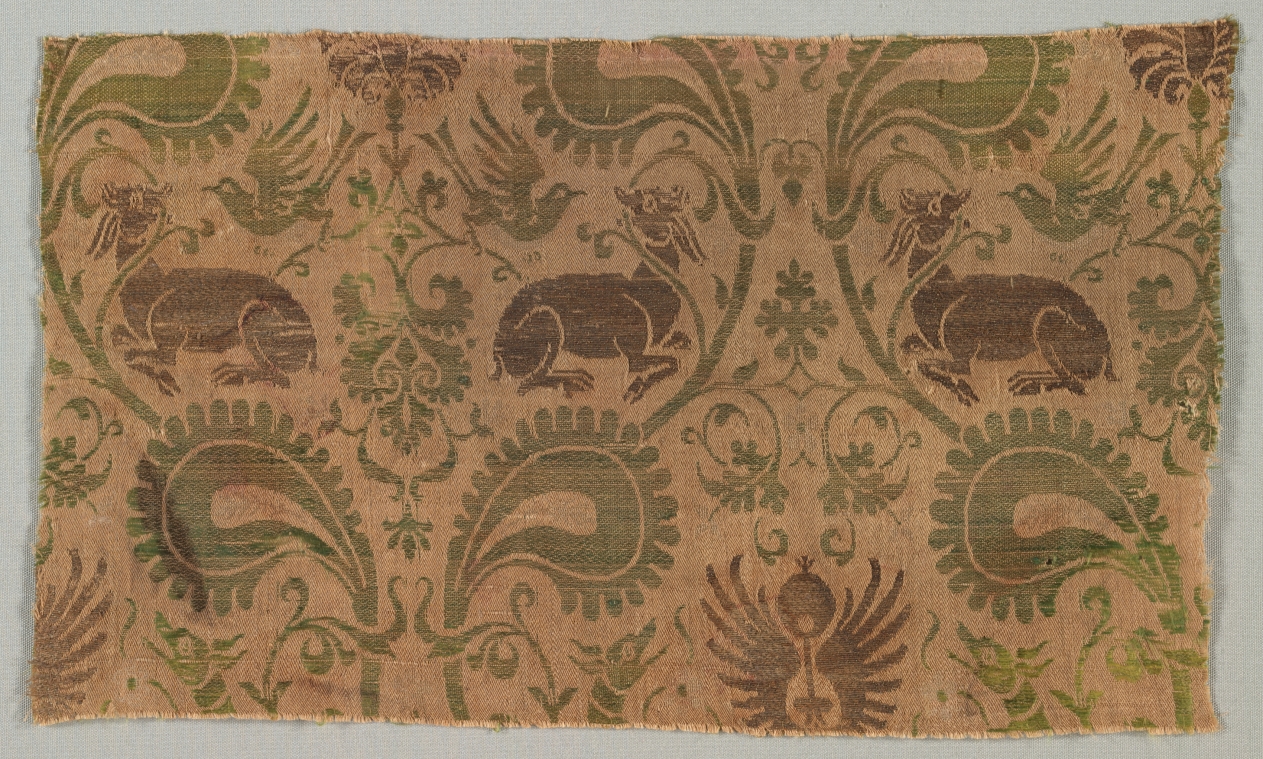
Silk with Dogs and Birds amid Vines
1350–1400
- Medium
- silk, gold thread; a combination of two weaves, 2/1 twill and plain weave (lampas)
- Classification
- Textile
- Dimensions
- Overall: 21 x 34.9 cm (8 1/4 x 13 3/4 in.); Mounted: 29.2 x 43.2 cm (11 1/2 x 17 in.)
- Culture
- Italy, second half of 14th century
- Museum
- Cleveland Museum of Art, Textiles
- Credit line
- Purchase from the J. H. Wade Fund
- Rights
- Public domain (CC0), as the museum states it.
- Who can see it
- Little Ones profiles and older: it shows gentle subjects for the very young. How works are placed
View at the Cleveland Museum of Art
About this work
Silks from China and the Islamic Near East introduced radically new designs with asymmetry and exotic animals around 1300, which Italian silk designers incorporated in an international style to compete with imports from the East. These large palmette leaves were adapted from Islamic silks whereas the recumbent deer, birds, and dogs (visible at the bottom) were popular Italian motifs. Textiles were lucrative commercial commodities during the Middle Ages. Intrepid Italian merchants traveled by land and sea to China, Mongolia, India, and the Islamic Near East, led by the maritime republics of Venice and Genoa. The renowned Venetian, Marco Polo, published his overland journey across Asia to China in 1265.