Window mode follows your eyes with your camera, in this browser only: no picture or position leaves your device.
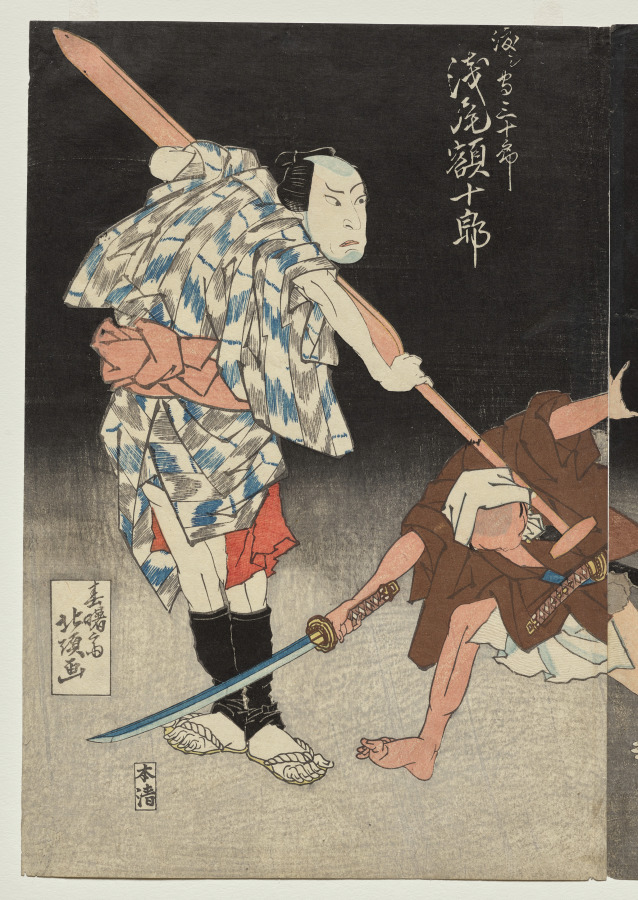
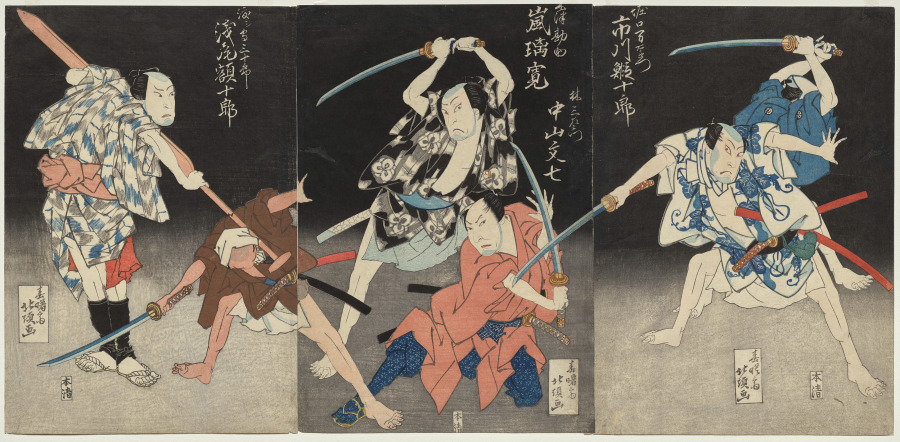
Ichikawa Ebijūrō II as Horiguchi Manzaemon (right), Arashi Rikan II as Kizu Kansuke, Nakayama Bunshichi III as Hayashi Sanzemon (center), and Asao Gakujurō as the Ferryman Sanjūrō (left) from the Kabuki Play "Eight Views of the Kizu River…
designer Shunshosai Hokuchō (Japanese, active 1822–1830)
1829
- Medium
- triptych of color woodblock prints
- Classification
- Dimensions
- Each: 36.2 x 76 cm (14 1/4 x 29 15/16 in.)
- Culture
- Japan, Edo period (1615–1868)
- Museum
- Cleveland Museum of Art, Japanese Art
- Credit line
- Edward L. Whittemore Fund
- Rights
- Public domain (CC0), as the museum states it.
- Who can see it
- Tweens profiles and older: its subjects are known and suit older children. How works are placed
View at the Cleveland Museum of Art
About this work
Three prints form a continuous scene from a Kabuki play written in 1778 by Namiki Gohei I (1747–1808) and produced at the Kado Theater in Osaka in the summer of 1829. It was the final performance for actor Ichikawa Ebijūrō II (1806–1829; right)—highly regarded for portraying villains—because he got sick and died several months later.
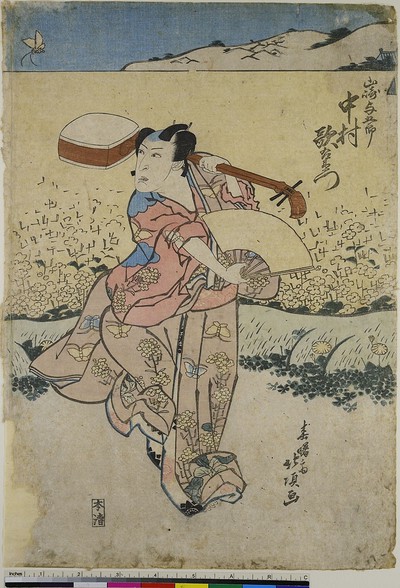
This design belongs to a category of Japanese prints called “actor images” (yakusha-e or 役者絵). They were collected by fans of popular Kabuki actors. Kabuki is a kind of entertainment that got its start in the early Edo period, evolving from dance performances with simple storylines to long plays with complex plots, elaborate sets, and full musical accompaniments. Performers wear showy costumes and heavy makeup and strike poses called mie at critical moments in the narrative. Dialogue is spoken in a stylized way that resembles singing.