Window mode follows your eyes with your camera, in this browser only: no picture or position leaves your device.
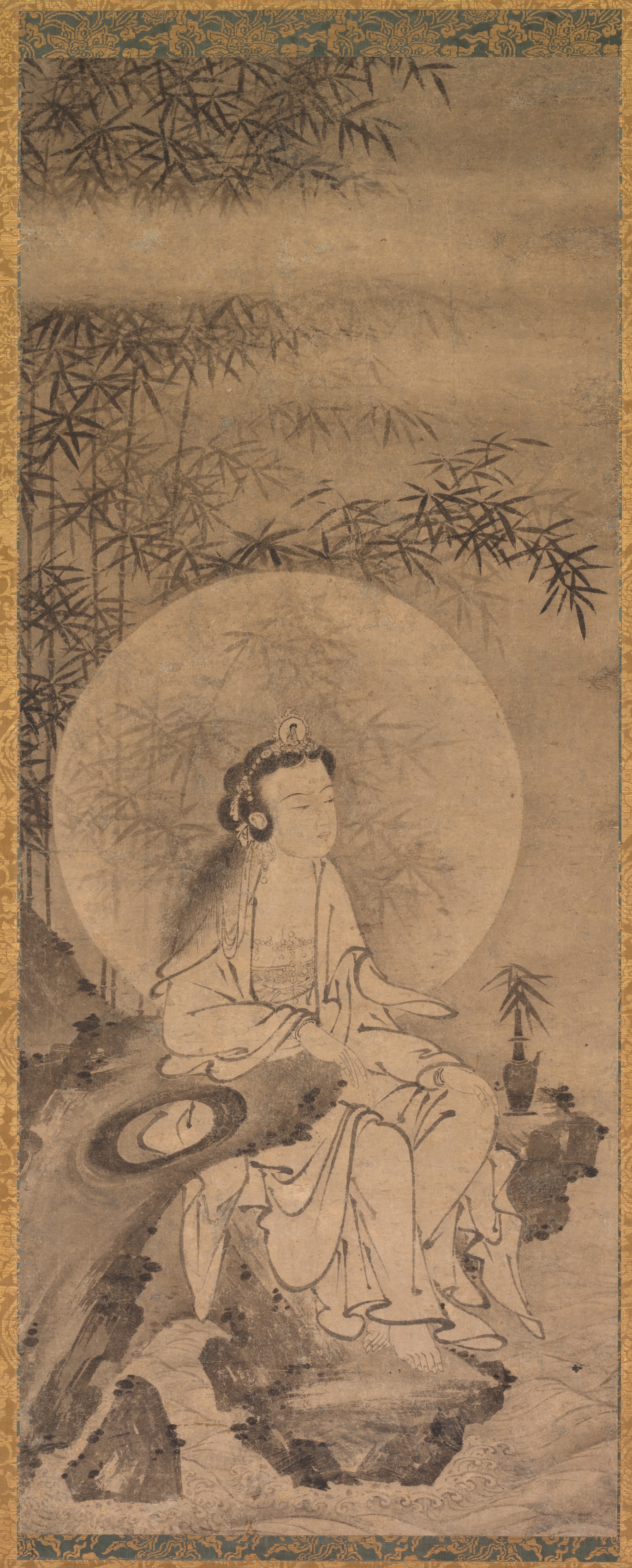
White-Robed Guanyin
attributed to Zhang Yuehu (Chinese, active 1200s)
late 1200s
- Medium
- Hanging scroll; ink on paper
- Classification
- Painting
- Dimensions
- Painting: 104.5 x 42.2 cm (41 1/8 x 16 5/8 in.); Overall with knobs: 195.4 x 61.8 cm (76 15/16 x 24 5/16 in.)
- Culture
- China, Southern Song dynasty (1127-1279)
- Museum
- Cleveland Museum of Art, Chinese Art
- Credit line
- Leonard C. Hanna Jr. Fund
- Rights
- Public domain (CC0), as the museum states it.
- Who can see it
- Teens profiles and older: its museum says too little about what it shows to place it for younger viewers. How works are placed
View at the Cleveland Museum of Art
About this work
The figure here sits on a rocky elevation representing Potalaka in the Southern Sea, Avalokitesvara’s island home. A vase with a bamboo sprig holds pure water, the nectar of life. Bamboo shines through the figure’s halo, a way of seeing the illusionary world through the Buddhist truth.
Avalokitesvara (Guanyin in Chinese), the bodhisattva of compassion, was integrated into the Chan Buddhist canon of venerated beings. In this context, the bodhisattva is often depicted in its female manifestation as the White-Robed Guanyin. The worship of the feminine White-Robed Guanyin has its origins on Mount Tianzhu in Hangzhou, where Qian Liu (852–932), ruler of the Wuyue kingdom, established the Upper Tianzhu Monastery to venerate her image.