Window mode follows your eyes with your camera, in this browser only: no picture or position leaves your device.
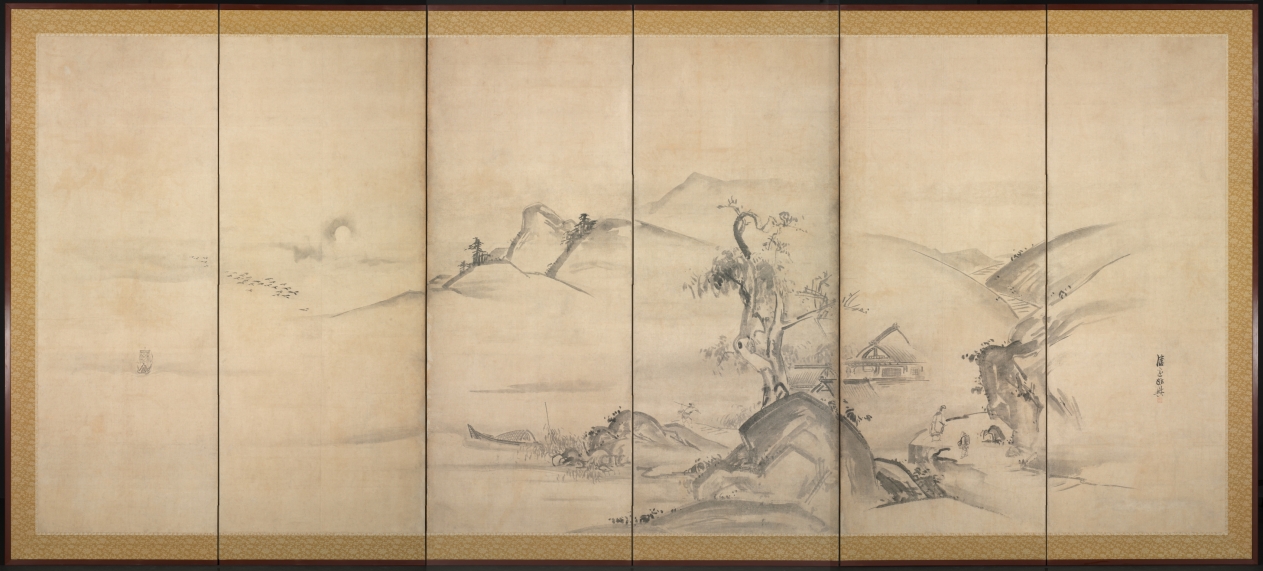
Eight Views of Xiao-Xiang
Watanabe Shikō (Japanese, 1683–1755)
early-mid 1700s
- Medium
- One of a pair of six-panel folding screens, ink on paper
- Classification
- Painting
- Dimensions
- Painting: 150 x 356 cm (59 1/16 x 140 3/16 in.); Mounted: 170 x 376 cm (66 15/16 x 148 1/16 in.)
- Culture
- Japan, Edo period (1615–1868)
- Museum
- Cleveland Museum of Art, Japanese Art
- Credit line
- Gift of N. V. Hammer
- Rights
- Public domain (CC0), as the museum states it.
- Who can see it
- Teens profiles and older: its museum says too little about what it shows to place it for younger viewers. How works are placed
View at the Cleveland Museum of Art
About this work
Watanabe Shiko, an Edo period painter who combined Kano school style with Rimpa style, re-created the Xiao and the Xiang rivers on a pair of eight-panel screens. For this composition, he followed the Kano school’s sense of space, adapted from miniature copying paintings (shukuzu) by the Japanese artist Kano Tanyu. Watanabe revised the typical representations of the Xiao and the Xiang rivers by rendering the theme Wild Geese Descending to Sandbar on the right screen and Evening Bell from Mist-Shrouded Temple on the left screen. He depicted simple motifs—moon, boat, geese, and temple—to suggest the other scenes while also creating airy space.