Window mode follows your eyes with your camera, in this browser only: no picture or position leaves your device.
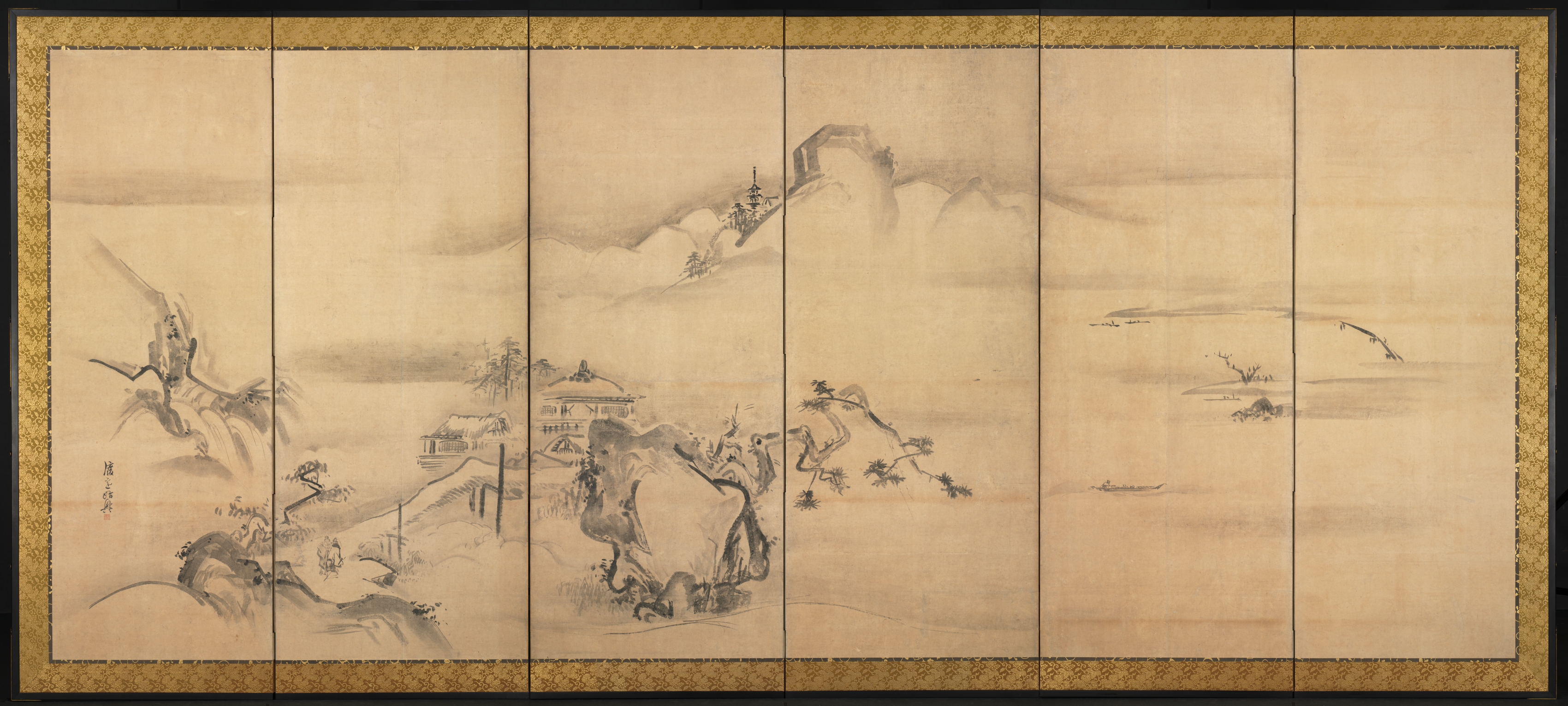
Eight Views of Xiao-Xiang
Watanabe Shikō (Japanese, 1683–1755)
early-mid 1700s
- Medium
- One of a pair of six-panel folding screens; ink on paper
- Classification
- Painting
- Dimensions
- Painting: 150 x 356 cm (59 1/16 x 140 3/16 in.); Mounted: 170 x 376 cm (66 15/16 x 148 1/16 in.)
- Culture
- Japan, Edo period (1615–1868)
- Museum
- Cleveland Museum of Art, Japanese Art
- Credit line
- Gift of Dr. and Mrs. Sherman E. Lee
- Rights
- Public domain (CC0), as the museum states it.
- Who can see it
- Teens profiles and older: its museum says too little about what it shows to place it for younger viewers. How works are placed
View at the Cleveland Museum of Art
About this work
Watanabe Shiko enjoyed a versatile and successful career, as well as a privileged upbringing, in Kyoto. His surviving work indicates a capacity to diligently study, master, and then interpret several painting techniques—each of which varies considerably in appearance. These byobu (folding screens), for instance, reflect training in the Kano school idiom that favored a monochromatic ink palette, vigorous brushwork, and traditional Chinese—rather than Japanese—subject matter. Shiko rendered this scenery in a particularly expansive manner, suggesting the vastness of China's topography relative to Japan's. Frequent visitors to the museum will recall that Shiko also painted the collection's favored pair of byobu, the Irises (CMA 1954.603).