Window mode follows your eyes with your camera, in this browser only: no picture or position leaves your device.
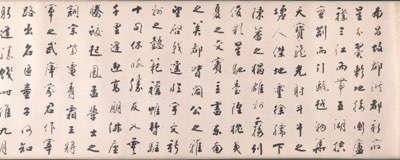
Mt. Taibo in the Style of Wang Meng
Du Qiong (Chinese, 1396–1474)
1442
- Medium
- handscroll; ink and light color on paper
- Classification
- Painting
- Dimensions
- Painting: 29.8 x 527.1 cm (11 3/4 x 207 1/2 in.); Overall: 30.6 x 976.7 cm (12 1/16 x 384 1/2 in.)
- Culture
- China, Ming dynasty (1368–1644)
- Museum
- Cleveland Museum of Art, Chinese Art
- Credit line
- John L. Severance Fund
- Rights
- Public domain (CC0), as the museum states it.
- Who can see it
- Teens profiles and older: its museum says too little about what it shows to place it for younger viewers. How works are placed
View at the Cleveland Museum of Art
About this work
When a Chinese painter "imitated" a painting by a past master, the intention was never to produce an exact copy. Du Qiong, the Ming painter from Suzhou, is a case in point. The painting style of this handscroll is actually closer to that of Huang Gongwang (1269–1354) than to the style of Wang Meng (about 1301–1385). Both masters were active during the previous dynasty and are among the so-called Four Great Masters of the Yuan dynasty (1279–1368). In this painting, the interplay of styles, including Du Qiong's own, contribute to an inner dimension that is more than visual. Mt. Taibo is located in the province of Zhejiang and is known for its scenic beauty. In this scroll, however, it is not depicted literally. The image is an ideal representation of mountains in southeastern China.