Window mode follows your eyes with your camera, in this browser only: no picture or position leaves your device.
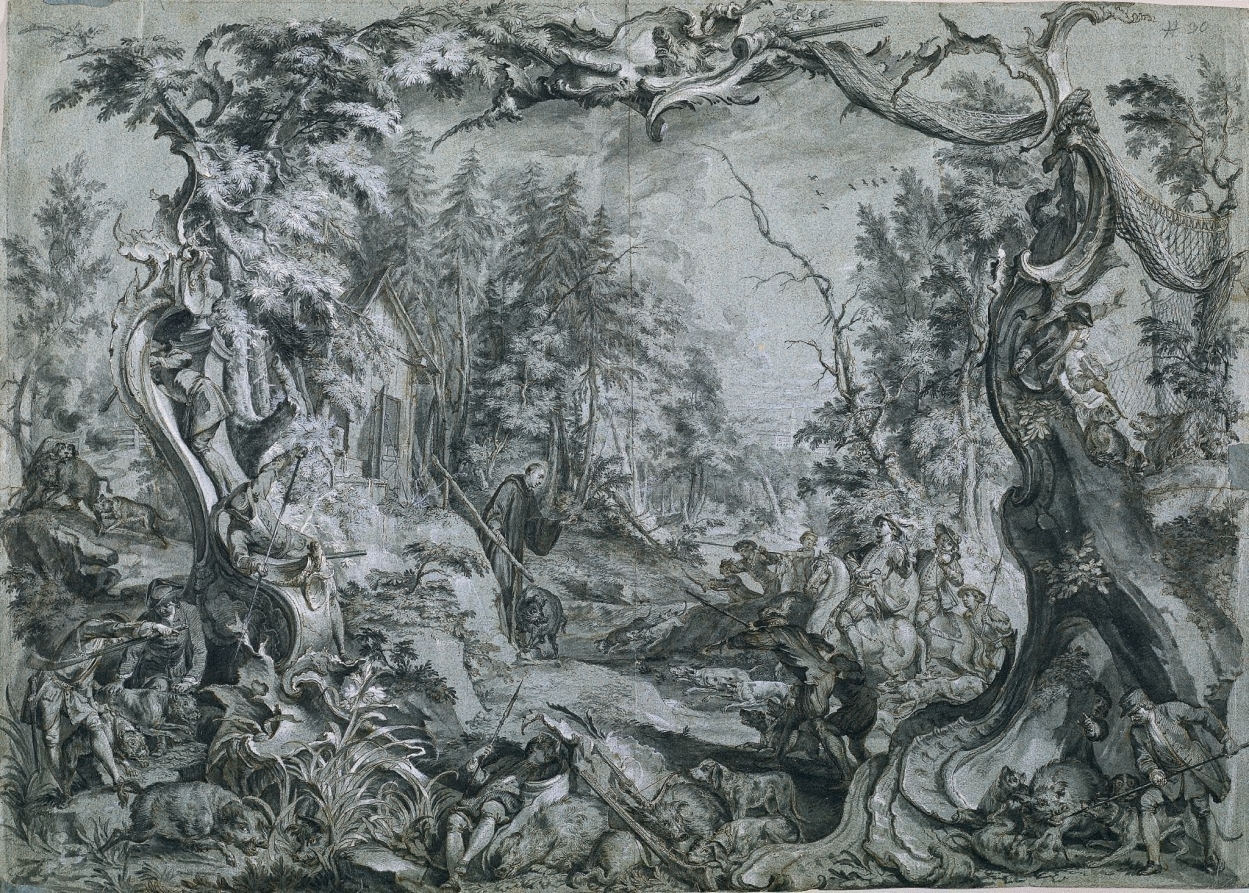
Saint Deicolus and the Boar
Johann Wolfgang Baumgartner (German, 1712–1761)
1747–48
- Medium
- pen and brown and gray inks and brush and gray wash heightened with white gouache; incised, verso coated with red chalk
- Classification
- Drawing
- Dimensions
- Sheet: 52.2 x 73.5 cm (20 9/16 x 28 15/16 in.)
- Culture
- Germany, 18th century
- Museum
- Cleveland Museum of Art, Drawings
- Credit line
- Dudley P. Allen Fund
- Rights
- Public domain (CC0), as the museum states it.
- Who can see it
- Tweens profiles and older: its subjects are known and suit older children. How works are placed
View at the Cleveland Museum of Art
About this work
German artist Johann Wolfgang Baumgartner's innovations in rococo design are magnificently demonstrated in this sheet showing the story of Saint Deicolus and the Boar. The format of the work imitates that of a decorative cartouche, an ornamental framework surrounding an open field usually reserved for an inscription or emblem. Baumgartner ingeniously adapted the cartouche form for this scene: the framing elements seem to grow out of the landscape but are clearly artificial, and have the appearance of exuberant metalwork intertwined with vegetation and rocks. Deicolus was an Irish saint who founded an abbey in the Burgundy region of France. Baumgartner shows an incident in which Deicolus saved a boar from the hunting party of the ruler Clotaire II. The highly finished drawing on blue paper was made as a design for print from a suite combining saints with depictions of the hunt.